
Four Ways of Confronting Islamophobia on Campus: Protecting Muslim Students from Abuse
From doxing to assault, Muslim students face real harm. Discover four ways to confront Islamophobia, bias, and bullying on campus, and build something better.
Authored by Imam Khalid Latif, Dr. Salman Khan, and Mazin Awad
Published: July 24, 2026 •Safar 10, 1448
Updated: August 8, 2026 •Safar 25, 1448
Read time: 6 min
Since October 2023, the past three academic years have exposed something painful but necessary for our community to confront: We were not prepared. The Prophet ﷺ taught us to tie our camel and trust in Allah.1 For far too long, in the higher education space, we trusted, but failed to tie the camel.
Our students entered a moment that demanded infrastructure, advocacy, protection, and long-term investment, and many were left carrying burdens far heavier than any young person should have to bear alone.
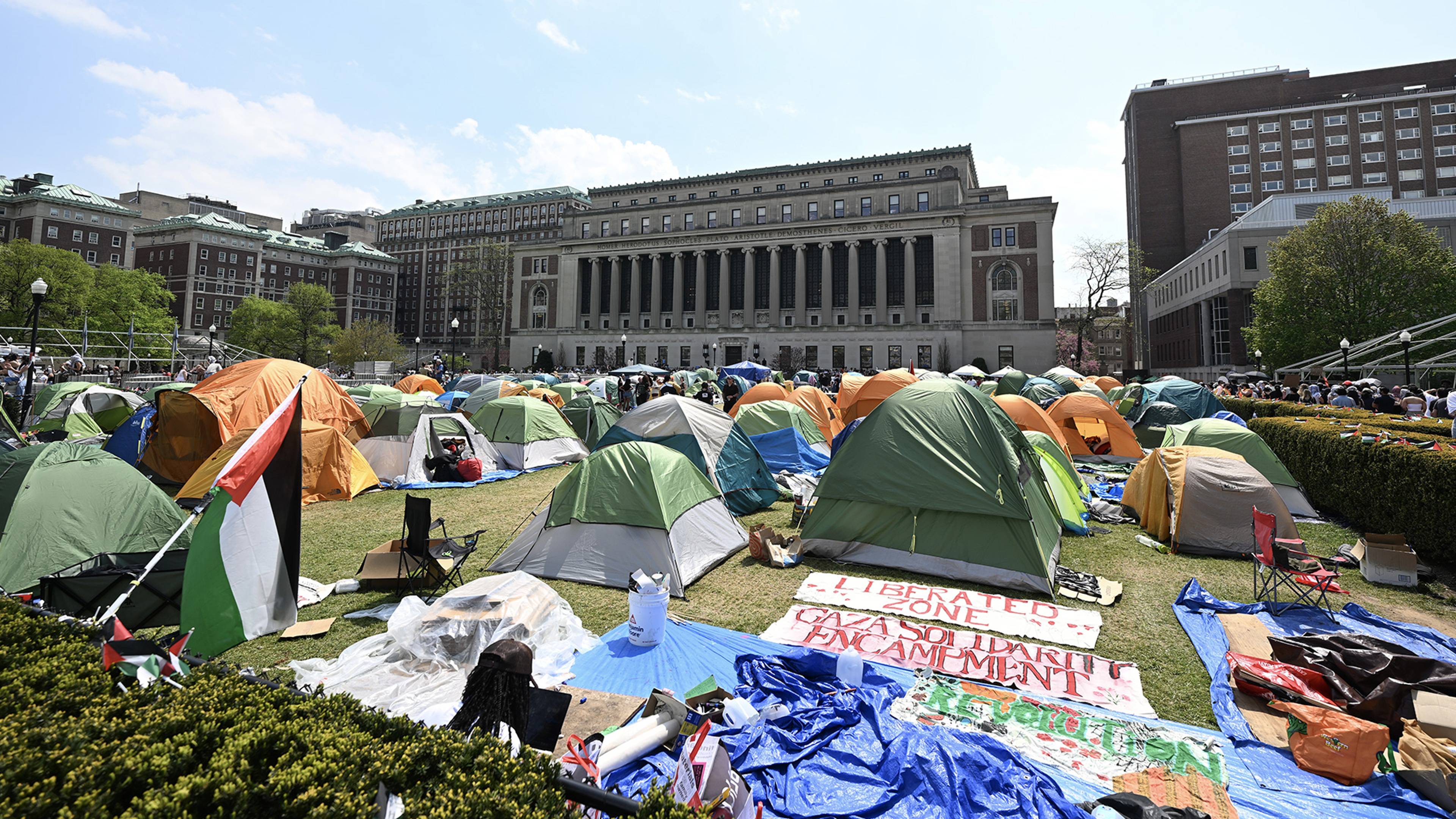
While the mainstream media narrative portrayed student protesters as violent, the reality on the ground was entirely different. The Ash Center at Harvard Kennedy School conducted a study of over 130 student encampments that encompassed over 3,000 days of student protests and found few incidents of property damage (less than 1%) and even fewer incidents of injuries to counterprotestors.2
And yet, despite the peaceful nature of these protests, Muslim and pro-Palestinian students experienced wave after wave of negative consequences.
Students were doxed.3 Their faces were plastered on digital trucks that drove through cities like Boston and New York.4 Job offers disappeared.5 Our sisters wearing hijab were followed and harassed.6 Students were sprayed with chemicals,7 hospitalized,8 surveilled,9 spat on,10 physically assaulted,11 and arrested.12 Some slept in encampments where sprinklers were intentionally activated in the freezing early morning hours.13 Others, like those at Rutgers and NYU, saw their campus spaces vandalized and destroyed, even on the morning of Eid.14 At UCLA, outside agitators attacked students with little intervention.15 At Stanford, students were targets of hit-and-runs.16 In North Carolina, students were stabbed.17 In Vermont, Hisham, Kinnan, and Tahseen were shot.18
Our student community has experienced no shortage of challenges and difficult encounters. What has been lacking is a willingness to seriously confront what these stories reveal.
What’s more, the consequences did not stop here. Muslim chaplains, people who stood beside their students with compassion and dignity, quietly lost their positions at several prominent universities. Alumni and professionals who spoke with moral clarity faced repercussions, including cancellations and withdrawn opportunities.19 Even now, we continue to witness professionals penalized for refusing to abandon their principles.
What has perhaps been most heartbreaking is watching institutions that pride themselves on dialogue, free inquiry, and academic freedom resort to suppression when those very values were tested. Many universities even resorted to violence, calling state or local police forces to forcibly remove encampment protestors, curbing free speech, canceling commencement speakers, or penalizing individuals exercising their right to free speech.
In the midst of this, important work has emerged from within the community. Organizations and advocates stepped in where they could. At Muslim Campus Life, initiatives like the Campus Islamophobia Tracker began documenting incidents of Islamophobia, anti-Muslim racism, anti-Arab racism, and anti-Palestinian racism affecting college students. Training modules were developed. Toolkits were launched. Faculty, administrators, chaplains, attorneys, and advocates worked tirelessly to support students navigating impossible circumstances. Legal organizations provided critical support in moments of crisis.
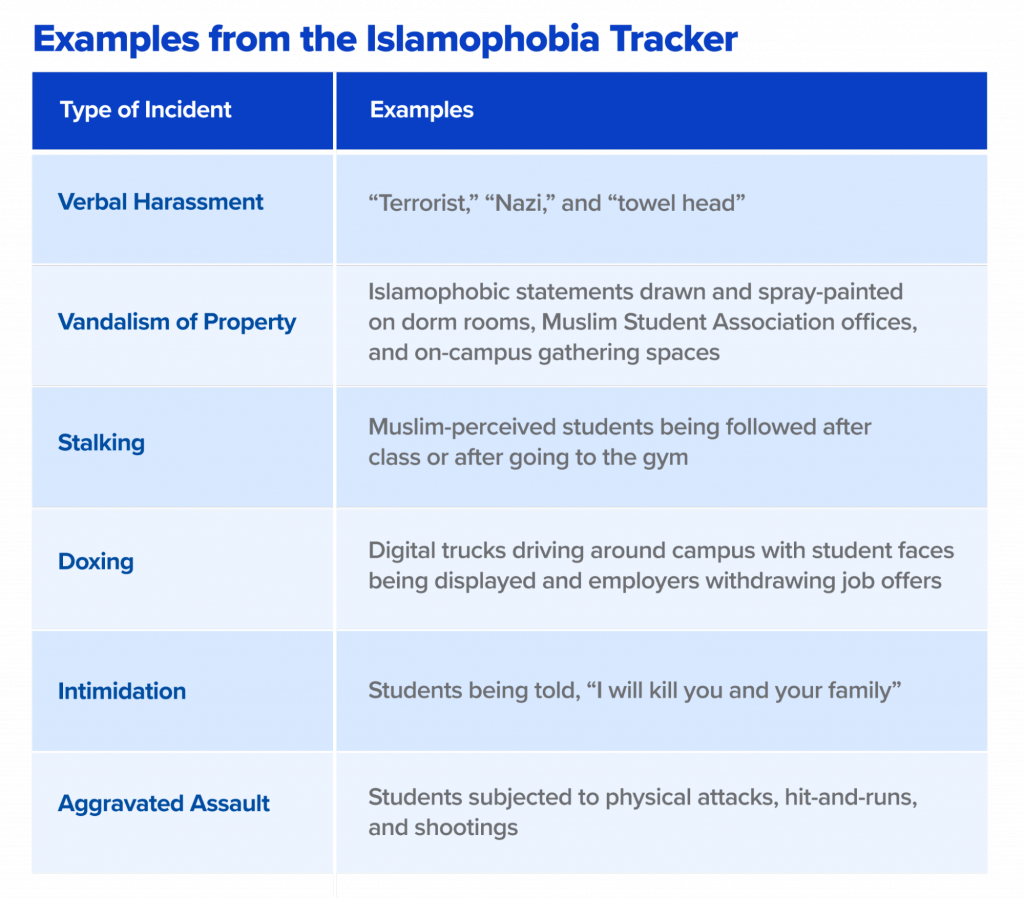

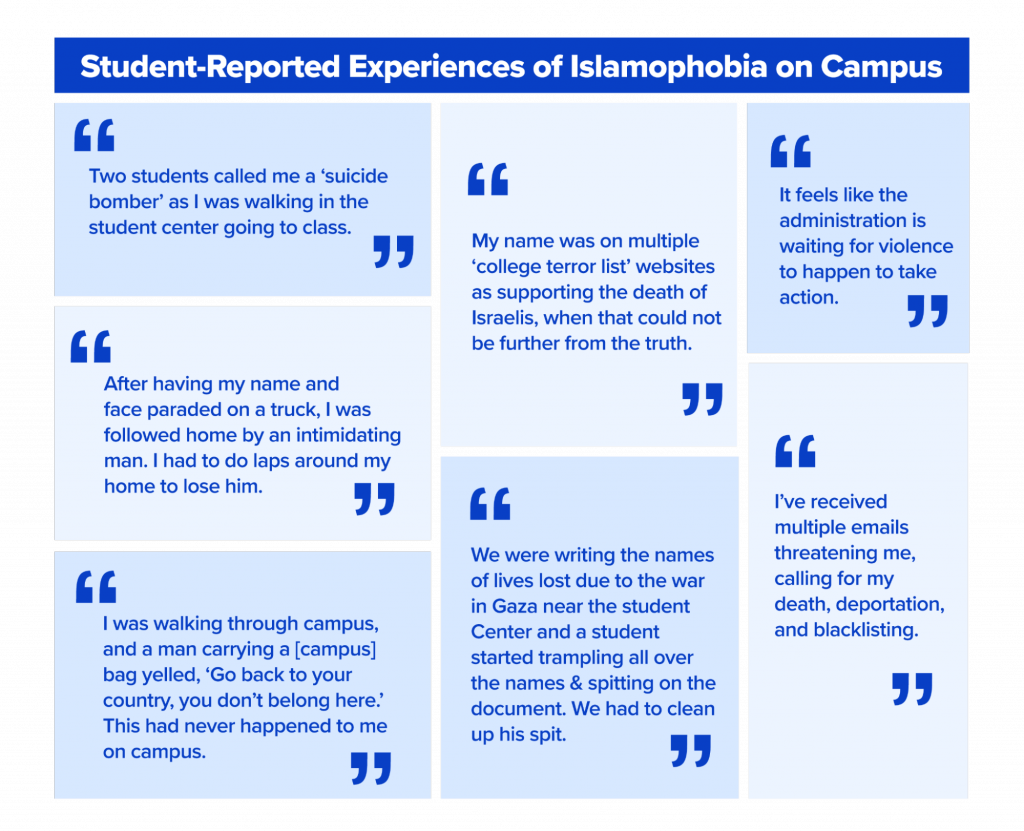

At the same time, we have to acknowledge that our collective response has fallen short. Despite progress, our community faces ongoing struggles, particularly the underreporting of incidents, the lack of data needed to inform and assess strategic action, limited sustained alumni engagement, and insufficient investment in Muslim higher education advocacy more broadly.
Recognizing these shortcomings is essential if we hope to better protect, support, and guide future campus communities when they need it most.
1. Report Islamophobic Incidents
So many of our students endure harm in silence, understandably reluctant to disclose information because of a heavy feeling of mistrust. The trauma of surveillance, particularly in post-9/11 America, has conditioned many Muslims to fear visibility.20 Students worry that reporting incidents will expose them to further retaliation. Many do not trust institutions to protect them, barely convinced that anyone is listening at all.
But documentation matters. Data matters.
In our current reality, stories undocumented by systems are too easily dismissed as isolated incidents. Official records speak volumes; they inform institutional responses, establish accountability, and protect future community members. Our tradition calls us toward justice, even when justice feels inconvenient or exhausting. Allah tells us not to let the wrongdoing of others cause us to abandon justice ourselves, and part of pursuing justice is preserving testimony. We must record what happened. We must name harm honestly, and refuse to allow the hurt of our fellow brothers and sisters to disappear, unaccounted for.
Organizations like Muslim Campus Life, Muslim Advocates, Palestine Legal, CAIR National, your local CAIR chapter, or your university reporting portal accept reports of campus incidents.
2. Contribute to Longitudinal Data Studies
Sadly, we are yet to possess robust longitudinal data on Muslim college students in North America. We have snapshots, moments, and isolated studies, but we lack sustained understanding. Without long-term data, we cannot fully measure whether campus climates are improving or deteriorating, whether interventions are meaningful or symbolic, or whether institutions are changing or simply waiting for attention to fade.
Longitudinal research is not just academic, it is strategic. Data strengthens the case for sustained institutional investment in Muslim student support. It allows advocates, chaplains, educators, and students to speak with credibility when demanding institutional change. It transforms pain into policy, and our community must begin investing in this work with seriousness and urgency. Spearhead and support longitudinal studies on Muslim college experience, like the recent survey launched by Muslim Campus Life.
3. Be an Engaged Alum
For most Muslim students, graduating signals the end of their relationship with their university. This represents a very transactional mindset, where students pay tuition, earn a degree, and never engage with their alma mater again. However, our faith teaches us to capitalize on the opportunity for good whenever we are able; we need to view our engagement with our universities postgraduation as an amana and sadaqa jariya to support future students on campus. Being an engaged alum can be an act of faith, solidarity, and long-term investment in the well-being of those who come after you.
An engaged alum is not simply a donor. An engaged alum is someone who says to future generations: “You will not have to navigate this alone.”
Alumni can hold influence that current students cannot. They can sit on alumni boards, lead donor conversations, and carry credibility with administrators. Imagine what it would mean if Muslim alumni across the country organized with intentionality, not only to celebrate accomplishments, but to advocate for protections, resources, chaplaincy support, scholarships, and structural accountability.
Islam places profound emphasis on community, the ummah, and the responsibility Muslims have to one another. Alumni engagement is an expression of that value in practice. Whether through donating to Muslim student organizations, volunteering at events, advocating for institutional support, or simply showing up, engaged alumni extend the ummah across generations and geographies.
Depending on your institution, you may have an official Muslim alumni association that is under the broader university’s alumni association or an independent 501(c)(3) that organizes alumni on behalf of the Muslim community. If you are a college graduate, joining your university’s Muslim alumni association can be a great first step to getting more involved. If a Muslim alumni association does not exist at your alma mater, consider starting one.
4. Invest in the Higher Education Space
Muslim students have never simply been passive participants on college campuses. Historically, MSA National led to the rise of many national organizations in the 1960s through the 1980s, including ISNA and the Fiqh Council of North America.21 Today, we have all witnessed the power that Muslim college students continue to wield in shaping national and international conversations. The question before us now is whether the broader community is willing to invest in them with the same seriousness and commitment they have shown in supporting the causes that matter to the ummah.
This investment may look like mentorship. It may look like funding. It may look like alumni organizing, policy advocacy, board participation, or simply sustained presence. In all its manifestations, supporting Muslim higher educational advocacy cannot remain symbolic. It must entail principled investment.
***
The failures exposed over the past three years cannot simply become sources of grief or outrage; they must become points of reflection and responsibility. If this moment teaches us anything, it is that care, preparation, and institutional support cannot be improvised in times of crisis. They must be built deliberately, sustained consistently, and rooted in ihsan. Working on the four areas mentioned here is the first step on the road to better empowering our campus communities to continue in the struggle for justice.
We must tie our camel first, and then place our trust in Allah.
References
1. ^
Sunan al-Tirmidhī, no. 2517; al-Albānī classified it as ḥasan (fair).
2. ^
Jay Ulfelder, “Crowd Counting Consortium: An Empirical Overview of Recent Pro-Palestine Protests at U.S. Schools,” Ash Center for Democratic Governance and Innovation, Harvard Kennedy School, May 30, 2024.
3. ^
Joyce E. Kim and Asher J. Montgomery, “Doxxed Harvard Students Decry ‘Heinous and Aggressive’ Online Harassment, Call for Greater Support from University,” The Harvard Crimson, December 8, 2023.
4. ^
Rebecca Massel, “Students Protest Against ‘Doxxing Truck,’” Columbia Daily Spectator, October 27, 2023.
5. ^
Johanna Alonso, “Are Students Who Protested Losing Out on Job Opportunities?” Inside Higher Ed, June 18, 2024.
6. ^
“Campus Islamophobia Tracker,” Muslim Campus Life, https://www.muslimcampuslife.com/islamophobia-tracker/.
7. ^
Chris Mendell, “Protesters Allegedly Sprayed with Hazardous Chemical at Pro-Palestinian Rally, Nearly Two Dozen Report,” Columbia Daily Spectator, January 22, 2024.
8. ^
Mendell, “Protesters Allegedly Sprayed.”
9. ^
“Ozturk, Khalil, Documents, Deportation, Pro-Palestine Protest, Canary Mission,” Mother Jones, January 2026.
10. ^
“Campus Islamophobia Tracker.”
11. ^
Jack Rutherford, Spencer Friedland, and Haley Huh, “Pro-Palestine, Pro-Israel Protestors Gather in Wake of Arrests,” The Emory Wheel, April 26, 2024.
12. ^
Mara Hall, “All 17 Students Arrested at Pro-Palestine Protest Take Pre-Trial Diversion," The Observer, November 19, 2025.
13. ^
“Pro-Palestine Protesters Begin Encampment in Harvard Yard,” The Harvard Crimson, April 25, 2024.
14. ^
“Rutgers University Arrest Jacob Beacher,” CNN, April 22, 2024; “Vandalism, Muslim Prayer Room, NYU,” The New York Times, April 4, 2025.
15. ^
Jonah Valdez and Akela Lacy, “Victims of UCLA Mob Attack Sue to ‘Hold the Aggressors Accountable,’” The Intercept, March 20, 2025.
16. ^
Anna Yang, “Hit-and-Run Injures Arab Muslim Student, Incident Under Investigation as Hate Crime,” The Stanford Daily, November 4, 2023.
17. ^
“Campus Islamophobia Tracker.”
18. ^
Katy Pickens and Will Kubzansky, “Brown Junior Among Three Palestinian Students Shot in Vermont Saturday Night,” The Brown Daily Herald, November 26, 2023.
19. ^
Ryan Quinn, “Rutgers Disinvites Engineering Graduation Speaker After He Criticizes Israel,” Inside Higher Ed, May 7, 2026.
20. ^
Diane Shammas, “Underreporting Discrimination Among Arab American and Muslim American Community College Students: Using Focus Groups to Unravel the Ambiguities Within the Survey Data,” Journal of Mixed Methods Research 11, no. 1 (2017): 99–123.
21. ^
See Abiya Ahmed, “Muslim Student Associations in North America,” in Oxford Research Encyclopedia of Religion (Oxford University Press, 2025).



Guest Contributor
Imam Khalid is the Director of Campus Support at Muslim Campus Life and the Director of the Islamic Center of New York City (ICNYC). He served as the Executive Director and Chaplain of the Islamic Center at New York University (NYU) for nearly 20 years, serving as the university’s first Muslim chaplain.
Guest Contributor
Dr. Salman is a Cofounder of Muslim Campus Life. He worked as an Admissions Reader at Stanford, First-Year Adviser at Harvard, and has spent several years working in nonprofits, schools, and government agencies including the US Department of Education. He earned his PhD from Harvard and lives in MA with his wife and children.

Guest Contributor
Mazin is from Rammun, Palestine. He serves as a Program Manager at Muslim Campus Life. He is a PhD student at the UCLA School of Education and Information Studies, where his research focuses on the religious identity development of Muslim college students in the US and its relationship to student success.
Disclaimer: The views, opinions, findings, and conclusions expressed in these papers and articles are strictly those of the authors. Furthermore, Yaqeen does not endorse any of the personal views of the authors on any platform. Our team is diverse on all fronts, allowing for constant, enriching dialogue that helps us produce high-quality research.
Want to appear on Yaqeen?
