Jump to:
Khutbahs
Ramadan Prep 2026: A Complete Guide | Special Lecture by Dr. Omar Suleiman
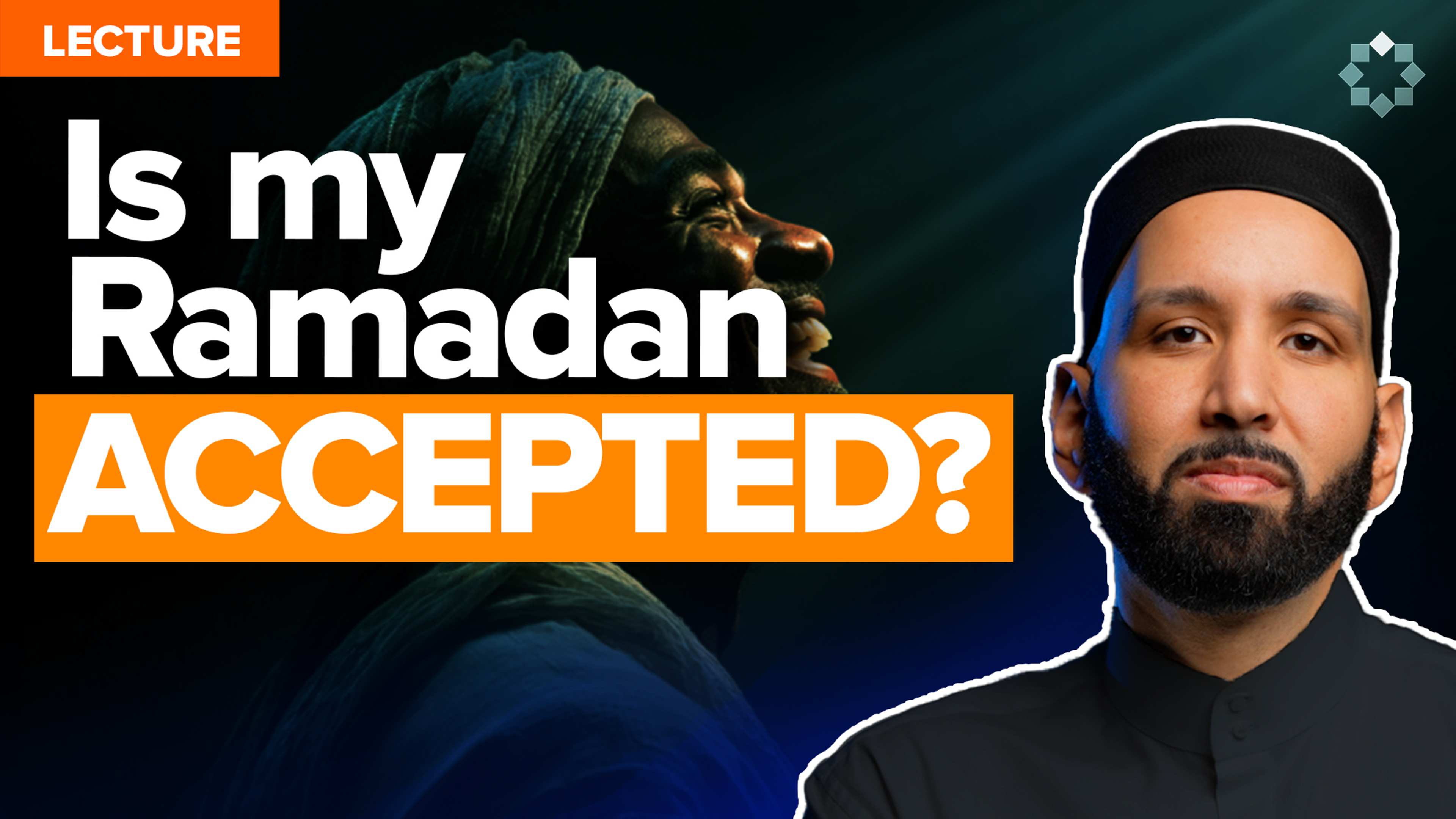
How can you know if Allah accepted your Ramadan?
As the month comes to a close, take time to reflect deeply. Do an honest evaluation of your Ramadan. Was it transformative? Did it bring you closer to Allah?
In this powerful reminder, Dr. Omar Suleiman encourages us to assess our worship, intentions, and growth, and shares a beautiful du’a the Sahabah would recite at the beginning of a new month, teaching us how to move forward with hope and purpose.
Stay connected and sign up for email updates on Yaqeen Ramadan content here: https://yqn.io/f7b0ab
This transcript was auto-generated using AI and may contain misspellings.
First and foremost, I want to thank the brothers from the ministry, from the masjid, the volunteers,
the staff, the imam, everyone that facilitated this lecture tonight. I want to thank all of you for coming out. I ask Allah subhanahu wa ta'ala to allow us to reach Ramadan and to allow us to have an accepted Ramadan.
Allahumma ameen. So I've been thinking a lot about this lecture. Probably more so than any lecture I've ever given on how to prepare for Ramadan and I'll tell you exactly why.
Two reasons. Number one, I always like to tie the Ramadan prep to the series that I'll be doing in Ramadan. And so for those of you that are following, we will be doing a series, bi'idhnillah,
at Yaqeen Institute for Islamic Research. The names of Allah subhanahu wa ta'ala and tying in the names of Allah subhanahu wa ta'ala to our daily lives.
And I named the series to show the universality of connection to Allah's names across circumstances. And so that's the first thing.
Number two, how do we not repeat the exact same thing every single year? You see, if I was to ask everyone in here, how many times have you heard a lecture about how to prepare for Ramadan?
I'm pretty sure everyone in here has heard a lecture about how to prepare for Ramadan tens of times, if not hundreds of times. Because every year the same thing happens.
We get excited, we make du'a, we know what the khutbas are going to be about, we make plans and then next thing we know, Ramadan is over and we say inshallah next year.
And we don't know if there will be a next year. So I wanted to start off with a basic premise. And it's actually something that I take from a beloved friend of mine, Shaykh Tahir Wahid,
When we would go to hajj, and may Allah azzawajal accept the hajj of those who have gone and may Allah azzawajal accept the hajj of those who intend to go but have not been able to physically go.
Allahumma ameen. He would always start off our hajj group and he would say, what is the reward for hajj? What is the reward for hajj?
I'm asking you now, what is the reward for hajj? Jannah, forgiveness, purity.
All of you are wrong. Why? Because the Prophet (ﷺ) did not say there is a reward for hajj.
He said al-hajj al-mabroor, a hajj that is accepted, has no jazaa illa al-jannah, has no reward except for jannah.
You see when we talk about the names of Allah subhanahu wa ta'ala, the Prophet (ﷺ) said Allah has 99 names. He did not say whoever memorizes those names dakhala al-jannah. He said man ahsaha.
You memorize them, you act upon them, you internalize them, you live with those names of Allah subhanahu wa ta'ala. The Prophet (ﷺ) did not simply say that attending Salat al-Jumu'ah is the reward.
Whoever comes early, before the adhan, sits down and listens attentively to the imam, then he has the reward.
You see the Messenger of Allah (ﷺ) always assigns an internal quality to an external deed so that we do not become obsessed with the performance and lose the substance.
And so if I was to ask you, what's the reward for Ramadan? He said (ﷺ) man sama Ramadan, ghufira lahu ma taqaddama min dhanbih? Whoever fasts Ramadan is forgiven for all of his sins?
No. He said man sama Ramadan imanan wa ihtisaban ghufira lahu ma taqaddama min dhanbih. Whoever fasts Ramadan with faith and seeking the reward, Allah will forgive them for all
of their sins. And so subhanAllah, if you think about what we say when we finish the salat as a habit, I'm not saying it's necessarily the sunnah, it's not the sunnah in fact to do it habitually,
but you say taqabbala Allah, may Allah accept from you. Someone finishes hajj, you say taqabbala Allah, may Allah accept from you. Hajj al-mabroor. It is sunnah and we say at the end of the month of Ramadan, may Allah azzawajal allow
us to not just say it, but to receive its meaning, taqabbala Allah minna wa minkum. May Allah accept from you and from me.
You see the profundity of this is the following, that we are seeking Allah's acceptance. And so I want to begin this lecture tonight by completely flipping the premise of what
the average Ramadan prep lecture looks like. And you know what the premise of Ramadan is this year? Not how can you read the most Quran this Ramadan, not how you can change yourself this Ramadan, not how you can do this or how you can do that.
The premise is how can you be sure that Allah has accepted your Ramadan? How can you be sure that Allah has accepted your Ramadan so that at the end of this month,
when we say taqabbala Allah minna wa minkum, it is not just a wish but a realization that indeed we hope that Allah azzawajal has accepted from us and from you.
And subhanAllah if you look at the idea of innama al-a'malu binniyyah, verily actions are but by intentions. The beginning is about Allah. It starts with something very basic.
Your Ramadan is not about you. It's not about your habits. It's not about how good you're going to feel. It's not about your own upliftment.
Your Ramadan is about Allah, not you. Connecting back to the names of Allah subhanahu wa ta'ala. It's about Allah, not you.
The end of Ramadan, if you were to put yourself ahead and you're standing in front of Allah
subhanahu wa ta'ala, and it is the last day of Ramadan, and this Ramadan has been presented.
You know I remember the very first time I read the ayah, bal al-insanu ala nafsihi basira wa la alqa ma'azeera.
Verily man sees himself even if he presents his excuses. You know when you've prepared your excuses in front of someone?
And they might be really good excuses, but you know that those excuses are not legitimate. So you know your teacher is going to hold you account. You know that your employer is going to hold you account.
And you're looking at how to arrange the timing, how to perfectly articulate why you fell short. Bal al-insanu ala nafsihi basira wa la alqa ma'azeera.
But even as you're saying it, you know that there's something illegitimate about your excuse. And when you're standing in front of Allah subhanahu wa ta'ala on the day of judgment and Allah says, why did you do this or why didn't you do this?
And you start giving your excuses, you know, and you know that he can see right through you because as much as ala nafsihi basira huwa al-basir subhanahu wa ta'ala.
As much as you see yourself, he sees you more than you see yourself. You know when they say he sees right through you, he sees right through you.
And so no matter how crisp the voice is, no matter how you articulate it, Allah azzawajal sees it through. Wa la alqa ma'azeera.
Even as you start to give your excuses, you already know where the excuses fall short and Allah al-'Alim knows more than what you know about yourself. So here's the premise.
Your Ramadan is not about you. It's about Allah. And I want you to think about the end of Ramadan. If you're doing an autopsy of this Ramadan, you have two trajectories.
If you live to see the end of Ramadan, either it was an accepted Ramadan or it was a rejected Ramadan. Those are the two possibilities.
If it was a rejected Ramadan, I want you from now to put yourself ahead of this Ramadan and to read the autopsy of your Ramadan.
And if this isn't your first Ramadan, then you probably have a lot of experience in failure and success. And so if you're reading through the autopsy of your Ramadan, why it failed, what is in
that autopsy? This is an experiment, a visualization. By the way, something very powerful to write down. Write it down for yourself.
Sit with yourself before Ramadan starts and write the autopsy of your Ramadan if it fails. And then on the other hand, if it was accepted, if it was a good Ramadan, why was it a good Ramadan? Write it down.
You see, Allah subhanahu wa ta'ala gives us the beginning and the end. And look how remarkable the consistency is. It begins with the name of Allah and with the intention of pleasing Allah subhanahu wa ta'ala.
It ends with, at the end of the period. [Al-Baqarah 2:185] "...and so that you may complete the period and glorify Allah for that to which He has guided you and perhaps you will be grateful."
The end of Ramadan, Allah tells you exactly what it should look like. What the end of Ramadan should look like, that you finish Ramadan.
And you are glorifying Allah for what He guided you to, and you have become grateful to Him for that guidance and every other blessing that follows.
This is what the end of Ramadan should look like. Like a successful Ramadan is that at the end. You glorify Allah for what He guided you to. Allahu Akbar. By the way, there is a legal implementation of this which is takbir al-'Eid. Right? Allahu Akbar.
Allahu Akbar. Allahu Akbar. La ilaha illallah. We don't do empty dhikr. Why are you saying Allahu Akbar, Allahu Akbar, Allahu Akbar, La ilaha illallah? And you are grateful. Allahu Akbar, Allahu Akbar. And to Allah belongs all praise.
So there is a legal implementation to this as well, that as you finish this period, you should come out declaring the greatness of Allah. Look at the consistency here. I gave you the example of Hajj.
[Al-Hajj 2:200] "So when you have completed your rites, remember Allah like your [previous] remembrance of your fathers or [even] with [much] greater remembrance." When you finish your manasik of Hajj, remember Allah subhanahu wa ta'ala.
[An-Nisa 4:103] "And when you have completed the prayer, remember Allah standing, sitting, or [lying] on your sides." That when you finish your prayer, remember Allah, standing, sitting and laying down. Salat al-Jumu'ah.
[Al-Jumu'ah 62:10] "And when the prayer has been concluded, disperse within the land and seek from the bounty of Allah, and remember Allah often that you might succeed." When you finish your Salat al-Jumu'ah and you go back to your daily life,
remember Allah frequently so that you may be successful. [An-Nasr 110:1-3] "When the victory of Allah has come and the conquest, and you see the people entering into the religion of Allah in multitudes, then exalt [Him] with praise of your Lord and ask forgiveness of Him. Indeed, He is ever returning [in mercy]."
When Allah gives you material victory, when He gives you the victory of Islam, when Allah awards you for your efforts, Glorify with the praise of your Lord and ask forgiveness of Him. Say Subhanallah, say Astaghfirullah, glorify Allah and seek forgiveness.
You see, the end of every one of our ibadat is remember Allah, remember Allah, remember Allah, remember Allah. The beginning of every single one of our ibadat is begin with Allah, begin with Allah, begin with Allah, begin with Allah.
Innama al-a'malu binniyyah. You start with the intentions solely for the sake of Allah subhanahu wa ta'ala. Somewhere along the way, your intentions might get chipped away at,
but you keep going back to at least that my original intention was, Oh Allah, Allahumma inni laka sumtu. I fasted for you.
Oh Allah, I am fasting for you. There's something so beautiful about the affair of Islam in this regard. You know what it is? That the Sahaba understood as the scholars of tazkiyah said,
that their whole life was merely worship of Allah subhanahu wa ta'ala. And so they did not distinguish between their sleep and their waking up. They did not distinguish between their eating and their fasting,
because all of it was in the obedience of Allah subhanahu wa ta'ala. You know what that means? Think of it this way.
The last day of Ramadan, you are commanded to fast. It is haram for you to eat or drink. The first day of Eid, it is haram for you to fast.
The same Lord that commands you to eat and drink is the same Lord that commands you to withhold from eating and drinking.
And so the very first affair of fasting is, Allah, what you tell me, I do. It is between you and I, oh Allah, this is your affair.
You command, I do not command. You tell me when to start my fast, you tell me when to end my fast. I don't get to add or detract a minute of that fasting. Why?
Because you are my Lord, I am your slave. And here's what I want you to think about.
When Ramadan starts, there is a covenant that is going to be made with Allah subhanahu wa ta'ala.
And the Sahaba, they were very different from every generation that came after them, including the Tabi'een, including the immediate generation after them.
And the best generation after the Companions of the Prophet (ﷺ) was the generation immediately after them. The best generation after the Sahaba was the generation of the Tabi'een.
The Sahaba were a people of quality. The Tabi'een were a people of quantity. Not without substance.
But without the depth that the Sahaba had of understanding of substance. The Sahaba understood this affair in the deepest sense.
The Tabi'een felt deficient in knowing the Companions. I mean, how would you act if you met Abu Bakr (رضي الله عنه)? How would you act if you knew Umar (رضي الله عنه)?
How would you act if you knew Uthman and Ali and Khalid and Ammar (رضي الله عنهم)? How would you act if you knew these people, may Allah be pleased with them? How would you act? Like, you would feel so small.
I met Ali (رضي الله عنه). What's my ibadah compared to his? I met 'Aisha (رضي الله عنها). What's my 'ibadah compared to hers? So the Tabi'een, they felt like we need to catch up here.
And Anas ibn Malik (رضي الله عنه), he says to the Tabi'een, Innakum lata'maluna a'malan hiya adakku fi a'yunukum min sha'rah.
That the secret, the difference between us and you is not the amount of prayer. In fact, the Tabi'een, if you took the number of khatms of Qur'an that they made, they made more khatms of Qur'an.
If you took the number of rak'ahs that they prayed, the Tabi'een prayed more rak'ahs than the Sahaba. If you took the feats of how much they would do, it was more than the Companions.
But Anas (رضي الله عنه) says, that's not the difference of the secret between us and you. Qala innakum lata'maluna a'malan. You do deeds. Hiya adakku fi a'yunukum min sha'rah.
It is smaller in your eyes than a strand of hair. Kinna na'udduha 'ala ahdi Rasulillahi (ﷺ) min al-mubiqa.
We the Companions saw those same things that you see smaller than a hair as of the most destructive major sins. We had greater reverence of Allah, Subhanahu wa Ta'ala.
You treat sins very small. We treat the same sins that you consider sagha'ir as kaba'ir. Minor deeds as major sins.
It's a reverence of Allah that we have that you don't have. Okay. Which brings me to the next point here. My last khutbah was about khutbah.
Was about how early you get to Salat al-Jumu'ah and the Prophet (ﷺ) giving the tiers of rewards, right? That who gets there first and how late is it to prepare for something, right?
I'm going to tell you something which is very important and please pay close attention. When the hilal of Ramadan shows there is a certain closing of a book and an opening of
another book, it's very serious how you welcome the hilal of Ramadan. It's not, Ramadan is not something that you get into.
Ramadan is something that you've prepared for and when Ramadan comes, idha ja'a Ramadan, when Ramadan comes, futtihat abwab al-jannah wa ghulliqat abwab al-nar, right?
The gates of paradise are open, the gates of hellfire are closed and the shayatin are chained up. There's something that happens at the beginning of the month.
That's the equivalent of when the angels close their rule book as the khutbah starts. That's the equivalent of takbir al-ihram and those that caught takbir al-ihram in salah.
That's the equivalent of getting to Mina before 'Arafah. It's the equivalent. Every one of these 'ibadat, they have that secret, that ingredient.
The Sahaba, they look at istiqbal al-hilal in a very special way, how they welcome the month of Ramadan in a very special way and I want you to pay very close attention to this.
Firstly, I want you to memorize this du'a with me. And we're going to go into the details of this du'a, insha'Allah Ta'ala.
'Abdullah ibn Hisham (رضي الله عنه), and he was a young boy when his parents embraced Islam. In fact, he has a very beautiful narration. His mother, who I believe her name was Zainab bint Humayd (رضي الله عنها), I know her name
was Zainab. Zainab (رضي الله عنها) was his mother. She brought him to the Prophet (ﷺ) when he was a child, and she wanted her child 'Abdullah ibn Hisham to take bay'ah with the Prophet (ﷺ).
And, you know, imagine when someone brings their baby, puts their baby... By the way, some of you come to me to take pictures with your baby. I'm not a politician, number one.
Number two, there's no barakah in my holding your baby or kissing your baby. And I'm being serious about that, by the way. I'm flattered. Jazakum Allah khair. But your baby's probably going to cry when you hand your baby to me.
And I'd rather spare myself and your baby the embarrassment and the trauma. Alright? But imagine this woman bringing her baby to the Prophet (ﷺ) to give bay'ah. He's so young.
And the Prophet (ﷺ) just puts his hand on his head, and he takes the bay'ah that way from her. To validate the mother that wanted her child. It's like in Hajj, where a woman holds up her baby and goes, What about this one? Does he have Hajj, Ya Rasulullah?
Does his Hajj count? So Zainab (رضي الله عنها), she brought 'Abdullah ibn Hisham to the Prophet (ﷺ) as that baby for the Prophet (ﷺ) to take bay'ah from her. 'Abdullah ibn Hisham, he says in an authentic narration,
that the Companions of the Prophet (ﷺ) would say this du'a the way that they would say or recite the Qur'an at the entrance of the hilal.
By the way, the hilal he's talking about here is every month. So this is a du'a that I want you to learn that you will say at the beginning of every single month from now on, bi'idhnillah. It's a good way to plug ourselves into the Islamic calendar as well, bi'idhnillah.
Because most of the time, outside of Sha'ban, Ramadan, Shawwal, Dhul-Hijjah, we have no idea what month of the year we're in. So it's a good way to accustom yourself to welcoming the month. He said that we would say,
Allahumma adkhilhu alayna Allahumma adkhilhu alayna bil-amni wa al-iman
wa al-salamati wa al-islam wa jiwarim min ash-shaytan wa ridwani min ar-Rahman There are narrations as well, and there are disputes about them.
To the Prophet (ﷺ), Allahumma ahillahu alayna bil-yumni wa al-iman wa al-salamati wa al-islam Rabbi wa Rabbuka Allah And I'll talk about the difference in Sha'ban a bit. But this is an authentic narration that we, the Companions, would say this
the way that we would say a surah from the Qur'an, the way we would recite the Qur'an when the month would come in. Allahumma adkhilhu alayna bil-amni wa al-iman Oh Allah, let it come upon us
with safety and Iman and faith. wa al-salamati wa al-islam and peace and Islam and submission. wa jiwarim min ash-shaytan
and protected from the devil wa ridwani min ar-Rahman and with pleasure from ar-Rahman. This is how they renew the intention of the month. Ramadan is no exception to this. And so the du'a that you will say
with the first night of Ramadan, how you will embrace Ramadan, is this du'a. Allahumma adkhilhu alayna First and foremost, let it enter upon us.
I'm going to share with you something that is a rule in Tazkiyat an-Nafs. A rule in Islamic spirituality. It is a rule, a fundamental rule
in how we understand Allah, Subhanahu wa Ta'ala. That kulla ummati yadkhulun al-jannah illa man aba This is one. Everyone enters into paradise from my ummah except for those who refuse.
Number two, no one will enter Jannah except by the mercy of Allah, Subhanahu wa Ta'ala. Please pay close attention to this.
You want your Ramadan to be accepted? First and foremost, Ramadan comes upon you. You do not come upon Ramadan. There's something deeply profound about alayna.
If Ramadan comes upon you, dear brothers and sisters, and you avoid what Allah, 'Azza wa Jal, has commanded you to avoid, and you do what Allah has commanded you to do,
bi'idhnillah, your Ramadan is accepted. Your Laylat al-Qadr is accepted. The judgment of it goes back to what we mentioned.
How will you continue to be in a state of Islam with Allah, 'Azza wa Jal, as Ramadan comes and it goes? Because it speaks to the fundamental nature of your Lord.
Allah, 'Azza wa Jal, does not look at it and say, oh well, this much, this much. You prayed this much on Laylat al-Qadr versus that. It starts with this.
Allahumma adkhilhu alayna. It comes upon us. It is from the nafahat of ar-Rahman, the breaths of mercy from the Most Merciful. Therefore, so long as we observe the season
the way that we are supposed to observe the season, it is accepted. It's like what I tell people when we go to Hajj. I say, listen, Allah, 'Azza wa Jal, says, fala rafatha wa la fusuq wa la jidal fil-Hajj.
Allah tells you everything not to do in Hajj. Allah tells you what the ihram is. Ihram means what is forbidden for you when you are in a state of ihram. Your Hajj is not going to be rejected
because you didn't make awesome du'a and tawaf. Your Hajj is not going to be rejected because you didn't cry in Sa'i. Your Hajj is a mercy that Allah sent upon you.
Observe the season of Allah, 'Azza wa Jal, upon you, this incredible mercy. Go where he tells you to go. If you sat in 'Arafah, this is a bad idea by the way, but if you sat in 'Arafah the entire day and you didn't sin,
but you observed the rites of 'Arafah and you didn't make du'a, your 'Arafah still counts. By the way, this is not an excuse to sit around and smoke or go to four different buffets in 'Arafah,
play cards, backbite and gossip and talk to other people. I'm saying that technically speaking, this is the mercy of Allah, 'Azza wa Jal, that if you just went there when he told you to go there, sat there, observed your ihram properly,
got to 'Arafah on time, left on time, observed the manasik, it is Allah's fadl upon you, it's Allah's grace upon you. That bi'idhnillah, your 'Arafah is accepted.
Your 'Arafah is accepted. So we start from this place. And why do I say this? Because I bring it back to what Anas ibn Malik (رضي الله عنه) said about reverence, the reverence of Allah, 'Azza wa Jal's sha'a'ir,
of Allah, 'Azza wa Jal's commands, of Allah's seasons, this incredible thing that he's put upon us. And then I want you to imagine sitting with 'Abdullah ibn Mas'ud (رضي الله عنه).
How many khatms do you think 'Abdullah ibn Mas'ud (رضي الله عنه) would make in Ramadan? I mean this man was the core recipient from the Sahaba of the Qur'an from the mouth of the Prophet (ﷺ).
Akhaztu sab'in. I took 70 surahs from the mouth of the Prophet (ﷺ). Ghaddan tariyyan kama unzil. Fresh. Like it was recited to the Prophet (ﷺ).
Ibn Mas'ud (رضي الله عنه) was the very first person to recite the Qur'an in public. He went to the Ka'bah and he recited Ar-Rahman, what the Imam beautifully recited tonight. And was beaten for it. He loved the Qur'an.
If you read the authentic narrations about fadl al-Qur'an, the virtues of the Qur'an, so many of them are from Ibn Mas'ud (رضي الله عنه). So I want you to imagine you're sitting with Ibn Mas'ud (رضي الله عنه)
and you're asking him for a Ramadan tip. Pretty amazing, right? So you say, Kayfa kuntum tastaqbilun ar-Ramadan
How would you, O Companions of the Messenger of Allah (ﷺ), receive the month of Ramadan? Are you ready? You ready for what he's going to say? He says,
Ma kana ahaduna yajur an yastaqbil hilal Ramadan wa fi qalbihi dharrah min hiqd 'ala akhihi al-Muslim No one of us would dare
to let the hilal of Ramadan come upon us and we have in our hearts a grudge against any one of our Muslim brothers. Whoa. That's something.
That's Ibn Mas'ud. You know, subhanAllah, I think about this and how about someone that has haqq against their parents? I know it stings, but it should sting.
Right? He's saying we would not dare, we would not have the jur'ah, the audacity to let the hilal of Ramadan come upon us and we have that in our hearts. So I ask you, do you have a grudge in your heart against your brother Muslim?
You haven't cleared it yet? You've got a few days. La yukallifu Allah nafsan illa wus'aha Allah, 'Azza wa Jal, does not burden a soul beyond its scope. At least try. Seek forgiveness for your brother,
seek forgiveness for your sister. Do everything you can to remove it from your heart until Allah, 'Azza wa Jal, muqallibal qulub, the one who turns the hearts, removes the residue from it. And he's the one who controls your heart. Right? But take the statement of Anas (رضي الله عنه)
in Al-Bukhari and the athar from Ibn Mas'ud (رضي الله عنه). And when you see the turns here, Anas is saying, you guys are getting this wrong. You're thinking about this the wrong way.
This is not an affair of quantity. This is an affair of depth with Allah. Rabb Ramadan, the Lord of Ramadan. And so I start off with Allahumma adkhilhu alayna.
Oh Allah, let it come upon us. Allahumma ballighna Ramadan. Let it come to us, upon us. Bil amni wal iman. And of course in the famous riwayah, bil yumni wal iman.
Al-yumni is grace, the grace of Allah (سبحانه وتعالى). Al-amni is safety. Safety and faith. Allahumma adkhilhu alayna bil amni wal iman. Safety and faith.
SubhanAllah, this Ramadan series, and I'm going to personally request you all to help us beat the shadow bands by watching it and sharing it, bil amni wal iman, because we have Gaza throughout the Ramadan series.
In fact, the Ramadan series this year is situated in Gaza. Okay? And we know exactly how these algorithms deal with that. And you will see a sister that's fleeing bombings
in the Ramadan series. When you wake up in Ramadan, your concern is let me not miss suhoor so that I don't get dehydrated today. I need to wake up on time,
set my alarm properly, get up, drink water, hydrate, get maybe some tamar, some dates, or whatever else I eat so that I can be sustained for the day of Ramadan. That's your concern.
And you know what it's like when you miss suhoor. And you wake up and you have that dryness in your mouth. Imagine the people of Gaza when they sleep in their tents.
And their concern is not whether or not they will have bread on the table. It's whether or not a bomb will fall on them that night. It's a different mindset. When you're not in safety,
you can't think properly. Right? You can't think properly. And so, Bil amni wal iman. Oh Allah, let it enter upon us with safety. Let us have safety this Ramadan.
And iman, and be able to exert ourselves in faith. And when I say, Alayna, I don't just mean me and my family. I mean my brothers and sisters in Gaza. I mean my brothers and sisters in Sudan.
Allahumma adkhilhu alayna. Ummati Muhammad (ﷺ). Bil amni wal iman. All of this ummah. Every single part of it. Let it come upon us
with safety, and iman, and faith. Was salamati wal islam. And peace, and submission. SubhanAllah.
Something very profound that the ulama point about this part of the hadith, by the way. When you think of safety, and you think of salam, you're thinking about you as the recipient. But not as the giver.
But you're not just asking Allah (سبحانه وتعالى) to receive safety, and salam, and peace. You're asking Allah to give safety and peace. I started off the lecture,
Allahumma inni a'udhu bika an a'dhilla aw u'dhal. Aw a'dhilla aw u'dhal. Aw a'dhlima aw u'dhlam. Aw ajhala aw yujhala alay. I seek refuge in you, O Allah, from
misguiding or being misguided. From slipping or causing to slip. From oppressing or being oppressed. Right? You're asking Allah (سبحانه وتعالى) to protect you from both. Look at this du'a.
The Prophet (ﷺ) says, al-muslim man salima al-muslimun min lisanihi wa yadihi. That the Muslim, salam, islam.
The Muslim is the one from whom other people feel salam from their hand and their tongue. Wal mu'min man amina al-nas
ala dimaihim wa amwalihim. And the mu'min is the one from whom other people have security or trust
in regards to their lives and in regards to their property. You see the connection? Salam, islam. Aman, iman. The Prophet (ﷺ) actually said,
the thing that you should fear most is that you are not giving aman. That you are not giving salam. Because then it's counterintuitive to ask Allah (سبحانه وتعالى) for those things when you are doing the opposite of them.
Right? And so you're not just asking Allah (سبحانه وتعالى) to let the month of Ramadan come with aman and iman and salamah and islam. You're asking Allah (سبحانه وتعالى) to allow you to manifest
those things and to not violate them yourself. Wa jiwari min ash-shaytan wa ridwani min ar-Rahman. It sounds so beautiful.
Jiwari min ash-shaytan wa ridwani min ar-Rahman. And for the devils to be put aside for protection from the shayatin. And for the pleasure of the Most Merciful.
Your highest pursuit is, Ya Allah, are you pleased with this Ramadan or not? Ya Allah, allow me to observe this Ramadan
in a way that's pleasing to you. Allow me to act in a way that's pleasing to you. Allow me to observe it in a way that's pleasing to you.
Hatta tarda. Until you're pleased, Ya Allah. That's the point here. This is what I want from this month. This is what I want you to guide me to.
And so we now come to the very simple hadith that you know. Remember your Ramadan now is about Allah. The whole premise of this lecture is
how to make sure Allah accepts your Ramadan. Allahumma taqabbal minna. May Allah accept it from us. Listen carefully to this hadith from the Prophet (ﷺ) that I know that you've heard many many many times.
Qala (ﷺ) man lam yada' qawla az-zoor wa al-amal bihi laysa lillahi hajatun fi an yada' ta'amahu wa sharabahu
Whoever does not give up falsehood and acting upon it Allah (سبحانه وتعالى) has no need of them to leave off their food and their drink.
For those of you that attended the sessions on 'Ibadur Rahman we talked about az-zoor. And we said az-zoor is a falsehood that harms someone.
Slander, fake news, backbiting, a lie that's told in court, shahada az-zoor, a false testimony that's given. Zoor is a falsehood that harms.
But there are other narrations where the Prophet (ﷺ) expands upon that. And so here's an assignment for you. And pay very close attention. Because Allah has no need. Allah shuts the door.
Remember the hilal of Ramadan comes. Mondays and Thursdays the deeds are presented to Allah. The Prophet (ﷺ) says, Allah (سبحانه وتعالى) says, I'm not even going to look at the deeds of these two people. Anziru hadhain hatta yastaliha
Don't even present their deeds to me until they reconcile amongst themselves. The hilal of Ramadan is coming. Ramadan is starting. The urgency. I want you to feel the urgency. And the Prophet (ﷺ) is saying,
whoever does not give up falsehood Allah (سبحانه وتعالى) has no need of them giving up their food and their drink. It doesn't matter. You're just dieting at that point.
You're just dieting at that point. Now, al-husn adh-dhann billah. We have to have good expectation of Allah (سبحانه وتعالى). Because that's a scary hadith.
So is there a way to take this hadith and to operationalize it for Ramadan? The answer is yes. There's a principle in Islam. And it goes back to the statement of Anas (رضي الله عنه).
That al-nawafil, voluntary good deeds, do not expiate for repeated sin.
When the Prophet (ﷺ) says, atbi' as-sayyia al-hasana tamhuha You follow up a sin with a good deed, it will wipe it out. That doesn't mean that you insist upon a sin,
and you commit a good deed and hold them simultaneously together. The word, man lam yada' qawla az-zoor minkum. Whoever does not give up falsehood.
And Imam adh-Dhahabi (رحمه الله), he compiled a work on al-kaba'ir. It's the most famous work in Islam on major sins.
If you google it, and you search major sins by adh-Dhahabi (رحمه الله), see the list, right? It's the most famous work that we have of categorizing al-kaba'ir.
Some of them we might not even take as kaba'ir. Many of the ulama of hadith, they say, qawla az-zoor wal-amal bihi is all of the kaba'ir, all the major sins. So we ask Allah (سبحانه وتعالى)
to protect us from al-kaba'ir. Allahumma amin. So you go and you search kaba'ir and you see am I guilty of any one of these major sins. That's number one.
Number two, la kabeera ma'a al-istighfar wa la sagheera ma'a al-israr. There is no such
thing as a major sin if a person seeks forgiveness for those sins. And there is no such thing
as a minor sin if a person insists on that sin. Do you understand the promise here? Whatever you have done, this is the hopeful part. Whatever you have done, qul ya ibadi alladhina asrafu
ala anfusihim la takhnatoo min rahmatillah inna allaha yaghfiru adh-dhunuba jamee'an. Allah will forgive it if you seek forgiveness from Him sincerely, right? But if you insist upon
even the smallest sin, it no longer is a sagheera, it's now a kabeera. Why? Because it shows
a disregard to Allah (سبحانه وتعالى) from whom you seek mercy. So it's about Allah
(سبحانه وتعالى). So that's the first shuk. Now, the next shuk. Man sama Ramadan imanan wa ihtisaban
ghufira lahumma taqaddam min dhunubihim. Whoever fasts Ramadan with faith and with seeking the reward, Allah will forgive them for all of their sins. One of the beautiful things
about fasting Ramadan is that all six of your articles of faith are engaged, or kan al-iman, are engaged in Ramadan. How? The first pillar of faith, al-imanu billah, to
believe in Allah. And the Prophet (ﷺ) says that Allah (سبحانه وتعالى) has said, all of the actions of the son of Adam are for him except for fasting. As-sawmu
bihi wa ana azzahu bihi. Fasting is for me and I will reward accordingly. SubhanAllah, how beautiful. Lissaimi farhatani. For the fasting person is two periods of joy. When
they break their fast and when they meet Allah with that fast. And so the very first way to engage iman here is to connect it to Allah (سبحانه وتعالى). At-ta'alluk billah. Wa malaikatihi.
There is no month in which you think more about the angels than Ramadan. Laylat al-Qadr alone, you want so badly for the angels to come to you, to write you down amongst those
that are pleasing to Allah (سبحانه وتعالى). And you aim for the highest. Imagine. Tanazzal al-malaikatu wal-ruh fiha. Ya Allah. Jibrail (عليه السلام) comes down on Laylat al-Qadr.
What if Jibrail comes to my house? What if Jibrail (عليه السلام) comes to my masjid? What if Jibrail al-Mikail, what if the angels, the best of the angels, Allah (سبحانه وتعالى) allows
them to record in my house, my prayer of qiyam al-layl. You have the angels that record when other people eat around you and you are fasting and you get the reward. You have the angels
that record when someone says something to you and you say inni sa'im. I'm fasting. And you don't respond. And the angels respond on your behalf. And the angels record. And
so you're engaging the malaikah in what brings them into your presence and what causes them
to flee away in Ramadan in a very special way. Al-imanu billah wa malaikatihi wa kutubihi. His books. Shahru Ramadan alladhee unzila fihil Quran. The month of Ramadan is the month
in which the Quran was revealed. And in fact, every single book the Prophet (ﷺ) said in an authentic hadith was revealed in Ramadan. The Torah was revealed in Ramadan. The Zabur was
revealed in Ramadan. The Injil was revealed in Ramadan. Suhuf Ibrahim were revealed in Ramadan. The Quran was revealed in Ramadan. And this is the month of the Quran. The guest of Ramadan is
the Quran. If Ramadan is the season, Ramadan hands you the mushaf and says, stop neglecting me. Alladhee unzila fihil Quran. So honor it that way. Honor the Quran that way.
Wa rusulihi. His messengers. Kutiba alaykum as-siyamu kama kutiba ala alladhina min qablikum. Fasting has been prescribed upon you as it was prescribed on those who came before you,
through whom, the messengers. In Ramadan, you try your best to be like the Prophet (ﷺ). There is no time of the year in which you are more like the Prophet (ﷺ) than the month of Ramadan.
The Prophet (ﷺ) coming to this earth was a season. How amazing for those that got to witness those
23 years alongside him (ﷺ) while he was walking amongst them. How amazing. May Allah (سبحانه وتعالى) grant us an eternity with him (ﷺ). Allahumma amin. But you try your best. You're paying attention
to his sunnah. You're doing things of his sunnah that you typically don't do. So you're engaging
the belief in al-rusul wa-l-yawm al-akhir. The hereafter. Lissami farhatan. For the fasting
person, there's two rewards. The reward of breaking your fast, but the reward of the hereafter. You're seeking the hereafter. You're directly giving up something of this world, seeking it in the
hereafter. The reward of the hereafter. Al-qadar wa-l-qadr. Laylat al-Qadr is in Ramadan. On that night of Laylat al-Qadr, everything that will happen in that year is going to be written. Whether or not
you will go to Hajj is going to be written. Whether you will go to Umrah is going to be written. Whether you will live or die is going to be written. Whether you will get that job or not is going to be written. Prophet Muhammad (ﷺ) mentions to us all of the different writings. Ibn Abbas (رضي الله عنه)
says a person will be walking in the marketplace on Laylat al-Qadr. And his name came down with a
death certificate on Laylat al-Qadr. On top of that, the number one problem that people have with qadr
is time. Mata, mata, when, when, when, when. Allah is the one who decrees when the sun comes out.
Allah is the one who decrees when the sun goes down. Allah is the one who decrees night and day.
You subject yourself to His timing, Subhanahu wa Ta'ala. This is to fast Ramadan with iman. Belief and engaging the belief in all six articles of faith as you're fasting Ramadan.
And seeking the reward. You will seek the reward of every moment in Ramadan. You don't approach Ramadan like any ordinary day or month.
Sins are worse in Ramadan than they are throughout the year. Did you know that? Sins are far more egregious in the sight of Allah Azawajal, egregious in the sight of Allah Azawajal in Ramadan than
any other time of the year or Dhul-Hijjah than any other time of the year. Why? Because when Allah offers a season of expanded mercy and good deeds are blessed with more, then to sin is particularly offensive.
Is to seek the reward of every moment, every tasbih, every ayah of Quran that you read, every time something that you don't like happens to you. I'm seeking Your reward with it.
Right? As we're taught to say that the thirst has gone and the veins are filled. And the reward has been guaranteed.
You're seeking a reward. What are you seeking in Ramadan? This is the manifestation of
You are the one who pardons. You love to pardon. So pardon me, forgive me. That's your ultimate ask of Ramadan.
I end with these two things, dear brothers and sisters, inshallah. I want to give you just a couple of practical tips in two minutes.
Fasting has been prescribed upon you as it has been prescribed upon those that came before you so that you may gain taqwa. Taqwa is restraint.
Allah only accepts, remember we say taqabbal Allah from the people of taqwa. Taqwa is that you restrain yourself from sin. This is taqwa. As Umar Ibn Abd al-Aziz, may Allah have mercy on him, said,
taqwa is not fasting long into the day or praying long into the night. Taqwa is avoiding the things which are displeasing to Allah Subhanahu wa Ta'ala. What is beyond that is extra. It's ihsan. Taqwa is to stop. Stop.
Siyam means to stop as well. The sun stopped. We stop. We pause. We restrain ourselves. You're restraining yourself from the halal should make you that much more aware of
you're restraining yourself from the haram. Taqwa is restraint. Look how beautiful.
The end of fasting is shukr. The beginning is taqwa. The end is shukr. Why? Because in the material sense when you hold back from the blessing of food and drink and
intimacy Allah Subhanahu wa Ta'ala allows you to recognize the blessing of those that don't have that food and that drink. Correct? You recognize it now. You become more empathetic. You become
more grateful to Allah Subhanahu wa Ta'ala for those blessings and so there's an awareness that comes as a result of restraint. An awareness that comes. Something else opens up.
But taqwa is restraint. Shukr is recognition. You recognize the blessing of everything that Allah has given you and at the top of that list hidayah, guidance.
I want you to imagine that last hour of Ramadan and bi-idhnillahi Ta'ala you are not of those that are doing an autopsy of failure. You're doing a record of success and you look back and you say
Alhamdulillah. Alhamdulillah for being Muslim. Alhamdulillah ala ni'mat al-Islam. Alhamdulillah ala ni'mat al-Quran. Alhamdulillah for what this faith gives me.
Alhamdulillah alladhi hadana lihada wa ma kunna linahtadi lawla an hadana Allah. Alhamdulillah. Alhamdulillah. Alhamdulillah. Alhamdulillah ala hadiyyat Allah. Alhamdulillah.
I don't want to be anything but Muslim. I'm so grateful that You allowed me to experience Ramadan. I'm so grateful that You allowed me to experience taraweeh. I'm so grateful that You allowed me to experience the Quran. I'm so grateful that You allowed me, ya Allah.
Taqwa is pausing the sin. Shukr is the gratitude that comes afterwards. You can't get to recognition without restraint.
You welcome Ramadan with taqwa. You end Ramadan with shukr. What does that look like in the practical sense dear brothers and sisters? And I end with this. It's super important. Your Ramadan is about Allah. It's not about you.
Number one. Ask Allah to accept your Ramadan. Ask Allah to accept your Ramadan before it even starts.
And ask Allah to guide you to what will make your Ramadan acceptable before it even starts. Hidayah. Hidayah. Hidayah. Hidayah. Hidayah. Hidayah. Hidayah.
Hidayah. Hidayah. Hidayah. Hidayah. Hidayah. Hidayah. Hidayah. Hidayah. Hidayah. Hidayah. Hidayah. Hidayah. Hidayah. Hidayah. Hidayah. Hidayah. Hidayah. Hidayah. Hidayah. Hidayah. Hidayah. Hidayah. Hidayah. Hidayah. Requires you actually submitting your affair to Allah Subhanahu wa Ta'ala.
Ya Rabb, I don't know how many khatms I'm supposed to do. I don't know how much Quran I'm going to be able to read. I don't know if I'm going to be able to do this or be able to do that. Ya Allah, You guide me to what's going to make this Ramadan pleasing to You.
Start off on that note. It changes everything. Like Zayd Ibn Amir Ibn Nufayl, who died before Prophet Muhammad (ﷺ) received revelation, but he knew Tawheed. He knew there was one God. And he puts his back to the Ka'bah.
He would say,
O Allah, if only I knew what was the most pleasing way to You,
I would worship You with that pleasing way, but I don't know any better. We know Zayd died before Prophet Muhammad (ﷺ) received revelation. We know.
We know. And so we start with that recognition. And we channel that recognition into His Rida. Number two,
Alaikum bihadha al-Quran, Alaikum bihadha al-Quran, Alaikum bihadha al-Quran. The Quran is Allah's letter to you. If Ramadan is about Allah,
how dare you neglect the letter that Allah gave you? How dare you neglect the rope? See these ropes in the sky? Wa atasimu bihabli Allah jami'an wa la tafarraqu The rope of Allah.
Hablu Allah al-mateen The rope of Allah. Allah extended that rope to you. The Quran. What does it mean to engage the Quran? I want you to read the Quran with a commitment to follow the Quran,
with a love of the Quran, with tafsir of the Quran, with tadabbur of the Quran. Occupy your free moments with the Quran. The Quran, the Quran, the Quran. Number three,
The greatest way to prove to Allah Subhanahu wa Ta'ala that you want His acceptance is to accept Him Subhanahu wa Ta'ala.
Make the commitments that need to be made. Wa idha sa'alaka ibadi anni fa inni qareeb ujeebu da'wata al-da'i idha da'an fal yastajeebu li wa yu'minu bi wa la'allahum yarshdun I answer your call, do you answer mine?
I answer your call, do you answer mine? Radiya Allahu anhum wa radhu anhum They are pleased with Allah and Allah is pleased with them. Commit yourself to that. I want you and I to look at our lives
and to see where the discrepancies are. Every single one of us has a discrepancy. Every single one of us. If you're intending from now to go back to those discrepancies
or to not repent from them in the first place, what's the point? Innam yada' qawla az-zukhr wa-l-'amal bihi aysa lillahi hajatun an yada' ta'amal wa sharaab What's the point?
And so make that commitment from now of what you intend to bring back into view with Allah Subhanahu wa Ta'ala. Number four, if Ramadan is the season,
the Quran is the guest, the masjid is the place. As Ibn Mas'ud (رضي الله عنه) says, and I'm paraphrasing that whoever wants to die upon Islam, then let them hold tight to the masjid of Allah Subhanahu wa Ta'ala.
This is your chance to renew your commitment to the masjid, Bayt Allah. You have a season from Allah, Kitab Allah, Bayt Allah, the house of Allah Subhanahu wa Ta'ala. Make the intention to come home.
Come home. Make the masjid the center of your life once again. Number five, Adh-dhikr.
Let your tongue be moist with dhikr before, during and after Ramadan. Fa'idha qadaytum manasikakum fa thkuru Allah Fa'idha qadaytum manasikakum fa thkuru Allah Fa'idha qadaytum manasikakum fa thkuru Allah
Fa'idha qadaytum manasikakum fa thkuru Allah Fa thkuru Allah Whatever it is, Takbiru al-'iddata wa takabbiru Allah Remember Allah, remember Allah, remember Allah.
And at the end of this Ramadan, dear brothers and sisters, don't tap out before Allah Azawajal allows you to tap out. So many people after the 27th night, they move on. So many people on the 30th night of Ramadan,
if there's a 30th night, they treat it as if it's not from al-'ashr al-awakhir. They're already in Eid mode. Until the last minute. From now, clear your schedule so that the last hour of Ramadan,
you are making du'a for acceptance from Allah Subhanahu wa Ta'ala. Clear your schedule. The last hour of Ramadan, I will worship Allah until the last hour. Allah Azawajal says, Wa'bud rabbaka hatta ya'tika al-yaqeen Worship Allah until death comes to you.
Worship Allah until the death of Ramadan comes to you. Meaning, use Ramadan as well, until its very last moment. Rabbana taqabbal minna innaka anta al-Sami' al-'Aleem Wa tub 'alayna innaka anta at-Tawwab al-Raheem
May Allah Azawajal accept from you and I. May Allah Subhanahu wa Ta'ala allow us to live to see Ramadan. Allahumma adkhilhu alaina bil-amni wa-l-iman wa as-salamati wa-l-Islam wa jiwari min ash-Shaytan
wa ridwani min ar-Rahman Allahumma Ameen Wa salli wa sallim wa barik wa 'ala Nabiyyina Muhammad wa 'ala alihi wa sahbihi ajma'een Subhanahu wa Ta'ala wa Alhamdulillah Ashhadu an la ilaha illa Anta, astaghfiruka wa atubu ilayk
Once again, Jazakumullahu khayran to all of the organizers, to this masjid, to those that made the effort to come and to be a part of this. As-salamu alaikum wa rahmatullahi wa barakatuh