fbpixel
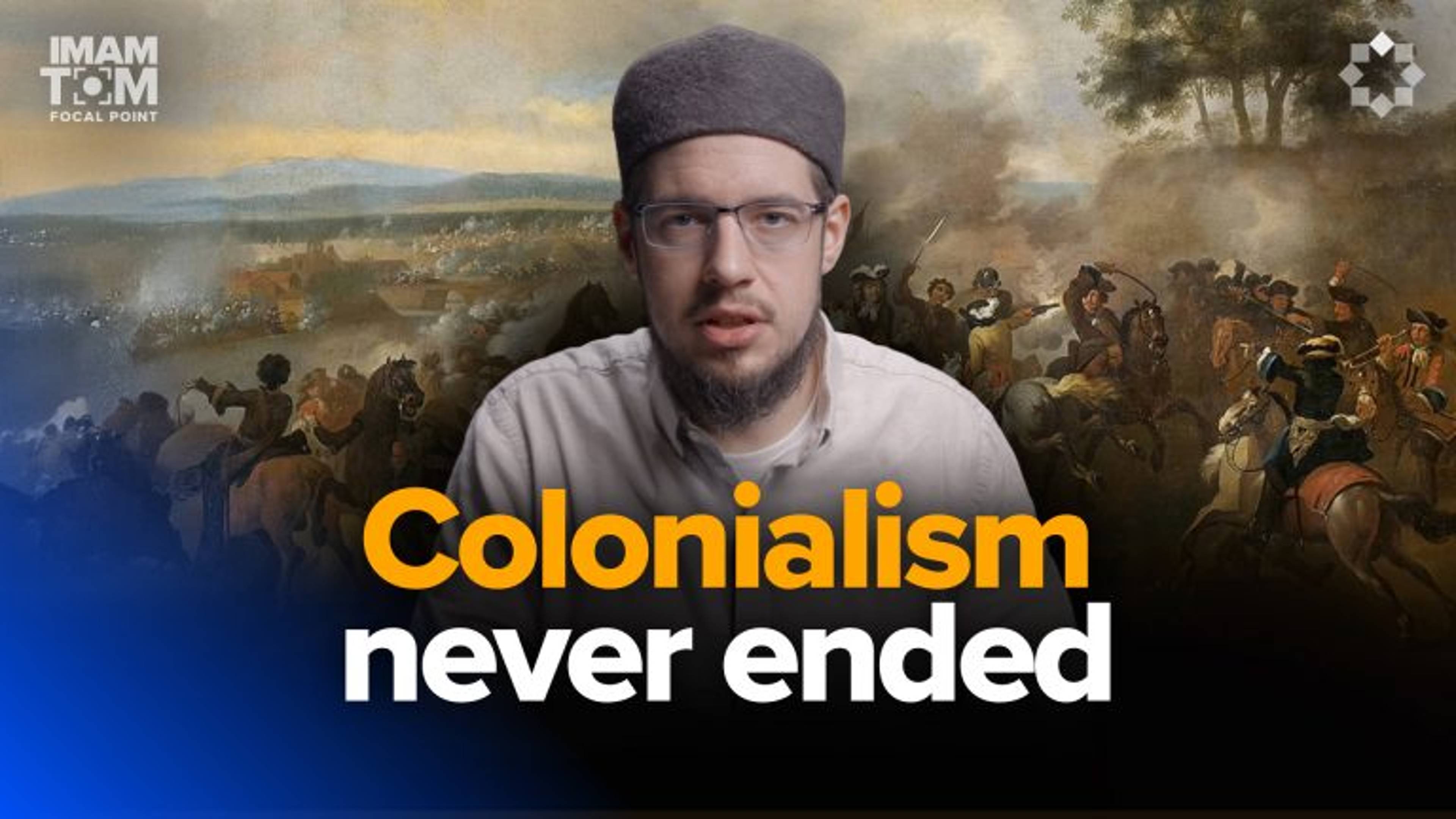
How Colonialism Hijacked the Muslim World | Focal Point with Imam Tom Facchine
Focal Point

How Colonialism Hijacked the Muslim World | Focal Point with Imam Tom Facchine

European colonialism didn’t just redraw borders, it dismantled the Muslim world from the inside out. From abolishing Islamic law to replacing scholars and institutions, the legacy of empire is everywhere—even in our own self-perception. In this episode of Focal Point, Imam Tom Facchine unpacks how colonialism restructured the Muslim world, and what Muslims must do to reclaim autonomy today.

This transcript was auto-generated using AI and may contain misspellings.
00:00Today we're going to talk about one of the most significant set of events, if not the
00:09most significant set of events. The borders, the political map, the language that you speak, institutions that we study in, it has been touched by European colonialism. European
00:22colonialism is one of the most significant, if not the most significant force, culturally, academically, institutionally, legally, that has set the terrain for the current world,
00:33especially for the current Muslim world. Now, colonialism is something that is tricky because it is simultaneously well-known in a general sense, but the nuts and bolts, the details,
00:44are often glossed over. And that actually makes it harder to drill down into what is so problematic, because when we think of colonialism, we think of just like killing and stealing and stuff,
00:55and then there becomes this homogenization of history and practices where other people, for example, people who want to defend European history and Western civilization,
01:06they want to say, oh, well, that's no different from what everybody else was doing. China's colonized people and the Arabs colonized people and everybody's colonized somebody at some point. Not really. So colonialism refers to something very specific. And then if we cross over to the
01:201800s, it refers to something extremely specific, actually completely unprecedented in human history that we have to talk about. Now, this type of colonialism was a little bit more typical or
01:32precedented historically. Even though there was a different arrangement from the typical type of domination, there were things that are in common in other types of conquering and other types of
01:42domination, such as brutal violence, ethnic cleansing, and resource extraction. The arrangement that colonialism established was one between the colony and the metropole. The colony was used in a
01:55very parasitic way to extract resources, intellect, lives, whatever you can from that, and it was funneled to the metropole or the empire. And what was special about it was the remoteness that was
02:09between the empire and the colony. In earlier times, in order to occupy somebody, you had to basically be on the ground. You had to be right there. Not so with colonialism. Colonialism was
02:19sort of like remote control domination, where you have something like the British Isles or the British Empire ruling the subcontinent, British India or British Hindustan, which is literally the opposite side of the world. You have the Dutch that were colonizing Indonesia. These things are happening
02:34across enormous distances. And what that created was a dynamic in which there was no possibility for the locals to successfully rebel against the ultimately responsible people for their domination.
02:48So it doesn't matter if you were in India or today's India or today's Pakistan or today's Bangladesh and you were under British colonization, there's no way you were going to get a chance to even sniff or look at the king or the queen. Way too far away. And there's all of this apparatus
03:02that was set up in between you, layers and layers and layers and layers, with the final layer, the layer that you have interface with typically being actually your own people, which is another aspect
03:14of colonialism that we have to talk about. So let's give some specific examples. You've got the defeat of the Mughal Empire in about 1757. The British East India Company, the EIC, was a proxy for
03:26the British government and the British Empire. But this is very typical of that era of resource extraction. You find these capitalistic venture groups, either from the British or the Dutch or otherwise, that are doing these things. And because they are trade companies and capitalistic
03:40enterprises, they are largely focused on just business, trade, commerce and resource extraction. That doesn't mean that they were peaceful. No. In fact, they often used guns, whatever they had,
03:51force in order to force themselves in on a market or to forcefully open up a market to their trade and to what they wanted to do. But the main structure is not something entirely foreign to us.
04:04This idea of the colony and metropole that even if there were tyrannical systems of tax extraction, let's say, that were happening on the ground, what European colonialism would do is it would come in
04:17and it would co-opt those systems, use them for themselves. But the only difference is that the tax money is now getting shipped across the world and people that are on the ground are being run
04:28into the ground. So if you want to take another concrete example, the British East India Company, the officials tapped into the existing Zamindari tax farming system in British India and eventually
04:39established direct collection systems that resulted in famines. Governing relationship is so remote and so far away that that alienation and that remoteness is going to produce negative outcomes
04:51and very dramatically negative outcomes. So there were several major famines that took place in British India before 1857, remember that date, such as the Great Bengal Famine of 1770. And we're
05:03talking millions of people dying from famines that were largely, you know, they're not just like natural disasters. There are vulnerabilities that are produced by the excessive tax farming of the
05:14colonial enterprise and other oppressive tactics. There was Chalisa Famine from 1783 to 84, the
05:21Dojabara Famine of 1791-92, the Agra Famine of 1837 and 1838. Because there is no organic relationship between the empire and the colony, then they just don't care. They're just after their bottom line.
05:35And if they have to extract everything in order to reach their bottom line, and if the people have to starve, then so be it. They didn't really care and they weren't under threat of a popular revolt,
05:45again, that was going to necessarily reach the real people who are pulling the strings. Now, let's look at some of the other tools in the toolbox of the early phase of European colonization.
05:57Another one was European investment. And I love this one in particular, because, again, people who want to defend European history or defend Western civilization, which is a complete social construct, they want to say, well, we built hospitals, well, we built roads. The infrastructure
06:12that European colonizers invested in really only served the empire. The roads that they built were roads to hasten and make more efficient the extraction of resources to send to the empire
06:24centers. The hospitals they built were often to treat the colonial administrators and the soldiers that were keeping the local population in line. Even if you want to talk about the Suez Canal,
06:36for example, the European powers invested in the Suez Canal. But they did so because it was going to align with their foreign policy interests and their trade interests. They had very advantageous financial agreements with many of the powers after, you know, demonstrating some show of force.
06:48And so they wanted the goods to flow more freely. This wasn't them just trying to invest in the Suez Canal because they loved Egypt and they wanted Egyptians to have a good way of life. No. And therefore, the so-called fruits of much of these infrastructure projects were distributed very
07:03unevenly. Like the average person is not going to benefit from these things whatsoever. Gee, we experienced a lot of that today. Anyway, another tool that was in the hand of the European colonizers was capitulation agreements. And you might have heard of this term before, but there's
07:15a lot of lack of clarity as to what it actually is. Originally, capitulation agreements were based off of medieval commercial agreements that granted extra territorial consular rights to foreign
07:28merchants. And we have a very similar system in the Sharia, where if somebody is coming to you from another territory and they want a specific license to trade, there needs to be a special
07:39relationship between the government that's sending him and the government that's receiving him. That's typical. But what happened under European colonization is that the European colonizers,
07:49they started to sign agreements and use such agreements as tools to get a foothold into other empires and places. So, for example, the British and the French, they signed agreements
08:02allowing their own commercial agents, which they called factors, they granted them legal immunity. So we've got a British trader who's coming into Hindustan and he has legal immunity. That means even if he kills someone on the ground, maybe he's not going to get punished for it. He's backed
08:17up now by the full force of the British Empire or the French Empire or whatever have you. You can see how this is already getting problematic. But then they continued to extend it, that they extended
08:27these extra territorial rights, not just to people that were subjects of their own empire, but religious minorities that were living in the other empire. So if they were a Christian nation,
08:39for example, that they would extend those same rights and privileges to Christian minorities within Muslim lands. Now, we know from the history of Islam, religious minorities were treated very,
08:49very well in Islamic history, almost without exception. Unfortunately, the exceptions are ones that we wouldn't claim as Sunni Muslims anyway. But in general, Islam was not spread by the sword. This has been a lie that has been propagated about Islam. You can look at
09:04Richard Bulliet's work, Islam from the Edge, many other works that have dispelled this myth that Islam was spread by the sword. All that was crusader propaganda. You can't even really accept Islam by force. It's kind of a nonsensical thing. We don't want fake converts. We want people who
09:18are going to genuinely convert to Islam. So religious minorities were generally treated well under Islamic governments and Islamic empires. However, there became this dynamic where, well, first of all, we should say that Muslims were not treated so kindly under Christian empires or
09:32other empires whatsoever. But the point is here that the foreign power started to try to win the allegiance and leverage and instrumentally weaponize those Christian minorities inside
09:44of Islamic lands. They were basically taking advantage of the fact that religious minorities were allowed and actually thrived within Muslim lands for centuries in order to create a special
09:56relationship with them and grant them certain privileges that would maybe make them a little bit more loyal or start to seep away their loyalty from the empires in which they lived. Now, you can
10:06see how this is gaining a foothold, a colonial foothold in the Muslim world. One of the ironies that I find about this is that Muslims in the West are treated like a fifth column, as if we have some secret plot to overthrow anything or to impose our will, which couldn't be further from
10:21the truth. But if you look into history, we find that, oops, again, every accusation is a confession that it was the Christian empires and the Christian nations that were using religious minorities in
10:32Muslim lands as a fifth column. So maybe that's a little bit of projecting and guilty conscience there. There's other tools that European colonizers used in Muslim lands, such as debt. Debt was a
10:43very powerful tool. Financial entanglements gave European powers leverage politically. For example, the British Prime Minister Disraeli arranged for the purchase of the Egyptian government's shares
10:55of the Suez Canal Company in 1875. That happened to be financed by the Rothschild bankers. So stay with me here, right? That this was a project that they initially invested in because they
11:09wanted the Suez Canal to be built so that it would increase the traffic of goods, and they already had favorable trade agreements in the area. Okay, well, the Ottoman Empire was also heavily indebted to the British, and they would take on a lot of debt from foreign powers. And this was not just the
11:23Ottoman Empire. Many other Muslim lands became very indebted to European powers. And then British or the French or whoever would come will buy out your shares for the Suez Canal, and then you can repay
11:36your debts to us. And of course, you have to find someone to finance it. And in this case, it just happens to be the Rothschilds. And there's also many, there's much evidence to demonstrate the way, specifically talking about the Ottoman Empire, in which the British used the leverage of
11:50debt in order to get the Ottomans to make certain reforms in law, especially laws that had to do with economics, even with waqfs, with religious endowments, and the like. Now, all of that is,
12:03again, not unheard of. This stuff is precedented in history, even if it's very sinister, even if it's oppression, even it's wrong. But in the 1800s, colonialism underwent a change. It underwent a
12:15transformation. And it morphed to something more sinister, which is the re-engineering of an entire society and the re-engineering of individual consciousness. There was a concerted effort to
12:27change the way that people lived, practiced their religion, thought about themselves, and identified. And the sad thing is, the effects of this project are still seen today. So what were some of the
12:40things that the colonial power started doing to the Muslim world in the 1800s and that continued until the colonial period was formally ended, whose effects still continue today? One of the most
12:51central things that happened was the dismantling of the Sharia. So the new colonialism had a very, very thick juridicality. Fancy word to say that there was a legal dimension. It wasn't like when
13:03Muslims came from land to land, and even if they conquered a land, they would allow the religious minorities to govern themselves according to their local laws. Typically, as long as you paid the jizya, which was a head tax that was in lieu of your military service, what was the business of
13:17the Muslim ruler to really determine every single law that you obeyed by? That was not the case with European colonization, especially its later period. The colonial administrators, they systematically
13:29dismantled the Sharia brick by brick. And the way that they did it is very, very tricky and sneaky and sinister. One of the obvious ways is simply abolishing the Sharia entirely. That you guys,
13:40we found you and you were practicing Islamic law. No more Islamic law. Now you're going to follow British common law. Another tactic was to confine the Sharia application to just personal status
13:51stuff. And this is the status quo in Western nations where Muslims are often able to use Sharia norms for their food or for marriage or divorce or inheritance. It doesn't really matter to the colonial administrators. They're just going to let you keep on doing that. But
14:05the third way that the Sharia was dismantled or limited or changed is the most sinister, at least to me, is the most sinister of all. And that is the co-optation of the Sharia through translation
14:19and codification. Translation, really? Let me give you some examples and then I'll demonstrate the patterns. In 1882, the Dutch reorganized the Islamic courts of Indonesia and they made several
14:32key changes. One of them was they separated the Sharia from what was locally known as Adat. And Adat, it is an Arabic word. It means like customs. They had two bodies of law that they referred to
14:43locally. One of them was the Sharia and the other, the Adat, was basically covering the individual local knowledge of the Mufti and his knowledge of the local culture, the local people and their
14:53circumstances. What the Dutch did was the first thing that these two spheres used to work as complementary pieces of a whole. That the Sharia provided the foundation and the skeleton of every
15:06rule that everyone was going to follow and the Adat and the customs, like in the Qaeda Fiqhiyya al-Urf Muhakkama, that culture or custom is observed and it's enforceable with certain
15:16important conditions. These things work together. What the Sharia was silent on or what it left vague or general was filled in by the Adat, by the customs. So if you're a Dutch colonizer and
15:28you're looking at this arrangement, you're saying, well, the Sharia has got to go. I'm going to take these Adat and they're more flexible and they're a little bit more vulnerable and I'm going to, I'm going to mess with them. And that's exactly what they did. The first thing that they did is
15:40they separated these two and they focused in on the Adat and they codified the Adat. That means that they wanted to ossify and freeze in time the Adat into very specific rulings that they could
15:53make a manual that would be uniform, that would apply to every single individual. What does that do functionally? It removes the flexibility of the practice of Islamic law. It removes the autonomy
16:05of the individual Mufti, the individual legal scholar and the community in itself that has a very personal connection to that Mufti. And it also removes the power of that community over
16:17their own knowledge. And now you're opening the floodgates where you're able to have Dutch colonial administrators go to school to study Adat law, learn the codified version of the Adat and then
16:28come and replace the local Muftis and scholars that were practicing the Sharia on the ground. And that's exactly what they did. Now, in order to achieve this, this last piece of the puzzle, they needed the Orientalists. They needed people who are going to produce knowledge, that were
16:43going to translate this stuff, that were going to give a little bit of credibility to the project. Because if the Dutch just went in and said, listen, all you guys, you just have to follow Dutch law from now on, there might've been a revolt. They didn't want that. And so they had
16:56people like Cornelius Van Vollenhoven, and I apologize, I don't know how to pronounce Dutch, that underwent enormous projects of translation in order to domesticate the sources of Islamic law
17:09and to co-opt them into an acceptable way under Dutch rule. And they knew exactly what they were doing, by the way. Van Vollenhoven, he understood it from his journals and diaries and statements
17:20and correspondences. He understood that Islam and the Sharia were anti-colonial forces, and his intervention in that space was to break up the anti-colonial sentiment. The same patterns exist
17:33in British India or British Hindustan, whatever you prefer to call it. Warren Hastings, one of the early colonial administrators, complained that the Sharia was too flexible. Listen, all these people in the United States, you've got anti-Sharia legislation introduced in 30 states. Some
17:48states in the United States have anti-Sharia legislation. Warren Hastings complained that the Sharia was too flexible. He said, quote, the Sharia was founded on the most lenient principles
17:58and on an abhorrence of bloodshed. Put it up in lights, write it on the wall, send it to the governor of Texas. That's Hastings. Okay. That was his problem with the Sharia. It's too lenient. These Muslims, they just, they're too merciful. We got to find something that's a little bit more strict.
18:13So Hastings, what did he do? He engaged in an enormous translation project. He was very keen on translating local religious texts. He actually wrote the introduction to the first ever translation
18:25of the Bhagavad Gita. Hope I'm pronouncing that right. And he stated in that introduction that accumulating this type of knowledge was essential to effective rule over the local population.
18:36Now, what he did later for the Muslims, he commissioned an English translation. If you're a you know, the fiqh text, al-Hidayah. He commissioned a translation of al-Hidayah and he codified it as
18:48the source of Islamic law. Forget the rest of the madhab, forget the other madhab, forget the faqih, forget the mufti, forget the qadi. It's all in this book. Al-Hidayah now is like the Quran or even more
18:59than the Quran. That's what Hastings did. The same way that it functioned in Indonesia, it functioned here where it stripped the practice of law from its flexibility, its local knowledge, the discretion
19:12that was offered the individual local scholars, and it also bypassed the local scholars and ulama. It created a new field of study that any British person could grow up and go be an expert in
19:25Mohammedan law and then get a job ruling over people in British India. Madness but true. Now after Hastings, Sir William Jones was the one that furthered these projects through his
19:36founding of the Asiatic Society. He wrote prolifically on a lot of different topics and he was the one that took this to its logical conclusion, the full-blown codification of all what he called Mohammedan law. It would be known as Anglo-Mohammedan laws because it's a mix. It's
19:50a mix of, well, we're not going to just tell you guys you have to follow British common law now. Now we're going to take a little bit of what you got and we're going to mix it with what we've got and then we're going to talk about it. And that's what you're going to have to follow from now on.
20:01These codes created concise, abstract, and uniform laws that could be applied by British judges, bypassing the local indigenous knowledge.
20:11It became its own profession. British subjects and local elites had to go to colonial schools where now they were supervised and the curriculum was controlled in order to get their profession or their expertise in this field and then continue on to the profession.
20:25This is just one area in which the European colonizers dismantled the Sharia and all of its practices. There's lots and lots more. They also destroyed the Waqf system and we've talked about that in other videos.
20:38The system of endowments, the modern Western University, the Yales, the Harvards, the Oxfords, who patterned themselves on the same model that we invented,
20:47that this was something that had funded all of the Muslim educational institutions or the vast majority of them in the Muslim world.
20:55This is what kept them independent and autonomous from whatever local Muslim ruler was trying to do or wanted to have happen. And it wasn't just for schools. They also were funding hospitals and roads and welfare institutions.
21:08Specifically when it comes to education, the colonial administrations, they seized the Waqfs or they ran them into the ground and corrupted them and looted from them in order to bring the education apparatus under its centralized control.
21:24And these were things that were done even in places that weren't formally colonized, such as the Ottoman Empire. With British pressure, the Ottomans abolished the Waqf system and seized all Waqf lands throughout the 1800s, the early 1800s actually.
21:36And so this obliterated the autonomy of the ulema and the traditional halaqat and the traditional system of knowledge production.
21:43And it made anybody who wanted to study sharia or to implement or to apply the law, even the mixed form of Anglo-Mohammedan law or this law, the Adat law or whatever, you could only now go to the colonial schools.
21:58And the colonial schools were under close control and monitoring by the colonial administrations. The content of those schools, as you could imagine, was very, very different from the content of traditional madrasas or Islamic centers of learning.
22:12They secularized Islam, so they cleansed it of all the things that would have to do with, let's say, the structuring of society and foundational ways that would challenge the colonial administration.
22:21And they essentially converted it into a way to confine the understanding and production of Islamic knowledge as things that only have to do with ritual worship, personal status, these things that are non-threatening.
22:35They also dismantled everything by divide and conquer strategy. This is well known by promoting religious rivalry within Muslim lands and promoting ethno-nationalism. Colonial powers drew artificial borders, such as the Sykes-Picot agreement.
22:49You can look at Iraq and you can see, gee, why is it a third Kurd and a third Shia and a third Sunni and people seem to be fighting? Gee, how did it get this way? Nine times out of ten, the answer is the European colonizers, they drew it up this way.
23:02They did it in order to be able to play different populations against each other. In fact, it is a historical truth that there was no one organized thing as Hinduism until the British came and created it.
23:15Not saying that the local practices and individual practices were not there. They were, but to call that all of this is one religion and that religion is called Hinduism, that was actually something done by the British.
23:25And they did it because it created now two groups that you can play off against each other. We also have the criminalization of Islamic norms and Islamic identity.
23:34So the most oppressive regimes would criminalize Islamic practices like hijab, Islamic courts, Sharia-compliant finance, family customs. If they're not criminalized, they would be stigmatized or regulated.
23:46We see that even in the United States today, again with the anti-Sharia legislation. People panicking about epic city, a bunch of people who want to buy a bunch of houses in the middle of nowhere and calling this a creeping Sharia and whatnot.
23:56So let's get into the last points here that the new colonialism, what set it apart so much from the old form of colonialism or the prior era of colonialism, is that it sought to restructure the Muslim individual.
24:10It sought to restructure the way in which the Muslim thought about him or herself. And we have explicit quotes from the colonial administrators to this end about killing the Indian and saving the man.
24:21We want people who are British in tastes and etc. that have British opinions, British sensibilities, even if their exteriors are from wherever they are.
24:30That the colonialism that was practiced by the British and the French and the Dutch and the other European powers, that it was to produce a certain type of subjectivity, a certain type of person that was subservient to the colonial administration.
24:44Part of this was denigrating Islam, making the practice of Islam and Islamic scholarship seem backwards, defunding Islamic education and the scholars to make them backwards.
24:54Having your best and brightest students go to study medicine and medicine, you're never going to even touch anything like a Quran or a book of Hadith, so that you can perpetuate the perception that those who go to study Islam are backwards.
25:08Now, what do we do about this reality? This is the world that we inherited. If you look around, if you woke up in 2025, you look at the political borders, you look at the languages being spoken,
25:17you look at the flow of B1 visas and students from this place to that place and where are people going? This is the world we inherited, the world that was made largely by European colonization, which is particularly pertinent to every Muslim in the world.
25:31What do you do about it? A couple things. One, make endowments wherever you can, and I'm specifically talking to the Muslims in the West, especially Muslims in the United States of America, where it is perfectly legal and acceptable to make charitable endowments.
25:45Every single mosque should be funded by a charitable endowment. Every single Islamic school should be funded by a charitable endowment. This is how things work, especially in the United States. You've got family foundations, you've got other types of foundations.
25:59We have the money, we have people who have made a lot of money. This is the need of the hour. That way you're not stuck in fundraising mode. Isn't it annoying, everybody? You're in the last 10 nights of Ramadan, it's the 27th, it could be Laylatul Qadr, you're in the middle of Tarawih,
26:13you've got Khushu'a, you're praying and you're crying in your prayer, and then all of a sudden you're in between Rakat and the doors close and it's time for a fundraiser. And what's the fundraiser for?
26:22It's just basic operational budget, keeping the lights on, paying the imam, whatever. This is not acceptable. We have to do better than this, but we're never going to do better than this if we don't normalize and make ubiquitous,
26:34make widespread, take back the model of the waqf that Islam gave to us.
26:39Corollary is that we should be very, very wary and skeptical and suspicious of our institutions being funded by government grants. Yes, we should.
26:50Those government grants might seem like free money, but there's always strings attached. Even if the string is just that, it can be taken away and removed whenever they want.
27:00That we really, this is a band-aid to a larger gaping wound that requires stitches. That we really need to take control of our own community institutions and to fund them properly.
27:11And government grants are not a long-term or sustainable option for that. We need to make sure that we implement the waqf. The next thing that we need to do is we need to fix Islamic knowledge. It doesn't mean fix Islam. Islam is perfect.
27:25We need to fix the way that we understand Islamic knowledge, produce Islamic knowledge, and teach Islamic knowledge. That Islamic knowledge has to be holistic.
27:35It's not the secular, colonial-approved version of Islam that's only limited to the five pillars and the four walls of the masjid. It has to deal with how to contribute to society, how to make society a better place, outside-of-the-box thinking.
27:49And we also have to send our best minds to study the deen. If you're complaining about the level of intelligence that's reflected in the religious scholarship around you,
28:00ask yourself, are you willing to send your son or your daughter to go study the deen full-time seriously as a lifelong vocation? If the answer is no, then I don't know that you really have much of a right to complain.
28:12You have to dedicate your best minds to Islam if you want to get the top-tier scholarship that we need for the moment in which we live.
28:21And the final thing is that all of us individually, all of us individually and also collectively should try to pursue financial and economic autonomy. Towards the end of his life, Malcolm X, rahimahullah, used to talk about this a lot.
28:34Black economics is what he called it, in the sense that we need to avoid debt, be debt-free. We need to take control over our businesses. The Muslim community should be able to provide jobs.
28:46All of these people who are getting doxxed for speaking out for the truth, where are they going to work? If we don't have any job opportunities for people, we can't employ people, we don't own land, we don't own buildings,
28:56then that is a very big strategic weakness, that we have to take control of our own communities. And if someone were to say, oh, it's too hard or it's too expensive in the United States, then I would disagree with them. Because there are many communities that are already doing it today.
29:10There are many communities that don't actually even purchase insurance. They don't even deal with commercial insurance. They have community insurance. They take care of insurance among themselves.
29:22That if someone within their community gets sick, everybody chips in and they take care of it. No HMOs required, no pre-existing condition needing to be proved, nothing like that.
29:35And the same with real estate. There's no need for loans or to go to the bank to get a loan and involve yourself with interest. There are communities in the United States that they pool their money and they purchase things collectively and they work collectively.
29:47And the Prophet ﷺ actually praised the Ash'ari tribe for a similar type of collective mentality. He said that when times got tough, they would gather everything that they had, all their food together on one blanket or one garment,
30:00and they would divide it up among themselves. That collective thinking and collective action is praiseworthy. And at this particular time, especially living in the world we live in, in the wake of European colonialism, it's what the Muslim world needs today.
30:17www.yaqeeninstitute.org