fbpixel

The 10 best days are here.

Give your sadaqah
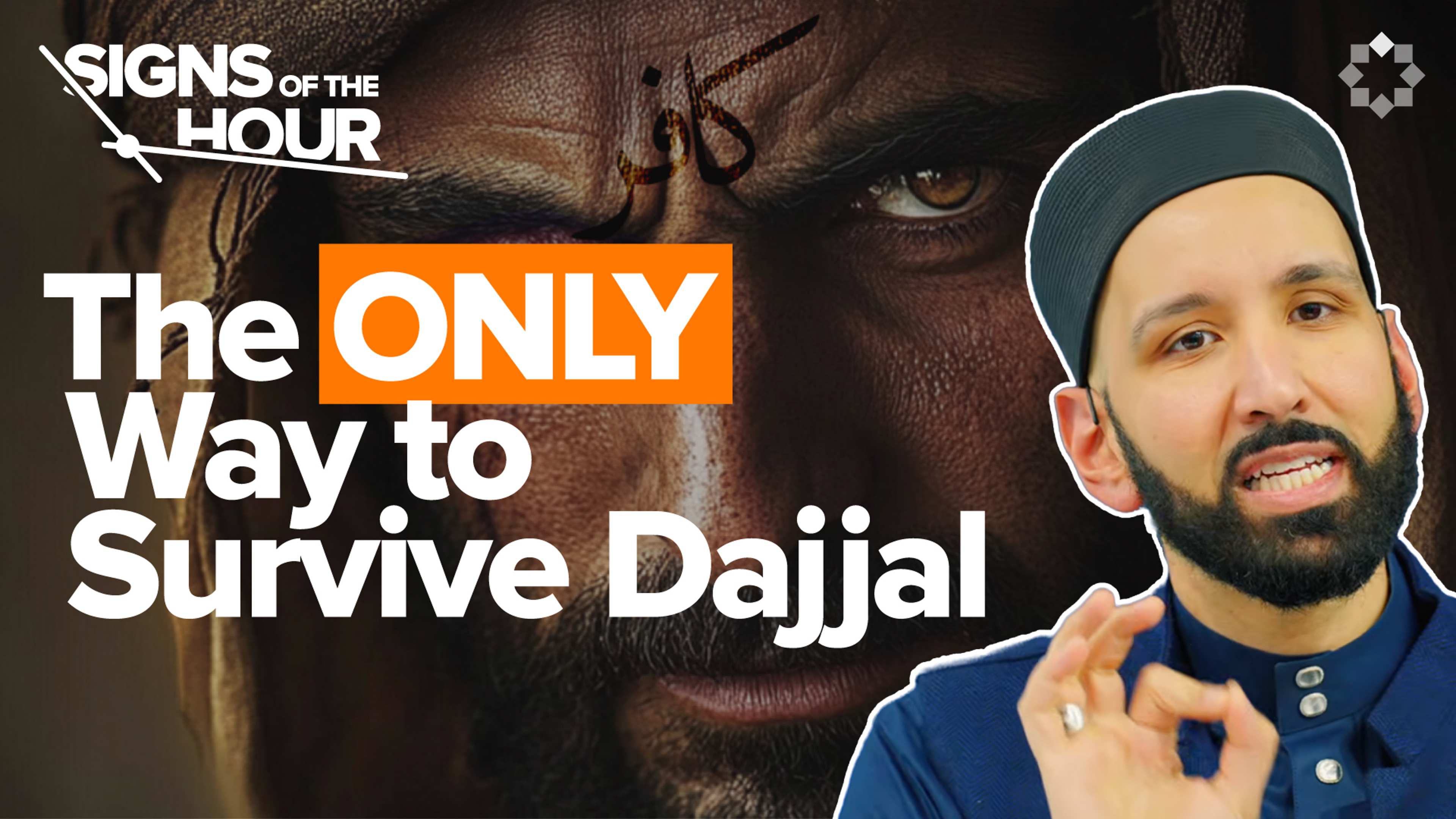
20 Verses of Qur’an That Protect from Dajjal | Signs of the Hour Ep. 4

Signs of the Hour

20 Verses of Qur’an That Protect from Dajjal | Signs of the Hour Ep. 4

How can you protect yourself from the Dajjal, and the era of dajalah (deception) that comes before him?

The Prophet ﷺ gave us guidance for our protection from these trials, including multiple du’as and 20 verses from Surah al-Kahf — and he taught us to make sure that we don’t become agents of deception today.

Here is a du’a he ﷺ taught us for when we leave home every day:

اللّهُـمَّ إِنِّـي أَعـوذُ بِكَ أَنْ أَضِـلَّ أَوْ أُضَـل أَوْ أَزِلَّ أَوْ أُزَل أَوْ أَظْلِـمَ أَوْ أَُظْلَـم أَوْ أَجْهَلَ أَوْ يُـجْهَلَ عَلَـيّ

Allahumma 'inni 'aʿudhu bika 'an 'adilla, 'aw 'udalla, 'aw 'azilla, 'aw 'uzalla, 'aw 'adhlima, 'aw 'udhlama, 'aw 'ajhala 'aw yujhala ʿalayya.

O Allah, I seek refuge in You lest I misguide others, or I am misguided by others, lest I cause others to err or I am caused to err, lest I abuse others or be abused, and lest I behave foolishly or meet with the foolishness of others. [Abu Dawud, hadith no. 5075]

And a du’a to read at the end of your salah:

اللَّهُمَّ إِنِّي أَعُوذُ بِكَ مِنْ عَذَابِ جَهَنَّمَ وَمِنْ عَذَابِ الْقَبْرِ وَمِنْ فِتْنَةِ الْمَحْيَا وَالْمَمَاتِ وَمِنْ شَرِّ فِتْنَةِ الْمَسِيحِ الدَّجَّالِ

Allahumma inni aʿudhu bika min ‘adhabi jahannama, wa-min ʿadhabi-l-qabri, wa-min fitnati-l-mahya wa-l-mamati, wa-min sharri fitnati-l-masihi-d-dajjal.

O Allah, I seek refuge in You from the punishment of Hell, from the punishment of the grave, from the trials of life and death, and from the evil trial of the False Messiah.

[Sahih Muslim, hadith no. 588]

This transcript was auto-generated using AI and may contain misspellings.
I want to move on, bi-idhnillahi ta'ala, before the next session where we will talk about
the death of the Prophet ﷺ and what followed, and then the theme of the death of the righteous and all of the ahadith about that, and the minor signs that would then follow.
This concept of ad-dajjal, and how you protect yourself from ad-dajjal, right, because clearly this is the worst of the major signs as it pertains to the believers, is khuruj al-Masih ad-Dajjal.
Meaning, technically speaking, if you can protect yourself from him, you can protect yourself from all the other signs as well, right? If you learn how to guard yourself from what that fitna would be like when ad-dajjal comes
out, then clearly you'll be able to guard yourself from all types of fitan bi-idhnillahi ta'ala that would follow. So the concept of ad-dajjal, what's the difference between ad-dajjal and kadhib? What's the difference between ad-dajjal and lying?
Does anybody know what the difference between those two things is? Ad-dajjal is an added layer of lying because it's a half-truth.
And you know, a half-truth is worse than a full lie. Why? Because just like those soothsayers, you have enough of a dosage of truth to validate what
you are saying or doing to make it more credible. And that's what makes it so dangerous, so pervasive. And why we have to be that much more careful.
And so ad-dajjalun are able to take a little bit of truth and then decorate it with a lot more to have just enough of reality to lie to you about the rest of it. So how do you protect yourself?
Well, if you think about the ways that first and foremost, we might perpetuate ad-dajjal in this world, because that's the scariest part of it all. I actually start with that because when you leave your house every single day, you should
be saying, Allahumma inni a'udhu bika min adh-dhalalah aw udhal, aw azillah aw uzal, aw adhlimah aw uzlam, aw ajhalah, aw yujhala alayya. That oh Allah, I seek refuge in you from leading astray or being led astray, from falling or
causing someone else to fall, from wronging or being wronged, or from being taken advantage of or from doing so to someone else. So this is what you're supposed to say as you leave your house every single morning.
Allahumma inni a'udhu bika min adh-dhalalah aw udhal, I seek refuge in you, oh Allah, from being astray or leading astray, aw azillah aw uzal, to fall or to cause someone else to
fall, aw adhlimah aw uzlam, to wrong or to be wronged, aw ajhalah aw yujhala alayya, or to be taken advantage of, or for someone to take advantage of me.
And so when you spread things about other people, you could actually be participating in ad-dajjal. Why?
Because when you forwarded it, someone can say, well, that person sent it to me, right? So someone got something from a source that wasn't right, that wasn't correct.
They took some truth, they decorated it with a bunch of falsehood, and then they spread it, and you chose to spread it as well. And the person who's now spreading it is banking on your credibility, on your trustworthiness.
And you're like, well, that person sent it to me. So you have to be extremely careful to not be a part of the process of ad-dajjal more than anything else. So when you talk about protecting yourself, first and foremost, you protect yourself from
doing the actions that are so dispraised by the Prophet ﷺ. Now how do you protect yourself from the fitna of ad-dajjal and the fitna of all of the signs of the Day of Judgment that follow as well?
You might remember I gave a khutbah on why the Qur'an doesn't even mention ad-dajjal? What are the wisdoms of the Qur'an not mentioning ad-dajjal? And it doesn't speak about the Mahdi, it doesn't speak about so many of these different things.
And the ulama said that of the wisdoms is the tasgheer, the belittling of a dajjal, like you're so irrelevant that you won't be mentioned, like Abu Jahl, right? Because you wanted to make yourself something and Allah Azawajal makes you nothing to the
And the ulama said that of the wisdoms is the tasgheer, the belittling of ad-dajjal, like you're so irrelevant that you won't be mentioned, like Abu Jahl, right? Because you wanted to make yourself something and Allah 'azza wa jal makes you nothing to the point that you're not mentioned.
And one of the wisdoms as well is that the Qur'an is more about being a book of covenant and learning the lessons of the past and how to hold on to that 'ahd, how to hold on to that covenant. The story of the prophets and the principles that you hold on to, so you don't fall in
the future. The Qur'an is not a book of a bunch of predictions. You hold on to the prophet's way, you hold on to the principles that you are taught in the Qur'an, you hold on to that 'ahd, and you will be able to survive everything that
comes after it. So it's important to understand that. You don't know the specifics, but you know enough in order to survive.
Also, to realize that ad-dajjal does not arrive in a vacuum. This is the hadith of Anas ibn Malik radiyallahu 'anhu that the Prophet ﷺ said,
be years of deception in which the truthful will be considered to be liars and the liars Inna amama ad-dajjali sinina khaddaa'a, yukadhabu feeha as-sadiq wa yusaddaqu feeha al-kadhib. That the Prophet ﷺ said that verily preceding ad-dajjal will
be years of deception in which the truthful will be considered to be liars and the liars will be believed.
And he said that al-amin, a person who is truthful, will be considered to be discredited and those who are treacherous will be trusted and those who are disgraceful will speak. So before ad-dajjal comes, there are things that precede him. And it's a world prior to him where realities are distorted and where everything is all
over the place. And I want you to think about it this way also, that before ad-dajjal comes and presents you false realities, you already have someone else that's doing that too. Who is that?
Shaytan. So all the dajjal is going to do, his fitna, is to distort reality so much and to make
that he tries to decorate the dunya for you, to decorate the life of this world for you so that you betray what Allah 'azza wa jal gave to you as a result of that, right? So all ad-dajjal is going to do, his fitna, is to distort reality so much and to make the cost of embracing his reality seem like it's worth it, right?
He's going to present you a jannah. He's going to present you a naar. Inna Allaha wa'adakum wa'ad al-haqq wa'attakum fa-akhlafu ba'dikum. Shaytan is already making you a promise other than the promise of Allah. Ad-dajjal will come and make a promise other than the promise of Allah, but it'll be so
visually compelling. It's like when you see those AI videos and you're like, wow, I thought I have a discerning eye. But even I got lost in that one.
Even I thought that one was real. And so you get to a point where your sensibilities are lost. Your fitra is compromised. And people in general, they operate only in vanity and they can't see past their surface
level vision. And so as people become shallower, the tools to distort that shallow reality become more advanced. And so you couple that with desperation and vulnerability and chaos.
It's a dangerous, dangerous fitna and we ask Allah subhanahu wa ta'ala to protect us from that fitna. Allahumma amin.
So we have, insha'Allah ta'ala, two things here in this toolbox. Number one will be what the Prophet ﷺ specifically told us as a general framework to protect ourselves from ad-dajjal and what is around the fitna of ad-dajjal because if you are protected from that, then insha'Allah ta'ala you're protected from everything
else. Number two, the 20 verses that protect the person from ad-dajjal. 20 verses in the Qur'an that the Prophet ﷺ gave to us and a brief overview of those 20 verses. Number one, al-iman, your faith.
To protect your iman, to guard your iman. As the Prophet ﷺ mentions, az-zaman alladhi la yuqbalu feehi al-iman.
A time where faith is no longer accepted, right? When, you know, to hold on to your faith before it becomes too extreme.
And the Prophet ﷺ said, Thalathatun: idha kharaja, la yanfa'u nafsan imanaha lam takun aamanat min qabl, aw kasabat fee imanaha khayra. Prophet ﷺ said, there are three things that once they appear, faith
will not benefit a person unless they previously believed and they derived good from that faith. And he said, ﷺ, tulu' ash-shamsi min maghribiha, when the sun rises from the west, wa ad-dajjal wa dabbat al-ard.
And ad-dajjal and the beast of the earth, that once that happens. If you don't have iman at that point, then you're not going to be able to survive it. And so really building your iman and building and protecting your iman and making judgment calls every day that I will not give up my iman for anything. That my faith is not compromisable.
I can't sell it for anything else. The more that you make that value judgment, the more that Allah 'azza wa jal solidifies it in your heart.
The more you nurture it, the more that insha'Allah ta'ala it takes hold. And so you nurture that iman as much as you can, because ultimately all of these signs are going to try to, or these fitan will try to snatch that iman away from you. And you don't want to die in any way with that iman being taken away from you, that
faith being taken away from you. Number two, al-'ilm, knowledge.
So some of you like all this stuff that we just covered, I don't see the practical benefit. The Prophet ﷺ, when he says that ma bu'itha nabi illaa andhara When the Prophet salallahu alayhi wa sallam says that, he's telling you that knowing these
things, having knowledge is one of the ways that you protect yourself. And so don't discount any of this, that the Sahaba were trying to interact with a reality that they believed in, they knew to be true, they just didn't know one. So don't discount it.
Knowing these things about Dajjal is very important and knowing these things about the fitnah. And this is inshallah ta'ala where I hope this class, bi-idhnillah, it'll take about a year, will inshallah ta'ala be the most beneficial class for you because every sign
that we cover from the Hour, we're going to talk about how to protect your iman in that sign and how to avoid the fitnah of that particular sign. Because if you have knowledge about it, then you recognize it, you say, oh, wait a minute, the Prophet salallahu alayhi wa sallam told us this would happen. I want to be on the right side of that. I want to be on the right side of that.
I want to be on the right side of that. The third thing is the du'a at the end of the salah. The Prophet salallahu alayhi wa sallam said that when any one of you finishes his salah, not let one of you leave the place of his tashahhud.
So this is before your taslim, when you're sitting down at the end of your salah, except that he says, Allahumma inni a'udhu bika min adhabi jahannam, wa min adhabi al-qabr,
wa min fitnatih al-mahya wa-l-mu'mat, wa min sharri fitnah al-masih al-Dajjal. I'm going to say it again slowly, Allahumma inni a'udhu bika min adhabi jahannam. If you say adhabi al-nar, that's also okay, it's narrated authentically.
So Allahumma inni a'udhu bika min adhabi jahannam, or min adhabi al-nar. Which is the worst of the things that you could fall into, right? If I end up there, then what was the point of all of this, right? So the very first thing, oh Allah, I seek refuge in you from the fitnah of that.
And wa min adhabi al-qabr, from the punishment of the grave. After the punishment of hellfire, the punishment of the grave. Wa min fitnatih al-mahya wa-l-mu'mat, from the trials of life and death.
This includes all the fitnah, all the trials of life and death. You're seeking refuge in Allah subhanahu wa ta'ala from all of them.
And from the fitnah at the time of death, wa min sharri fitnah al-Masih al-Dajjal. And specifically the fitnah of al-Masih al-Dajjal, right? So make that a part of your tashahhud, no matter how fast you need to go, no matter what you
need to do, right? Make this mandatory for your prayer. That you do not finish your salah, except that after Salat Ibrahimiyyah, you make du'a and you seek refuge in Allah subhanahu wa ta'ala from these things.
SubhanAllah, there's another narration, by the way, it's about Abu Bakr As-Siddiq radiallahu ta'ala anhu. And it's narrated by Abu Abdullah As-Sunabihi radiallahu ta'ala anhu, one of the Tabi'een.
And listen to what he says, it's authentically narrated. And inshallah ta'ala we can practice this in this time of fitnah. He said, I arrived in Medina during the khilafah of Abu Bakr, and I prayed Maghrib behind him.
And in the third rak'ah, after Maghrib, Abu Bakr radiallahu ta'ala anhu would recite,
Rabbana la tuziq qulubana ba'da idh hadaytana wa hablana min ladunka rahma innaka anta al-wahab. The eighth verse of Surah Ali 'Imran.
This is an authentic narration, that he would do this during Hurub al-Riddah, during the time of severe fitnah, that he would read this verse in the third rak'ah, where of course you don't typically read another surah after.
He would read this single verse, Rabbana la tuzigh qulubana ba'da idh hadaytana wa hab lana min ladunka rahma innaka anta al-Wahab. And because this is an authentic narration from Abu Bakr, as Ibn Ashur says that this
is like a personal plea to Allah from As-Siddiq radiallahu anhu to save him from this deviation after the death of the Prophet salallahu alayhi wa sallam, we can act upon that as well. But make this du'a in general, ya muqalliba al-qulub, thabbit qalbi ala deenik, Rabbana
la tuzigh qulubana ba'da idh hadaytana wa hab lana min ladunka rahma innaka anta al-Wahab. And you'll find, SubhanAllah, that this du'a is one of the most important du'as in this time.
So again, it is the verse on the first page of Surah Ali 'Imran, the eighth verse on the first page of Surah Ali 'Imran. Number four, flee from fitnah. Flee from fitnah.
Listen to what the Prophet salallahu alayhi wa sallam said, man sami'a bi-d-Dajjal, whoever hears about Dajjal, he said, salallahu alayhi wa sallam, go far away from him. Because someone's going to think, I can handle this.
And he's going to come to him thinking that he's a believer, but then he's going to get confused from his shubuhhat, from all of the doubts that he puts in his mind, and he's going to leave with his iman lost. That's actually a methodology.
Don't put yourself in fitnah. Don't tell yourself, oh, I can get away with... these confusing things. I can read this. I'm not going to be affected. I can watch this. I'm not going to be affected. I can listen to this. I'm not going to be affected. I can hang out with these
people. I'm not going to be affected. I can put myself in this environment. It's not going to affect me. Who was the Prophet ﷺ talking to? He was talking to the Sahaba. Do any of us think
that we're better than that generation of people? And the Prophet ﷺ is telling them, a people that went through Badr, Isra wa al-Mi'raj, Badr, Uhud, Khandaq, that if Dajjal comes, go away from him.
Stay away from fitnah. That when fitnah becomes severe, take to the mountains and avoid it. Get out of your mind this idea that you can put your iman in dangerous places and not lose it.
The Prophet ﷺ warned about losing it. To the greatest generation of iman that ever existed. So this is the fourth thing. The fifth thing, and this is inshallah ta'ala, where we'll spend the next
10 minutes bi-idhnillahi ta'ala. The Prophet ﷺ said that whoever memorizes 10 ayat from the beginning of Surah al-Kahf, or in another narration, the last 10 ayat. So the first 10 or
the last 10 ayat of Surah al-Kahf, then that will grant them immunity from Dajjal. SubhanAllah, this is an activity of tadabbur. Of reflecting on the Qur'an that each and every
single one of you can do. This is not tafsir, this is tadabbur. This is reflecting. When the Prophet ﷺ tells us to memorize something, he's telling us to memorize and
internalize and to act upon. And wallahi, I'm telling you, I swear by Allah, as a personal
exercise, I just said, can I connect every single verse of this to Dajjal and his fitnah and the signs of the Day of Judgment, and every single one of those verses can be connected. And I'll
give you my personal tadabbur bi-idhnillahi ta'ala, and then you think about it as well. Number one, alhamdulillah all praise is due to Allah who revealed the Book to his servants,
and there is no distortion in that Book. What does that tell you? The Qur'an is your anchor always. Al-Kitab. You go back to the Qur'an and there is no distortion in the Book. You know,
the minute, subhanAllah, that you start to hear weird ideas, when your fitra is right, when your fitra is right with Allah subhanahu wa ta'ala, you know what's going to start happening? You'll start hearing some weird narrations, those WhatsApp narrations, you go,
ah, it sounds kind of off. Sometimes you might be wrong, because sometimes you might be like, that sounds kind of off. But it might actually be a hadith that you never heard. But the more that you familiarize yourself with the Qur'an and the Sunnah of the Prophet ﷺ,
seriously, like, you almost start to get like a Sunnah sense. This doesn't sound right. This feels different. Because your fitra opens up to good things, because you're trying to be in harmony
constantly with the revelation. And so Allah azawajal makes your harmony with reality in accordance with revelation. Now your method should be, if the Prophet ﷺ said it, then he's
telling the truth. Like, I'm not going to say he didn't say it ﷺ and this isn't true until I verify it. But you start developing a natural sense, the Book of Allah is straight, the Sunnah is straight,
like the Deen is so clear. Once someone comes with something I've never heard, and they start distorting ideas for me, I go back to that and I anchor myself in that revelation. So the Qur'an
corrects your perception, and Dajjal tries to disorient your perception. The Qur'an anchors you in revelation, anchors your perception of that.
Qayyiman liyundhira ba'san shadidan min ladunhu wa yubashshira al-mu'minina alladhina ya'maluna as-salihat anna lahum ajran hasanan. So Allah azawajal says that it is perfectly upright. And it warns of a severe punishment from him.
And it gives good news to the believers who do righteous deeds, that they're going to have a mighty reward with Allah subhanahu wa ta'ala. Qayyiman means standard. The Qur'an sets the standard. And when the Prophet ﷺ said,
know that you will not see your Lord until you die. Know that your Lord is not one-eyed. And he tells you these things ﷺ, what's he saying? Remember what I told you. So when he comes to you and he starts telling you different things,
right? These are your basic ideas of creed. Remember Qayyiman. And at the same time, what are we being told here?
We're being told that Allah azawajal promises a mighty punishment and Allah azawajal grants a mighty reward because Dajjal is not just disorienting. He's got a Jannah and a Nahr.
He has what appears to be a paradise and a hell. And the Prophet ﷺ said, when you jump in one, you enter the other. Right? So if you enter into his paradise, you enter into his hellfire or you enter into Allah azawajal's hellfire. And if you enter
into his hellfire, then that inshallah ta'ala will be your entry into paradise. Makithina fihi abadan. And they will reside therein forever.
The difference between anything that anyone else promises you and what Allah azawajal promises you is that what Allah promises you is eternal. Someone can give you a temporary fix. Someone
what appears to be a temporary Jannah, but only Allah azawajal gives you a forever Jannah. And so his outcome is not a short-term illusion, subhanahu wa ta'ala. It's a permanent reality.
Wa yundhira alladhina qalu ittakhatha Allahu waladan, ma lahum bihi min 'ilm wa la li aba'ihim. Kabumat kalimatun takhruju min afwahihim, in yaquluna illa kathiba. And Allah warns those who say that Allah has taken a son. They have no knowledge of this,
nor did their forefathers. Grave is the word that comes out of their mouths. They speak nothing but lies. The deepest deviation is when you start to distort the reality of Allah azawajal himself.
And that's why knowing who Allah is is so important. His Asma'u, his Sifat, everything about him. Once you start to tinker even with the reality of who God is himself, then Dajjal can easily enter into that. I mean you believe that God is in this and in that and you believe that God has
become this and this and this and that. What's the difference now? I'm just another manifestation of God to you. So Allah azawajal warns those that try to distort the reality about who Allah
azawajal is himself. Falaqallaka ba'i'un nafsaka alaa atharihim illam yu'minu bi hadha al-hadith asafa. It's like you're going to kill yourself over their fate. And if they don't believe in this message then what a shame.
Many of the people that will follow Dajjal will follow Dajjal because they always go with the group. And many of those who will follow dajjalic trends will follow dajjalic trends because everybody else is doing it. Like, well, if that person is doing it, that person is doing it,
they go with the group. And Allah ta'ala is saying, stay back. إِنَّا جَعَلْنَا مَا عَلَىٰ الْأَرْضِ زِينَةً لَهَا لِنَبْلُوَهُمْ أَيُّهُمْ أَحْسَنُ عَمَلًا Verily, everything that is on this earth is an adornment so that we can test you to see
which of you is the best in deeds. Do not be taken back by attraction. Do not let zīnat al-hayāt al-dunyā, the beauty of this worldly life, distract you from what is true. وَإِنَّا لَجَاعِلُونَ مَا عَلَيْهَا صَعِيدًا جُرُزًا
And everything that we made to be an adorned reality for you, we're going to turn it into barren dust, complete dirt. Everything you see will vanish. And so don't trade Allah's eternal
reward for the spectacle. It's all going to be gone. Right? Allah ta'ala says أَمْ حَسِبْتَ أَنَّ أَصْحَابَ الْكَهْفِ وَالرَّقِيمِ كَانُوا مِنْ آيَاتِنَا عَجَبًا Like, do you think the people of the cave and the inscription were amongst his wondrous signs?
You think the people of the cave is just a one-time thing? Is it just something that you're just supposed to marvel at? And you're just supposed to say, "Oh, that was what an amazing story. These people?" No. Allah subhanahu wa ta'ala is the one who grants true miracles
to people of faith under pressure. Allah ta'ala says إِذْ أَوَىٰ الْفِتْيَةُ إِلَى الْكَهْفِ فَقَالُوا رَبَّنَا آتِنَا مِنْ لَدُنْكَ رَحْمَةً وَهَيِّئْ لَنَا مِنْ أَمْرِنَا رَشَدًا Remember when the young people were driven to the cave and they said,
"Our Lord, grant us mercy from yourself and guide us rightly in our affair."
Are you willing to change your friends? Are you willing to change your environment? Are you, you know, the first test of the Sahaba was hijrah after their imam, right? And then it
was jihād in the way of Allah, obviously fighting back the oppressors that were coming at them, but like, are you willing? And that's the thing, like at the end of the day,
īmān is going to require very tough choices for us. And these young people were willing to retreat into a cave despite being young men that had everything for the sake of Allah
subhanahu wa ta'ala to protect their īmān. And they were asking Allah ta'ala for mercy and guidance. And the Prophet ﷺ mentioned that there would come a time when that retreat would be necessary. And by the way, it's important to note that that retreat is sometimes
partial, not whole, sometimes partial, not whole, meaning there are fitna situations in your life that you need to get away from. Are you willing to get away from them or not? And if you're not,
then you're just looking at the people of the cave as asātīr al-awwalīn, just like they, the hypocrites did. They just said, these are just stories, you know, these are just tales that are from fortune tellers. And these are just fables that come from the past.
Fast forward, and I'll end with this, inshā'Allāh, to address the last ten āyāt. Subhan'Allāh, āyah 1 through āyah 10. And then āyah 101 through 110. How does, what's the, what's the 101st verse of Sūrat al-Kahf?
Those whose eyes were covered from my remembrance and they couldn't properly hear the remembrance. Right? When your internal condition corrupts you to where you're not seeing properly anymore. You're not hearing properly anymore.
Do the disbelievers think that they can take my servants as protectors besides me? We have prepared hellfire as a lodging for them. No one will protect you from Allah ta'ala. And one of the things that Dajjāl will say to people, by the way, he'll say, listen,
I have enough power that if I'm on the truth, you'll be okay. And even if you're not, I'll be able to take care of you. Don't worry. I've got you covered. He'll try to downplay the risk of following him.
And the smaller dajjāls try to downplay the risk of following them and going about their way. And Allah ta'ala says, and this is one of the scariest āyāt in the Qur'ān.
Say, shall we inform you of the greatest losers in this world? The biggest losers. Those who think that they're doing good and they're actually not doing anything at all. When Allah ta'ala turns their efforts, turns their deeds into nothing.
What a shame. A person who maintains their īmān all these years and then they fall at the end. May Allah protect us. Right? So it's, don't think that because Allah got you this far that you can't go down.
No, like, I don't want to just guard my īmān. I want to guard my entire body of good deeds.
That these are the people that denied our Lord's signs, āyātihi, that denied Allah's signs. And they're meeting with Allah subhanahu wa ta'ala. So their deeds became worthless.
And their reward is going to be hellfire for their disbelief and for their mockery. One of the things here about mockery, by the way, is that one of the signs that a person is losing their īmān
is when they find it easy to mock religion. That's also something of the twenty-first century, by the way, we need to be very careful with. We have become desensitized to the mockery of Allah ta'ala and his āyāt, his prophets.
We become desensitized to making jokes about āyāt, to making jokes about the prophets, to calm down, to saying, oh, you know, and this is going to happen and this is going to happen. And, you know, like mocking even these concepts of like Dajjāl and stuff like that. Right?
Careful, careful with the mockery as it comes here.
Those who believe and do righteous deeds will have gardens of Paradise as a welcome that they will abide therein forever.
So the promise of al-Firdaws al-'ālā beyond this all, the more severe the fitna, the better chance you have at achieving al-Firdaws al-'ālā. If you are patient and you are steadfast in that fitna. The last two verses.
Say, if the ink from my Lord's words were endless, it would run out before his words would be exhausted. Allah subhanahu wa ta'ala is saying, he gave you enough guidance to survive. The Qur'ān is enough. It's what you need.
He gave you enough of his guidance to survive. Finally.
Say that I am only a man like you. And it has been revealed to me that your Lord is one. So whoever hopes to meet his Lord, then let him do righteous deeds and never associate anyone in worship with Allah subhanahu wa ta'ala.
The Prophet ﷺ being told to establish the thawābit, to establish the fixed premises. That there is Allah and there is everybody else and there is no one like Allah.
And there is no one who can give you what Allah can give you. And there is no one that you should hope to meet and strive to meet like Allah subhanahu wa ta'ala. These twenty verses, if you memorize them, internalize them, contemplate upon them.
You'll be able to strive through that fitna and not be disoriented. The next time we'll talk about the death of the Prophet ﷺ and the death of the righteous and the loss of clarity.
And how the Sahaba and those that came after them were able to hold themselves in that. And we ask Allah ta'ala to grant us firmness. Allahumma āmīn. JazākumAllāhu khayran. Wa-assalāmu 'alaykum wa-raḥmatu -llāhi wa-barakātuh.
For more information visit www.yaqeeninstitute.org