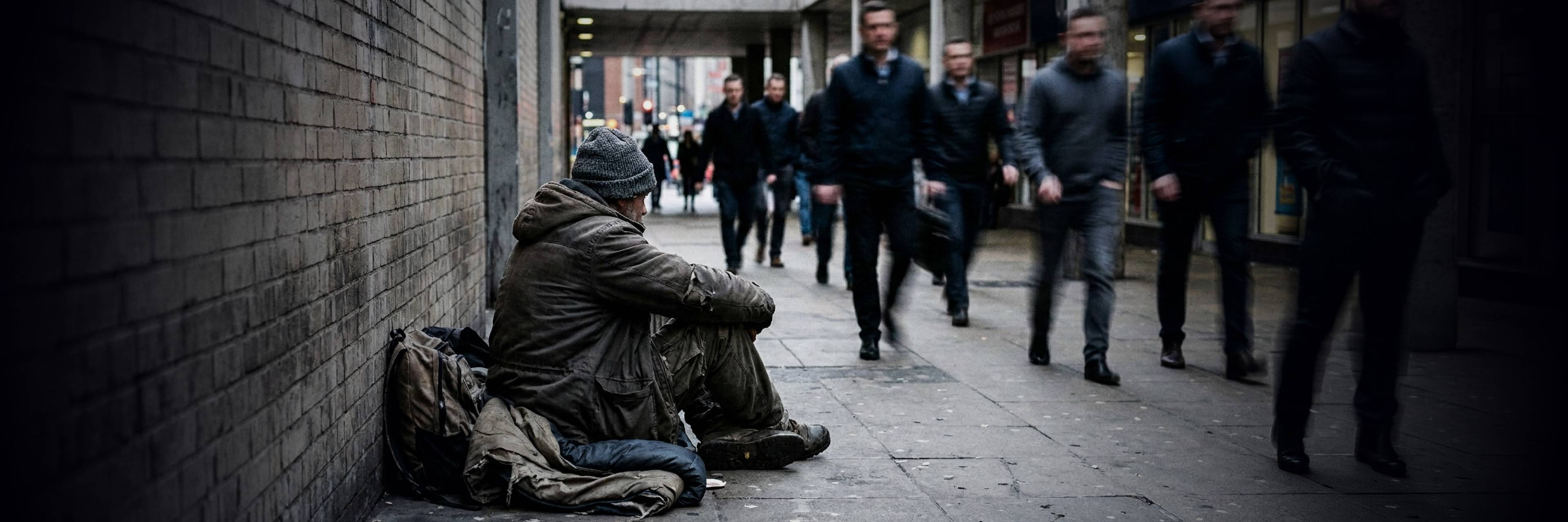
Centuries before modern social psychology gave a name to what is now called the "bystander effect," the Prophet Muhammad ﷺ set forth a moral framework that spoke directly to its dangers. He drew a parable of a group of people who boarded a ship after casting lots, some settling on the upper deck and others on the lower. When those below wished to draw water, they considered boring a hole in the bottom of the ship so as not to trouble those above them. The Prophet ﷺ taught that if those on the upper deck permitted this, all would perish together, but if they restrained the others, all would be saved together. This parable establishes a central truth: harm is never truly isolated to some while sparing others, and silence in the face of destruction is not a neutral stance.
Modern research describes the bystander effect as a well-documented phenomenon in which the presence of a crowd reduces the likelihood that any individual will step forward to help. Rather than increasing safety, the presence of others diffuses responsibility, so that each person assumes another will act. Studies show people are far more likely to help when alone than when part of a group, even when they feel empathy or moral concern. Significantly, this hesitation does not arise from cruelty or indifference, but from uncertainty, conformity, and social pressure that quietly paralyze moral action. Yet while psychology explains why people hesitate, it does not settle the ethical question of whether such silence is acceptable when harm is clearly unfolding. The Prophetic parable of the ship answers this by reframing moral responsibility as collective and unavoidable, and by making clear that the failure of the upper deck, though not active wrongdoing, is still wrongful inaction.
This interventionist ethic is grounded in obligation rather than personal preference. Allah describes the believing community as the best brought forth for humanity precisely because they enjoin what is right and forbid what is wrong, thereby making moral intervention a defining feature of faith. The Prophet ﷺ made this duty even more explicit when he said, "Whoever among you sees an evil, let him change it with his hand. If he is unable, then with his tongue. If he is unable, then with his heart, and that is the weakest of faith." This teaching directly confronts passive bystandership. Rather than presenting a simple choice between action and silence, the Prophet ﷺ outlines a hierarchy of responsibility: physical intervention first, when it is safe and possible; verbal objection when physical action is not feasible; and only when both are genuinely impossible does inward rejection suffice, and even then it is named the weakest expression of faith. In this framing, silent disapproval is not praised but merely tolerated as a last resort. This principle is further reinforced by the Qur'anic command to uphold justice even when it implicates ourselves or those closest to us: "O you who believe, stand firmly for justice, as witnesses for Allah, even if it be against yourselves, or parents, or close relatives."
The findings of psychology add nuance to why intervention often fails unevenly. Bibb Latané and John Darley first identified the bystander effect through controlled experiments, showing that diffusion of responsibility, fear of social judgment, and pluralistic ignorance—where members of a group privately reject a norm yet wrongly assume most others accept it—all suppress intervention. Later research revealed that people are significantly more likely to help those they perceive as belonging to their in-group. A 2021 virtual reality study by Rovira and colleagues found that participants intervened faster and more often when the victim shared their social identity, and hesitated more when the victim was perceived as an outsider, even when the harm was equally severe.
Such dynamics are especially pronounced when harm targets visibly vulnerable groups. In many Western settings, Muslim women who wear hijab are disproportionately subjected to verbal harassment, intimidation, and physical assault, and documented incidents describe them being shoved, spat upon, threatened, or humiliated in public while crowds look on and do nothing. These situations follow the textbook pattern of bystander scenarios: witnesses may feel uncertain, fear escalation, assume authorities will act, or read the silence of others as a sign that action is unnecessary, while social identity dynamics further dampen empathy when the victim is seen as an outsider. From the Prophetic vantage point, this silence is not neutral. The parable of the ship applies directly, for allowing harm to persist because it seems to affect only one person or one group ignores the broader damage to the whole community. To witness such harm and remain passive is to accept a tear in the shared vessel.
Social media introduces a further dimension. Harm is now often witnessed through screens by thousands at once, and videos of harassment or violence can circulate widely before being removed, turning suffering into content. Rather than mobilizing collective action, these platforms often amplify the diffusion of responsibility and reward documentation over intervention. When thousands are watching, individual responsibility feels diluted, and the act of recording may be driven by the pursuit of attention and peer approval. A 2016 investigation by The Huffington Post examined cases in which assaults were filmed and shared rather than stopped, citing psychological experts who noted that peer approval, attention seeking, and the pursuit of online visibility can override empathic responses, particularly among adolescents and young adults for whom peer validation strongly shapes behavior. From the Prophetic perspective, witnessing harm without acting when action is possible is morally consequential, whether the harm unfolds on a street or on a screen.
Research also offers practical strategies to reduce bystander inaction. Responsibility framing, which reminds individuals that they are personally accountable, raises intervention rates and mirrors the Prophetic insistence that responsibility cannot be outsourced to the group. Skills-based training reduces fear and hesitation by equipping people to act safely, aligning with the Islamic emphasis on knowledge as a prerequisite for ethical conduct. Mental rehearsal, too, plays a role, as those who imagine themselves intervening are more likely to act, much as the Qur'an and Sunnah use parables and moral scenarios to cultivate readiness before crisis strikes.
The bystander effect thrives in ambiguity, distance, and collective silence, but the Prophetic framework confronts it with clarity, responsibility, and moral courage. The parable of the ship leaves no room for comfortable neutrality, and the hadith on forbidding evil leaves no room for passive faith. Allah's command to stand firmly for justice as witnesses even against ourselves, our parents, and our relatives removes the final barrier to intervention, calling the believer to act even when it is uncomfortable or costly. Either harm is restrained, or everyone sinks. Faith is not passive, and moral excellence is measured by the willingness to act when the ship begins to take on water, or before its hull is even pierced.