fbpixel
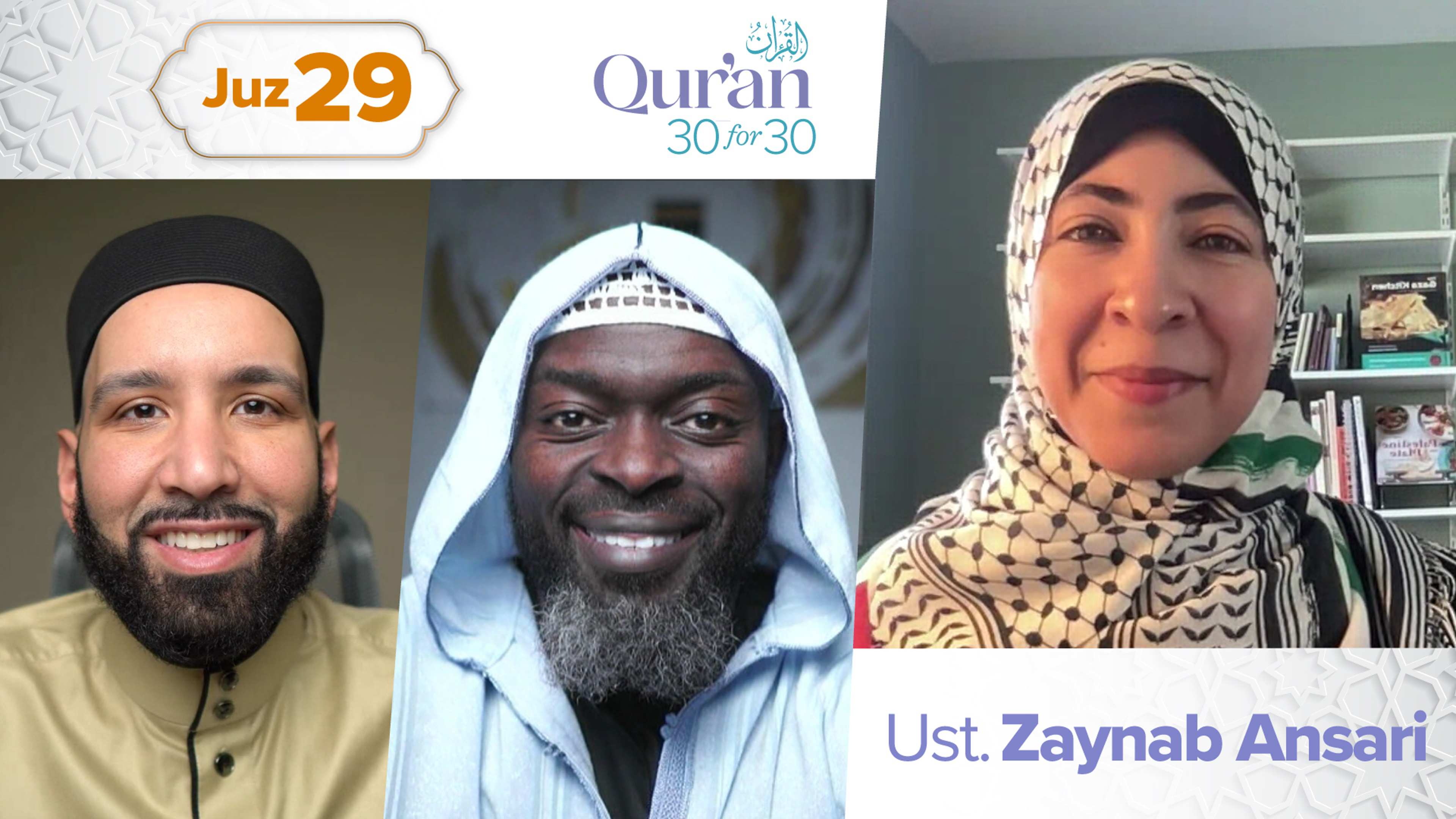
Juz’ 29: Ust. Zaynab Ansari | His Majesty and His Mercy
Trailer | Qur’an 30 for 30 Season 4
Trailer | Qur’an 30 for 30 Season 4

Juz’ 1 with Imam Tom Facchine | Diseases of the Heart, Identity, & the Choices We Make
Juz’ 1 with Imam Tom Facchine | Diseases of the Heart, Identity, & the Choices We Make

Juz 2: Dr. Tesneem Alkiek | Love, Devotion, & Sacrifice
Juz 2: Dr. Tesneem Alkiek | Love, Devotion, & Sacrifice

Juz 3: Dr. Tahir Wyatt | Remembering Resurrection, Maintaining Faith
Juz 3: Dr. Tahir Wyatt | Remembering Resurrection, Maintaining Faith

Juz’ 4 with Sh. Yasir Fahmy | A United and Saved Community
Juz’ 4 with Sh. Yasir Fahmy | A United and Saved Community

Juz’ 5: Ust. Youssra Kandil | Gender Roles & Upholding Justice
Juz’ 5: Ust. Youssra Kandil | Gender Roles & Upholding Justice

Juz’ 6: Sh. Yaser Birjas & Dr. Ahmed Khater | Our Deen is All About Caring For Each Other
Juz’ 6: Sh. Yaser Birjas & Dr. Ahmed Khater | Our Deen is All About Caring For Each Other

Juz’ 7 with Sh. Mohammad Elshinawy | Greatness is Never Forgetting God is Great

Juz’ 7 with Sh. Mohammad Elshinawy | Greatness is Never Forgetting God is Great

Juz’ 8: Dr. Farah Islam | Guidance & Reviving Hearts
Juz’ 8: Dr. Farah Islam | Guidance & Reviving Hearts

Juz’ 9: Sh. Suleiman Hani and Sh. Mustafa Umar | The Believer's Worldview

Juz’ 9: Sh. Suleiman Hani and Sh. Mustafa Umar | The Believer's Worldview

Juz’ 10: Dr. Haifaa Younis | The Connection Between Heart and Ritual

Juz’ 10: Dr. Haifaa Younis | The Connection Between Heart and Ritual

Juz’ 11: Sh. Ibrahim Hindy and Ust. Nuriddeen Knight | Allah’s Promise is True
Juz’ 11: Sh. Ibrahim Hindy and Ust. Nuriddeen Knight | Allah’s Promise is True

Juz’ 12: Sh. Belal Assaad | Grief, Patience, and the Story of Yusuf (as)

Juz’ 12: Sh. Belal Assaad | Grief, Patience, and the Story of Yusuf (as)

Juz’ 13: Ust. Sarah Sultan | False Idols and Emptiness
Juz’ 13: Ust. Sarah Sultan | False Idols and Emptiness

Juz’ 14: Ust. Najwa Awad | The Blessings of the Bee

Juz’ 14: Ust. Najwa Awad | The Blessings of the Bee

Juz’ 15: Dr. Tamara Gray and Sh. Mowlid Ali | The Many Insights of Surah al-Kahf
Juz’ 15: Dr. Tamara Gray and Sh. Mowlid Ali | The Many Insights of Surah al-Kahf

Juz’ 16: Sh. Ismail Kamdar | Alone with Allah
Juz’ 16: Sh. Ismail Kamdar | Alone with Allah

Juz’ 17: Sh. Joe Bradford and Sh. Yousef Wahb | Angels and Messengers
Juz’ 17: Sh. Joe Bradford and Sh. Yousef Wahb | Angels and Messengers

Juz’ 18: Dr. Nazir Khan and Ust. Roohi Tahir | Protecting Your Light

Juz’ 18: Dr. Nazir Khan and Ust. Roohi Tahir | Protecting Your Light

Juz’ 19: Dr. Jinan Yousef and Dr. Omar Husain | Mercy and Regret
Juz’ 19: Dr. Jinan Yousef and Dr. Omar Husain | Mercy and Regret

Juz’ 20: Sh. Yahya Ibrahim and Dr. Jihad Saafir | Musa and Qarun
Juz’ 20: Sh. Yahya Ibrahim and Dr. Jihad Saafir | Musa and Qarun

Juz’ 21: Dr. Hassan Elwan and Dr. Rania Awaad | Wisdom, Leadership and Awareness
Juz’ 21: Dr. Hassan Elwan and Dr. Rania Awaad | Wisdom, Leadership and Awareness

Juz’ 22: Dr. Ovamir Anjum | True Masculinity

Juz’ 22: Dr. Ovamir Anjum | True Masculinity

Juz’ 23: Sh. Furhan Zubairi | Balancing Hope and Fear
Juz’ 23: Sh. Furhan Zubairi | Balancing Hope and Fear

Juz’ 24: Dr. Usaama al-Azami and Sh. Abdirahman Kariye | Don't Just Be Righteous, Be a Rectifier
Juz’ 24: Dr. Usaama al-Azami and Sh. Abdirahman Kariye | Don't Just Be Righteous, Be a Rectifier

Juz’ 25: Ust. Faatimah Knight
Juz’ 25: Ust. Faatimah Knight

Juz’ 26: Mufti Abdul Rahman Waheed and Dr. Zohair Abdul Rahman | Our Afterlife and Our Purpose
Juz’ 26: Mufti Abdul Rahman Waheed and Dr. Zohair Abdul Rahman | Our Afterlife and Our Purpose

Juz’ 27: Ust. Lobna Mulla | Has Not the Time Come for the Hearts to be Humbled?

Juz’ 27: Ust. Lobna Mulla | Has Not the Time Come for the Hearts to be Humbled?

Juz’ 28: Sh. Ammar Alshukry and Dr. Osman Umarji
Juz’ 28: Sh. Ammar Alshukry and Dr. Osman Umarji

Juz’ 29: Ust. Zaynab Ansari | His Majesty and His Mercy
Playing

Juz’ 29: Ust. Zaynab Ansari | His Majesty and His Mercy

Juz’ 30: Sh. Majed Mahmoud and Ust. Dania Tbakhi | Eid Special

Juz’ 30: Sh. Majed Mahmoud and Ust. Dania Tbakhi | Eid Special

Qur'an 30 for 30 | Season 4

Juz’ 29: Ust. Zaynab Ansari | His Majesty and His Mercy

The 29th juz has the most vivid descriptions of the Hereafter. It also contains signs that we should ponder upon to remember our purpose in this world. Ust. Zaynab Ansari joins Dr. Omar Suleiman and Sh. Abdullah to reflect on Allah’s Majesty and His Mercy in revealing this rich Qur’an that helps us ponder upon these signs and keep us steadfast.

0:00 Introduction
6:04 Ust. Zaynab Ansari gives an overview of the juz and reflects on Allah’s Majesty.
14:06 Dr. Omar Suleiman reflects on the signs and warnings in Surah al-Mulk.
23:48 Sh. Abdullah Oduro reflects on how Allah encourages us to use our senses to know our purpose.
33:57 Reflections

Download our FREE eBook “Qur’an 30for30: Judgment Day Edition”.

During the last blessed nights of Ramadan, support Yaqeen’s mission and donate today.

This transcript was auto-generated using AI and may contain misspellings.
00:00 As-salamu alaikum wa rahmatullahi wa barakatuhu. Bismillah walhamdulillahi wa barakatuhu.
00:15 We are now in Juice 29. We want to welcome you all back to Qur'an 30 for 30 and remind you before we get started with the night that as you go into the 29th night, the last odd
00:26 night insha'Allah to please consider insha'Allah ta'ala making a donation to Yaqeen. We hope that you've been benefiting from all of the free content that's been coming out. Alhamdulillah Yaqeen is and always will be free insha'Allah ta'ala and we rely first and foremost on the
00:41 grace of Allah subhana wa ta'ala and then the investment of people that want to see this content insha'Allah ta'ala reaches many people in the world. And so we need you insha'Allah ta'ala to bid the night not just support Yaqeen tonight but support all the wonderful efforts
00:56 that are out there. Allah knows best if we'll ever get another opportunity like this again subhana wa ta'ala. These last 10 have been absolutely beautiful and you know you never
01:07 know which one is going to be your last. So let's take advantage insha'Allah ta'ala, full advantage of tonight bid the night ta'ala and of course we make du'a for our brothers and sisters around the world, our brothers and sisters in Al-Aqsa, our brothers and sisters
01:19 in Sudan, our brothers and sisters in Tunisia, our brothers and sisters in Yemen, all over the world. We ask Allah subhana wa ta'ala to grant them victory and to grant them his aid. Allahumma ameen. And with that insha'Allah ta'ala we have Ustada Zainab with us today.
01:33 Ustada Zainab Ansari masha'Allah the free Palestine stuff is amazing masha'Allah. So you got Palestine all over the room and you know alhamdulillah even the mark of it obviously
01:46 in your hijab. So you were sharing before we got started that your kids put together the room that way. So salamu alaikum wa rahmatullah wa barakatuhu, bismillahirrahmanirrahim, thank
01:58 you so much Sheikh Omar, Sheikh Abdullah for inviting me. So the poster that you actually see is something that my children prepared a while back. We were actually going to a
02:11 march in support of Palestine and you know Palestine has just been on our minds over the last few weeks honestly. So I felt it just really felt especially in Ramadan really
02:22 appropriate you know for us to demonstrate our solidarity. You know as my kids get older they're much more aware of these injustices that are happening and how the Palestinian
02:32 people are just so bravely resisting occupation. So I felt this was really really important to highlight you know in our reflection on you know on the Quran during Ramadan when
02:46 you look at our amazing you know Muslim brothers and sisters in Palestine and how bravely they are there at Al-Aqsa resisting brutality and standing up against oppression and they're
03:01 supplicating Allah subhanahu wa ta'ala and praying and you know we're just so kind of caught up in our lives here in the West with our first world problems and I just felt very strongly that I wanted to kind of share that support and my kids inspired me alhamdulillah.
03:15 SubhanAllah bless you and your family and bless our brothers and sisters at Al-Aqsa. SubhanAllah one of the most touching images of Ramadan I remember after the 27th night
03:28 looking at the images of Al-Aqsa where the people defied the orders to evacuate and you had over a quarter million people in Al-Aqsa that were in air tikaaf on the 27th night
03:38 so well the images the beautiful images of the Haram in Mecca with like two million plus people you know flooding in Salah and then you know the images of Al-Aqsa and the images
03:49 of course of Medina it was like alhamdulillah this ummah is still alive alhamdulillah I mean this ummah still loves its deen and we still have hope in the night there are reasons
03:58 for optimism and of all of the three holy places to see Al-Aqsa that way was was deeply moving alhamdulillah because we we have to insist on these places we have to insist on
04:11 our connection with Allah and of course you know on the other hand subhanAllah you see the oppression you see you know the hardships that a lot of our brothers and sisters are going through and we ask Allah to be with them in their time of need and really want
04:25 to remind everyone you know again tonight on a very serious note subhanAllah make du'a for the ummah when you're making du'a for your own forgiveness when you're making du'a for your own things make du'a for this ummah this ummah needs our du'a right now so keep
04:40 the ummah in your du'a bi-idhnillah ta'ala jazakum allah khayr astagfirullah for reminding us of that today as well thank you sheikh Abdullah sheikh Abdullah how you doing man
04:50 alhamdulillah can't complain alhamdulillah can't complain are you are you dressed today in solidarity with Morocco sheikh yes yes the world cup right now I was actually to
05:06 be honest I was looking for a Sudanese though but I there we go yeah so alhamdulillah he's the one that's like got the whole Sudanese collection he was along with us last night
05:20 yeah exactly I had a number of them that's why I used to wear when I was in Medina but I don't know where they went how's your last ten been going alhamdulillah it's going well
05:32 just time management you know I like to sleep right after tarweeh and then any liven my night you know like the two hours then you know make sure I get the last day of the night
05:46 so inshallah today we're gonna switch the order a bit ustada Zainab actually has prepared the overview of the juz alhamdulillah so we're actually
05:59 going to start with ustada Zainab today bismillah go ahead thank you so much bismillah ar-rahman ar-raheem alhamdulillahi rabbil alameen wa sallallahu ala sayyidina muhammad wa ala alihi wa sahbihi taslima
06:13 again it's such an honor to be here for the amazing Quran 30 for 30 with Yaqeen Institute and I just want to begin by reminding everybody that the arrangement of the mushaf you know
06:27 that we have in front of us is really a result of a few things one is that Jibril alayhi salam visited the Prophet peace be upon him in the last year of his life alayhi salatu wasalam
06:39 and they reviewed the Quran twice so that when the Prophet passed away salallahu alayhi wasalam that the companions had a really good sense of the arrangement of the mushaf
06:50 the arrangement of the surahs the arrangement of the ayahs within the surahs and I want you all to understand that this is something that is you know that really inspires us to be able to read the Quran from a very kind of holistic paradigm or framework
07:04 and I want you to understand that for people that don't understand the Quran they don't appreciate the Quranic narrative they open the Quran sometimes making the mistake of thinking
07:15 that they're going to find a very linear narrative and the Quran is not like that and what you're going to see are very beautiful connections within the surah
07:25 from surah to surah across the ajza all around one theme and that really really emphasizing that theme and that theme is the unicity of Allah subhana ta'ala
07:37 and the finality of the prophecy of Sayyidina Muhammad salallahu alayhi wasalam so when we go through the 29th juz'ah as much as I am reading the 29th juz'ah
07:48 I'm always thinking about the last one juz'ammah so let me say a couple things about that of course we know that juz'ah 29 begins with surah al-mulk
08:00 and inshallah Sh. Omar will speak more directly to that so it begins you know obviously it's called juz'ah tabarak because of that so it starts with the idea of the majesty the sovereignty of Allah subhana ta'ala
08:14 and what I find very intriguing and this is something that is really relevant across the entire Quran whether it is the shorter mufassal surahs that are revealed in Mecca
08:26 that Sayyidina Aisha radiallahu ta'ala anha says really emphasize lessons of Tawheed and the afterlife or whether it is the revelations that come during the Medinan period that are full of legislation
08:38 again subhanallah there really are unifying themes that really kind of help us to understand what is that Quranic paradigm and whether it is emphasizing again resurrection
08:49 during the Meccan period or reminding the Muslims in Medina what is this project of prophetic community what is it about it all goes back to again these themes of la ilaha illallah muhammad rasulallah
09:01 I really really want to emphasize that and to point out that with the Quran it has this really kind of singular quality that if you are coming to the revelation with questions
09:11 and I've had this happen multiple times I know people where this has happened for multiple times if you go to that mushaf with that concern on your mind whatever might be kind of a concern that you have in your heart
09:24 the questions that you have if you sincerely ask Allah subhanahu wa ta'ala for that guidance for that clarity you'll find it across the Quran but in particular in the next to last juz' at the 29th juz'
09:37 as soon as we open the surah we see that Allah subhanahu wa ta'ala is again directing us to his majesty, his sovereignty, his grandeur in particular
09:46 answering really the most profound existential questions that we have about our existence and you know we know there is subhanallah there is a whole sort of
09:58 you know kind of industry and kind of economy if you will of writing and you know there are certain ideas certain philosophies of new atheism and so on
10:10 that really are subhanallah even appealing to people in the Muslim community and you know I always find this you know really quite baffling when I open the mushaf and I see that every single objection
10:24 that somebody could raise about the existence of God about the existence of the afterlife about the purpose of creation
10:34 that Allah subhanahu wa ta'ala answers all of these questions throughout these surahs beginning with tabarakalladhi biyadihil mulk and then concluding with the last surah in the juz'
10:48 so we really can I think we can read the surahs in this particular section with an understanding that Allah subhanahu wa ta'ala is really issuing a call for a paradigm shift
11:01 that you know as we talk about paradigms that Allah subhanahu wa ta'ala is going to tell us what is the truth what constitutes ultimate reality
11:10 how does this quest this search for truth how does it look how does it begin where does it culminate and it really begins always with a divine word
11:21 and it ends with a divine promise and we see these themes all throughout the surahs you know in the 29th juz' one of the things that really struck me as I was looking at the surahs
11:33 I was considering that Allah subhanahu wa ta'ala so of course you know we're going from chapter 67 to the next one al-qalam and look at that again it's not arbitrary this arrangement the naming of the surahs
11:46 as we go to the next surah in this juz' to me it's so intriguing that the surah is named for this implement of writing this implement of knowledge the Quran you know the miracle being that it's given
12:00 to this unlettered people that are not accustomed to having a civilization based upon learning and writing and erudition but here Allah subhanahu wa ta'ala is revealing something so incredibly profound here Bismillah ar-Rahman ar-Rahim
12:14 Noon wa al-qalami wa ma yasturoon noon by the pen and by what they inscribe you are not ma anta bina'mati rabbika bimajnoon you are not om muhammad by the favor of your lord a madman wa inna laka la ajran ghayra mamnoon
12:28 and indeed for you is a reward uninterrupted wa inna laka la ala khuluqin aleem and verily you are of great noble character and you know I was reflecting on the surah and the naming of the surah
12:41 and thinking about the fact that again going back these most existential questions what do we know about the qalam right one of the things that we know is that our prophet said peace and blessings be upon him
12:52 that verily the first to be created by Allah was the pen Allah told it to write so it wrote all that will exist until forever and I just have you know I find this incredibly reassuring
13:06 in that when we open the surahs as we're reading through the message you know as we find ourselves in those moments where we have questions where we are perplexed where we are confused where we are questioning we are where we are kind of looking around
13:19 or you know looking around us and whether it's experiences of loss of sorrow whether it's kind of looking at what is affecting the larger Muslim ummah to know that Allah subhanahu wa ta'ala is aware to know that Allah subhanahu wa ta'ala has written all these things
13:33 to know that nothing falls outside of the bounds of the will of Allah ta'ala to me is incredibly reassuring you know there's so much more I would love to say about this juz'at but I'm really really eager to learn from our scholars here
13:46 so again thank you for having me on Jazakumullahu khairan Astaghfirullah Zainab and inshallah ta'ala I mean we'd love to hear more inshallah ta'ala so hopefully we'll have some time towards the end to discuss some of these further connections
13:59 may Allah bless you for those powerful connections thus far so I actually wanted to talk about the beginning of this juz' in surah al-mulk
14:10 and I want you to approach surah al-mulk to this juz' almost in the same way you approach al-fatihah to the rest of the Quran if you think about juz' 29
14:21 there is a lot of fear about the punishment of the hereafter and there's also a lot of hope in the reward in the hereafter so this is the juz' in which you have surah al-qiyamah this is the juz' in which you have al-haqqa
14:35 right, the reality this is the juz' that talks about the most vivid descriptions of the day of judgment for the people and the start off with surah al-mulk it is an introduction to the entire juz'
14:49 and on top of that surah al-mulk protects you from the bad fate of everything you're going to read in the rest of the juz' so the Prophet ﷺ mentioned that
15:10 the Prophet ﷺ said that there is a surah in the Quran of 30 ayahs that will intercede on behalf of its companion and in one narration it will argue on behalf of its companion until that person is forgiven and it is
15:26 so imagine subhanAllah on the day of judgment when the Prophet ﷺ mentions to us that surah al-mulk comes to you on the day of judgment to argue for you in front of Allah ﷻ until you are forgiven
15:39 so this surah is the protector of all of the bad fate that you find in surah al-qiyamah and surah al-haqqa and other places in this juz' where Allah ﷻ talks about the one who was unprepared
15:53 so you have that and then you also have the punishment of the grave and of course the very famous narration from Allah ﷻ that whoever recites تبارك الذي بأده الملك every night
16:05 منعه الله بها من عذاب القبر Allah ﷻ will protect him thereby from the punishment of the grave and he said at the time of the Prophet ﷺ we used to call this surah al-māni'ah
16:17 the surah that protects so if a person heeds the warning of this surah if a person acts upon the commands of this surah if a person internalizes this surah
16:30 as they approach the rest of this juz' then they can hope for the good outcomes that are mentioned in this juz' and they can also hope for protection from the negative outcomes that are mentioned now subhanAllah just a summary of this again and then you kind of look at the way
16:44 that it really unfolds itself the beginning of surah al-mulk is listen, hear, listen, hear, listen, hear look, observe, look, observe, look, observe
16:58 so it's like it's very clear that Allah ﷻ is talking about the functions of everything around you and Allah ﷻ is saying look at these functions look at the stars in the sky look at the clouds
17:10 look at the creation of the heavens and the earth you know, why are you not able to see the power and the intelligence of this design just using your bare eyes
17:22 and using the gift that Allah ﷻ has given you of your hearing tarji' al-basrah hal tara min futoor I mean do you see anything off do you not understand are you not able to appreciate the way that it all functions in perfect harmony and by the way
17:36 wa laqad zayanna al-samaa al-dunya bima sabeeh wa ja'annaha rojuman al-shayateen subhanAllah the stars that you see in the sky and the things that you see of this galaxy you might just think
17:50 it's a decorative ornament and it's even beautiful just as that but it actually serves a profound purpose there are things that are happening with these things for your dunya that you can't understand and to repel other creations
18:04 and to do what Allah ﷻ commands them to do within the entire scope of His creation that you can't even see that are literally beyond your dimension so it's this constant
18:17 you know, call to you to listen to see, to observe and then Allah ﷻ mentions the entrance of the people who did not heed that into the fire so Allah ﷻ mentions wa lilladhina kafaru bi rabbihim a'dhabu jahannam
18:31 wa bi'sal maseer that those who disbelieve will suffer the punishment of the fire when an evil destination idha ulqoo feeha samee'oo laqad zameeqan wa naboor and then when they're tossed into it they can hear its roaring
18:45 so you couldn't hear Allah's words in this life you couldn't hear the call in this life you couldn't use your hearing to come to an appreciation you know, from this life now you're hearing the roaring of the fire
18:59 may Allah ﷻ protect us wa hiya tafoor takaadu tamayyazu minal ghayth it almost consumes itself in fury kullama ulqee feeha fawjun sa'alahum khazanatuha alam ya'tikum nadeer
19:13 and then every time a group is cast into it the angels say to them well, weren't you told about this? alam ya'tikum nadeer qaloo bala qad ja'ana nadeer fa kathabna wa qulna ma nazalallahu min shay
19:26 in antum illa fee dalalan kabeer and they of course deny they say, I mean they will reply and say yes, the warners did come to us but we denied and we said Allah ﷻ has not revealed anything to us
19:38 in antum illa fee dalalan kabeer and we said to the messengers that you are in pure error and they then say to themselves they're saying, subhanAllah
19:51 you know, reminding themselves that this is what we said to the messengers when they came to us law kunna nasma'u aw na'qeelu ma kunna fee ashaab al-sa'eer if only we would have listened and if only we would have used our intelligence
20:04 we would not have been in this situation that we are in fa a'tarafu bi dhan bihim fa suhqan fee ashaab al-sa'eer and so they confess their sins at that moment and so they find themselves in the residence or amongst the residence of the fire now, look at the next verse
20:18 which is especially profound as we are in these last 10 nights so Allah mentions all of these people who are unable to use wasa'il al-ma'arif the faculties of knowing Allah ﷻ
20:31 law kunna nasma'u aw na'qeelu if only we would have heard if only we would have thought about it then we would have come to the right conclusion but we refused to hear we refused to think about it
20:44 now, we hear it and at the same time so we weren't listening to the message that came through the angel in this life and now you hear the angel themselves speaking to you saying sa'alahum khazanatu
20:58 the angel is saying to you didn't you hear didn't you hear didn't you hear didn't you hear didn't you hear didn't you hear
21:12 didn't you hear you hear you know didn't you think about it now what's what's missing here is the inability to see or Allah subhanahu wa ta'ala talking about couldn't you see because what's next in this ayah inna allatheena yakhshawna rabbahum bilghayb verily those who feared Allah subhanahu wa ta'ala and who were in awe of their lord in the unseen despite not being able to see
21:25 him subhanAllah so the people of ihsan they feared Allah subhanahu wa ta'ala and they had all of Allah subhanahu wa ta'ala love of Allah subhanahu wa ta'ala even though they could not see him and
21:36 Allah azawajal says lahum maghfiratun the forgiveness minal ghafoor from the most forgiving so think about when you say allahumma innaka afoo wa intuhibu al-afoo fa'afoo anni
21:47 oh Allah you are the you are al-afoo you're the one who pardons you love to pardon so pardon me here you have lahum maghfiratun you have the forgiveness from Allah subhanahu wa ta'ala so you don't
21:58 have to worry about the consequences of your sin wa ajrun kabir and you have a great reward which is al-jannah okay so Allah azawajal just spoke to us about people who refuse to listen who refuse
22:10 to think and refuse to use the faculties of getting to know Allah subhanahu wa ta'ala so that they could attain that better place for themselves and now they have punishments and they have
22:23 consequence here Allah subhanahu wa ta'ala is saying for those who used to worship Allah subhanahu wa ta'ala in the unseen despite not being able to see him and of course this has
22:33 two meanings one of them the scholars say that Allah is the greatest of the unseen himself so he is the greatest part of it like you couldn't see Allah yet you still worshiped him as if you
22:43 could see him and in the unseen refers to you yourself being unseen meaning you used to worship Allah subhanahu wa ta'ala in private and call upon him lahum maghfiratun you have his forgiveness
22:56 wa ajrun kabir and you have an amazing reward of al-jannah that awaits you so Allah azawajal is putting you to ease with everything that comes with the rest of this juz it's important for you
23:07 to understand that when you hear those descriptions of jannah when you hear those descriptions of Allah's forgiveness when you hear people have a favorable fate on the day of judgment go back
23:18 to this ayah and ask yourself are you that person because if you are lahum maghfiratun wa ajrun kabir then you'll have the forgiveness of Allah and you'll have an amazing ajr you'll have an amazing
23:30 reward and subhanAllah the most vivid description of Allah's reward is surat al-insan so you want that here is that here's the description of jannah the most beautiful description of jannah comes through surat al-insan and inshallah ta'ala with that i'll go ahead and pass it to shaykh
23:45 abdullah jazakumullahu khair, khairakumullah, bismillah, wassalatu wassalamu ala rasoolillahi wa ala alihi wa sahbihi wa man wala amma ba'd allah make us from the inhabitants of jannah
23:58 those that stay there and reside there forever inshallah by the permission of their lord our lord subhanahu wa ta'ala what i want to talk about primarily is
24:11 how allah subhanahu wa ta'ala as shaykh omar mentioned uh how he you know within the chapter of uh how he tells us to use our senses the senses that he has created for us facilitated
24:23 for us to use in a way that is befitting for our existence and our purpose but taking a backtrack and then seeing subhanAllah that was mentioned earlier regards to even knowing our purpose this
24:34 is a question nowadays you know you find within a lot of men that are falling into the movements of masculinity etc and finding out who they are as a man and what it means to be a man in this society in this era the first tenant that a lot of them speak about is knowing your purpose but
24:48 what is important for the muslim particularly if they're trying to find their purpose which is a fitri aspect it is something that the naturally the human being will sit and ask why am i here
24:59 and what once i find out why i'm here what am i supposed to do about it well the muntalik the the first the armada or the milestone which which used to start at is knowing your purpose your
25:11 existence of why you're here those that may not believe in god but those that may want good for people it is important to know particularly for the muslim if we take from them we have to take
25:22 it with quote unquote a grain of salt why is that because our foundation is based on our belief in god our belief in god entails and requests from us to live accordingly but if there's someone that
25:35 calls people to good whatever good may be for them we as muslims understand that good emanates from what god has told us what is good and what he has told us what is evil so based on that premise
25:46 our purpose is couched in our belief in god in our in our our love of god and many other aspects of worship love fear honor respect trust all of those ultimately are manifested in god in the creator
26:01 of the heavens and the earth this is important in regards to the quranic worldview of the purpose of life which was spoken about earlier what i want to capitalize on is how allah speaks
26:13 particularly at the end of the chapter of uh beginning of the chapter of al-insan and at the end of qiyamah allah speaks about those that were disbelievers and they belied the message and turned
26:27 away allah asks a rhetorical question rhetorical question is a question where you know the answer or it is something that if you dig dug deep inside of yourself and you were truthful there would be a
26:38 level of a level of acknowledgement of that which you've already felt but due to society due to friends family etc the environment it may have altered or may have quote unquote for lack of
26:49 better words adulterated your thinking and your your process of what is moral what is chaste etc allah subhanahu wa'ta'ala says here
27:01 does man think that he will be left alone unquestioned what is beautiful about this word sudha sudha actually comes from uh what is not what is used for the camel the camel that
27:11 wanders aimlessly how many people do we meet in our life when you ask them why are you here i don't know what's your purpose i don't know but for the muslim the one that believes in a god voluntarily
27:23 particularly speaking to our youth as well voluntarily believes in god understands who he is and what he says he is not and the purpose of that when they're asked why why are you here
27:35 they can at least say you know it's to worship god and to do my best in that fashion and he has given me a framework and that is the religion of islam that's the sharia and the sharia is there to nourish my soul the more that i practice and do my best because religiosity is just me doing my
27:50 best so allah subhanahu wa'ta'ala says does mankind think that they were left aimlessly right and this should automatically bring intiba or you know bring the attention to the individual that may have questions about life which is normal then allah subhanahu wa'ta'ala says here
28:10 allah subhanahu wa'ta'ala asked the question again was he not a drop of fluid a fluid was he not a drop of human fluid then he became a clot and then allah made it into a living body and
28:23 proportioned its parts so allah even mentions the periods of gestation or embryology if you will that allah creates us in stages that we know takes place in the womb of the mother but then
28:33 allah says then after they're created you notice how your hands are the same length your legs are the same link generally the majority of human beings are with that particular uh characteristic
28:45 then allah confirms the genders he says here and he has made them a pair zhoj is a pair and what's the pair male and female
28:58 allah asked the question is allah does he then not have the power to bring dead to life allah just gives you a small aspect of his creation and i always want to remember remind us
29:09 that there is the anatomy the creation and the physiology the functionality of that creation created object that anatomy that particular thing whether it's the cell or whether it's
29:20 the hand allah subhanahu wa'ta'ala says isn't he the one that just gave you this example of all these forms of creation and its stages and how it manifests shouldn't he be the one that's
29:30 able to bring the dead back to life so allah subhanahu wa'ta'ala is reminding you of his his lordship his ability which is an introduction for you to show you what ultimately the purpose
29:42 of life should be and it should involve allah subhanahu wa'ta'ala then allah goes on to the next chapter after mentioning the creation in the stages he asked a question again he says
29:59 he asked the question was there a period of time when man was not even worthy of mention now scholars have mentioned here with the man here uh insan particularly scholars mentioned was adam because he is our father he is the first of
30:13 creation that he was not anything that was mentioned at the time scholars mentioned before before the the spirit the soul was was blown into him by the angel by the permission of
30:26 allah subhanahu wa'ta'ala there was no mention of him allah subhanahu wa'ta'ala continues on say
30:36 then allah subhanahu wa'ta'ala mentions the stages again he says verily we created man out of a drop of intermingled fluid so that we may try him so here amshaj is the mixture of the fluid of the
30:48 man and of the woman allah subhanahu wa'ta'ala says after that then after that so that we may try him so he kind of fast forwards and says okay the purpose of the purpose of your creation
31:00 was to be tried by allah subhanahu wa'ta'ala to be tested as allah subhanahu wa'ta'ala says in the chapter of tabarik in the chapter of mulk why the one that has created life and death why to test you
31:17 to see which one of you are best in your actions what's beautiful here is he says to show best to show that there is a range you will make mistakes but there is always ahsan there is no ceilings for the muslim in regards to their efforts to allah subhanahu wa'ta'ala
31:31 there's always an opportunity for you to be better but it will require from you at times to take it back to the basics why was i created wow allah created me from uh the mixture of fluids and then he's proportionally he is fashioning
31:47 khaliq al-bari' al-musawwir allah wants you to think about this because when you think about it you firstly say subhanak i'm not able to do this this is beyond my own imagination this has been mentioned 1400 plus
31:59 years ago discovered much later and there's many more discoveries that have not been that have not happened but it's mentioned in the quran but i want to ponder over that my purpose of life is to show him gratitude to the best of my ability then allah subhanahu wa'ta'ala when he says
32:14 then he mentions we've given him the senses hearing and seeing we will end here allah subhanahu wa'ta'ala says after that surely we showed him the right path
32:28 regardless of whether he chooses to be thankful or unthankful so here allah subhanahu wa'ta'ala is showing we have given him the huda we have shown him the path and we give him the tawfiq
32:40 if he or she reaches out for it because we know there's two types of guidance there's the guidance of showing you the way and there's the guidance of enabling you to go the way so allah subhanahu wa'ta'ala will show you the truth he will show you the how he will show you
32:52 morality he will show you honesty he will show you goodness but are you making the small effort at least the intention because what's so beautiful about islam and in general what's beautiful about
33:04 beautiful about a father a mother a friend is that they appreciate your intention when allah rewards you more than we quote unquote deserve just for our intention so making that intention
33:15 to understand our purpose of our existence and having an oath with allah that allah once i see this inshallah i will do my best to live accordingly allah subhanahu wa'ta'ala says there are people that are like that shakin they show gratitude to them but there are those that
33:31 they close it whether they cover it whether it's denial whether it's whether it's defiance there are people that do not want to live up to that purpose and allah subhanahu wa'ta'ala mentions the abode for the first and he mentions the abode for the latter may allah subhanahu wa'ta'ala make
33:44 us to those that remember his greatness i remember his beautiful names and attributes and that they are consistently shouted upon us and to make us to those that call upon him to further fulfill our ultimate purpose
33:57 you know last night someone in the masjid came up to me and he said that you know i i fell in love with the quran through quran 30 for 30 i didn't really understand the deep connections
34:08 the intricate connections of these things until i started watching quran 30 for 30 on a nightly basis and he was in tahajjud and subhanallah he was saying that it's taught me before before i even get to it just to start thinking about connections uh before i even listen to y'all
34:22 talk about it and and subhanallah that's the beauty of the quran is that nothing is accidental nothing is random may allah accept and may allah subhanahu wa'ta'ala make us people of the quran
34:33 who do tadabbur of his ayat his ayat as in his as ibn al-qayyim rahim allah says we just actually covered this in urdu that the one who contemplates the ayat of allah that are manifest in his
34:45 revelation the ayat of allah that are manifest in his creation will not find themselves in loss i mean you'll you'll constantly be immersed in that so may allah subhanahu wa'ta'ala make us those
34:55 people and they're deeply connected in this in this just the the contemplating allah's revelation the contemplating on his creation so i wanted to firstly ask us that the zainab any other connections
35:06 you have in the jizz that you wanted to elaborate on any uh comments inshallah the final thoughts would love to hear them inshallah bismillah ar-rahman ar-rahim thank you uh shah umar shah abdullah so as you were presenting uh i was
35:20 thinking subhanallah about the the role of the intellect in terms of how we receive the quran in terms of how you respond and you know if you if you recall uh last year and probably the year the year before that one of the things that i really love to do as part of the quran 30 for
35:35 30 is to reflect on the impact of the reception of the quran and those around the prophet and to kind of think about and the reason why i think about this is because you know
35:48 often we get these questions about well why doesn't everybody believe and why is it easy for one person to have faith and the other person is struggling or the other person is a disbeliever
35:59 and i think it's really helpful for us to kind of go back look at the surahs look at how allah
36:07 speaks about human faculties in these surahs and to consider how in the climate of mecca in the environment around the prophet that you had people that had um you know probably
36:22 commonalities in terms of coming from quraish in terms of some of maybe the family kind of biographies and so on but the reception of the quran is is very different for men that are very
36:34 intelligent men so as as sheikh omar was speaking i was thinking about um the ayahs in surat al-qalam where allah subhanahu wa ta'ala reveals to the prophet
36:48 do not obey every worthless um um someone that kind of just kind of makes these kind of empty sort of uh oaths who goes about scorning people with malicious gossip
37:03 a preventer of good transgressing and sinful um and then the the ayahs go on to tell us
37:13 when our verses are recited to him he says legends of the former people so these ayahs are actually al-walid ibn al-mughira and also another thing that i i was thinking about as um
37:26 as as sheikh omar as you spoke um you know you mentioned the ayah and and and and they will say if only we had been listening or reasoning we would not be amongst the companions
37:40 of of the the blaze and then also thinking about sheikh abdullah's presentation in terms of the overall purpose of existence the questions that that we that we should ask and then thinking about surat al-mursalat where allah subhanahu wa ta'ala says
37:54 so uh again trying to put those thoughts together just thinking about again you have two people um al-walid ibn al-mughira and and say you know and endowed with faculties with intelligence
38:07 with um leadership amongst the quraish and just look at how the the vastly different response to you know to the message and what's so interesting is that say you know omar there's a story ascribed
38:18 to him in the musnad of imam ahmed about how he hears the verses from al-haqqa and he becomes receptive towards the prophet peace and blessings be upon him he says uh that he felt that islam had began to settle in his heart at that point and then he then al-walid i was just reading something
38:32 about al-walid ibn al-mughira earlier which i wanted to share and al-walid al-walid ibn al-mughira like he has these moments like these sort of uh kind of flashes of of sort of uh brilliance and
38:44 then they're kind of like overshadowed so um al-walid ibn al-mughira i'm sure you know you you know this story better than me he's the first person who actually when the quraish are gathered
38:54 around to rebuild the kaaba who actually ventures to he can you know to pick up the axe and actually um say okay i'm going to because i think but uh they had i think the section the kaaba
39:06 between i believe it was um the hajar aspen and they actually had that so he goes and he takes his axe and he actually says as he's taking the axe to dismantle that part of the kaaba so they
39:17 can rebuild it he actually says he prays to allah and he actually says which means oh allah we have actually not departed from your religion this is al-walid ibn al-mughira actually saying this
39:29 imagine that right there's like that brief little moment there and then he says is what he says oh allah we do not want except that which is khair so again i want i really
39:41 want to emphasize this point that these two you know these these two men with similarities but vastly different outcomes because the same al-walid ibn al-mughira that's instrumental in rebuilding the kaaba and we know how the story concludes mashallah the prophet comes
39:56 say the al-amin is here let him place the black stone and he resolves that dispute amongst the quraish but the same al-walid who has that moment of we're recognizing allah subhanahu wa ta'ala is the same al-walid ibn al-mughira that these ayahs are revealed about
40:11 because ultimately those faculties that he really that he needs like true sound understanding and intelligence he does not have that right he doesn't have that perception of ablade anymore
40:23 that uh that sheikh ammar spoke about whereas Sayyidina Ammar look at that trajectory right he goes from that hostility to embracing islam so it's really interesting when you think about
40:32 the impact of these ayahs on on uh on the people around the prophet peace and blessings be upon him what profound reflections indeed it it is the acting upon the moment and not just having the
40:47 moment you know and that's what even ramadan differentiates um the repenters from those that will maintain their statement alliances and make us from the repenters
40:58 any final thought just the aspect of you know sometimes you'll find i remember when i became a muslim you'll find people say yeah that's for you you know and you know we're different people different psychology different experiences so islam is good for you but for me due to my
41:12 experiences you know we may have the same faculties but due to our experiences our personality it doesn't fit me but it's just a reassurance that it's universal and it's it's important for us to
41:21 dig deep with humility for joining us tonight with the powerful reflections and as we all go into the 29th
41:35 night please keep us in your dua once again uh last last push to donate inshallah um tonight please join us for we'll have a lot going on tonight inshallah we'll have our late night
41:46 khatam quran so those of you that will be joining on youtube that should go live around i want to say uh around 11 p.m central a little earlier
41:59 hopefully inshallah where we do our khatam quran dua uh so please do join us mr zainab you wanted to share one more thing i'm sorry if i may just share one more thing
42:10 uh so this is back to you know our conversation the beginning around palestine and may allah subhanahu wa ta'ala allow us to see the liberation of palestine during our lifetime you know my my daughter of course we've never been to palestine but she has this dream
42:25 about al-aqsa and and i really want to share this because it's very powerful she's never had a dream like this she sees al-aqsa and she's she sees an angel a massive angel it's in white and
42:36 brilliant and it's there at al-aqsa and throngs of people and she has a very strong in this dream she has a very strong sense of the the angel actually saying that we've become uh distracted
42:48 by the world from what really matters and then in the next part of her dream subhanallah she's actually going to people saying so she's kind of having a dream within the dream and she's
42:58 describing to people what happened seeing al-aqsa the angel the angel sit reminding us we've been distracted from what really matters and she says at that point the people that she tells about the dream are just supplicating as if it's like yoman qiyamah it was really really powerful
43:13 and i just wanted to share that because it just comes out of the blue and she's never had a dream like that and i think just the timing of it with everything we've seen in palestine and the muslims standing there being strong and in the face of just this tyranny and oppression
43:29 you can really see people that truly have this yaqeen that they truly believe in the akhira like you can see the contrast there that that stark contrast between the tyranny and the disbelief
43:43 and the kufr and arrogance embodied by the zionists as they block people from worshiping allah peacefully and the beautiful iman of the palestinians it's just amazing
43:56 and again we're distracted from that because we're just constantly worried about our own sort of situations and kind of chasing our immediate concerns and worldly consumption and i really
44:08 want to emphasize this point to our dear listeners let's make sure to keep our beloved brothers and sisters in our dua that's such a powerful thing right now um i mean that's the best conclusion
44:23 for tonight so our our brothers and sisters in your du'a and also i reward you all for the incredible reminders of and uh shaykh abdullah as always