
fbpixel

10 years of Yaqeen. Help power the next 10.

Donate Now
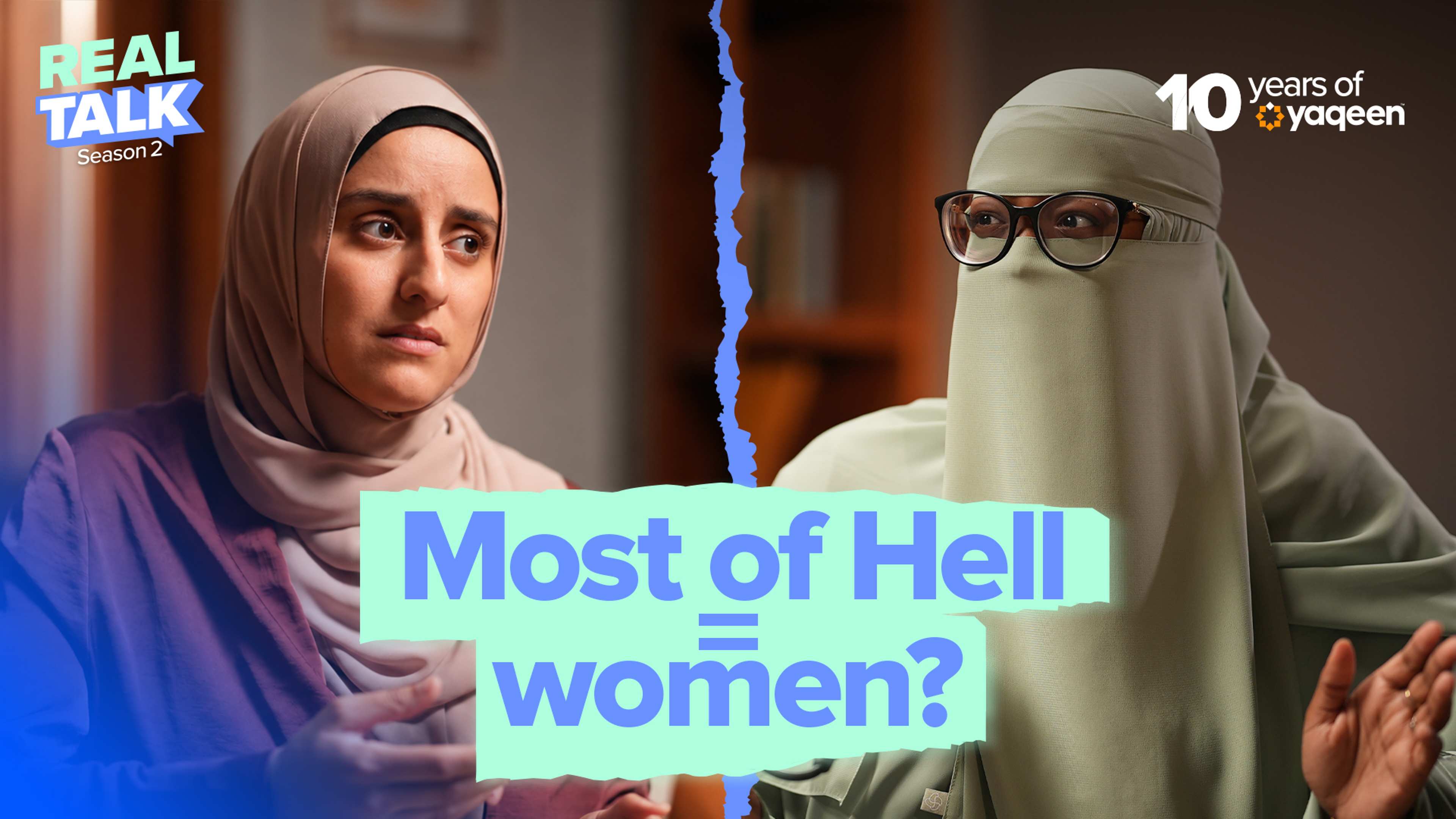
Hell Mostly Made Up of Women? The Hadith Explained | Real Talk | Dr. Tesneem Alkiek

Real Talk Series

Hell Mostly Made Up of Women? The Hadith Explained | Real Talk | Dr. Tesneem Alkiek

Did the Prophet ﷺ describe women as "deficient in intelligence and religion"?

Real Talk weighs in with Yaqeen scholar Dr. Tesneem Alkiek and host Cadar Mohamud, who examine one of the most circulated and least understood hadiths about women: the narration in which the Prophet ﷺ addresses a gathering of women, warns that they will be the most numerous of the inhabitants of Hellfire, and describes them as lacking in ʿaql and deen.

Dr. Alkiek walks through the narration and the setting in which it was delivered and explains why his words were not understood by those present as disparaging toward women.

This transcript was auto-generated using AI and may contain misspellings.
00:00Because if I hear that the majority of us are on hellfire, I'm thinking to myself like, should I bother trying? Prophet's character? And let's talk about context because those are very
00:07important. 85% of stonewallers are men. There were problems clearly in marriages in the community at the time. Women, look, here's your chance to go to Jannah. Women, here's your chance to avoid the
00:20hellfire. Using again that targhib and tarhib, that balance of warning and the balance of hope. It's not something that was exclusively reserved for women. Many scholars said a single woman's
00:31testimony is sufficient. So scholars came back and tried to understand why is it that a woman's testimony is restricted. That women are deficient in deen. And it gives the example that women can't
00:43fast on their menstruation. And this is why I'm confused. Our default assumption is like, not us again. Not us again. Yeah. Someone's misuse of a hadith affects your relationship
00:54with the Prophet, peace be upon him. Sorry. Affect your image of the Prophet, peace be upon him, right? No one doubted a woman. No woman was told, we're not taking your hadith because you're a
01:04woman.
01:23You ready? Let's do it. Dr. Tasneem, there's a hadith that many women talk about, have so many questions. And I'm really excited to dive into this hadith because I think we're able to add some
01:38real perspective to it, insha'Allah. So I'm going to read the hadith out to you. The Messenger of Allah, peace be upon him, went out on the day of Eid to a place of prayer. He passed by the women
01:48and said, oh women, give charity for I have seen that you make up the majority of the people of hell.
01:55They asked, why is that, oh Messenger of Allah? And he replied, because you frequently curse
02:03and are ungrateful to your husbands. I have not seen anyone more who can overcome the resolve of a prudent man more than one of you. A wise woman asked, oh Messenger of Allah, what is
02:18naqs al-'aql and deen? He replied, is not the testimony of a woman equal to half the testimony
02:27of a man? They said, yes. He said, that is naqs in aql? And does she not refrain from praying
02:36and fasting during her menstrual period? They said, yes. And he said, that is naqs in deen.
02:46Now, there's a lot to unpack here. I will say, I feel like there's a lot of things that this hadith says about women, that women have spent a long time trying to negate themselves from. One being,
03:01we're less rational, we're less religious. Oh, and don't forget, most of us make up the people of hell. Yep. Already. And I don't want to, you know, walk past or ignore that, that stings a
03:14little bit, or ignore the fact that a lot of people use this hadith to, I guess, weaponize against women. When you read this hadith, what questions do people ask about it first? Like,
03:29what questions do people ask about it? Jazakum Allah khayran. This is going to be a long one, right? There's a lot to unpack in this hadith. As you mentioned, like, I would categorize it
03:40in three categories. Number one, there's a question of, why are the majority of women in hellfire? Why are, in sort of the same bucket, why are women described as, like, all of them
03:53are cursing and ungrateful to their husbands? It feels like a major stereotype. Second one, why are we deficient in our aql? Right? So, you didn't read out the full translation,
04:06but oftentimes what happens is naqs is translated as deficient, and aql is translated as intellect. So, the assumption is that you're lacking intellect. Why, and in the same bucket,
04:18why is the testimony of a man worth more than a testimony of a woman? Third bucket, why are we deficient in religion, in deen, and aren't we just obeying God's command by
04:33doing what he told us not to do, fasting and praying when we're on our periods? So, I think those are the three major categories, and obviously those are really big categories, and each one could
04:43take its own episode. But before we get into any one in specific, let's look at the prophet's character, and let's look at the context of what's happening here. You know what, even before I get
04:57into that, because I think that, like, just to target the pain point right away, look, anyone can cherry pick anything. Anyone can use a hadith for whatever agenda they have. It's difficult,
05:09but we have to put aside any negative experiences we might have had with the hadith, especially for any woman who was told she can't do something, or she did something wrong because there's something
05:19inherently wrong with her, or that she was, like, constantly berated as, no surprise, this is why you make up the most of hellfire. Like, all the different ways that women might have encountered
05:31this hadith, it's really, really difficult, but having to put those aside and recognizing, again, anyone can take a hadith, anyone can take an ayah and abuse it. Our job here today is, let's try to
05:42understand this objectively as much as we can, and really try to appreciate what the prophet, peace be upon him, might have been trying to tell us. That's our starting point. Okay, so let's get
05:53into it. The prophet's character. This is what I get, this is what I think is so fascinating, because the prophet, peace be upon him, in this hadith feels like he's singling out women.
06:04Sounds like it. Right? Yeah. What if I told you he was trying to do the opposite? Perhaps he was trying to do the opposite, right? Because it's fascinating. She comes back and she's recollecting,
06:15like, recalling the prophet in, obviously, a positive manner, and she was pointing out, like, look, when the prophet, peace be upon him, used to talk to people, when he heard there was
06:26something happening with one, two, or three people, instead of saying, hey, you, and you, and you, what do you think you're doing? It was his prophetic character to say, like,
06:36to talk about people widely, like, ma baal aqwam, right? What's up with this group of people? They're divorcing their wives, they're taking them back, they're divorcing their wives, they're
06:46taking them back. Don't do that, right? Because word gets to him that there's not just one man, two, three men, whatever the number is, that is doing it, and rather than pointing them out and
06:58essentially humiliating these people, he comes back and he talks in a way that seems to be talking about all men, but that's not the case. That's a really important, like, reset, yeah,
07:11and a distinction. Allah subhanahu wa ta'ala does the same thing in the Qur'an, by the way, right? Allah subhanahu wa ta'ala says all of mankind is jahool, is ignorant, right? The Prophet ﷺ included, are the other prophets, are the greatest of people, are those who have
07:26knowledge and wisdom who Allah subhanahu wa ta'ala praises in other areas included, right? Allah subhanahu wa ta'ala, the Prophet, peace be upon him, have certain ways of speaking,
07:35and a lot of times that includes sighat al-mubalaghah, this idea of, like, your hyperbolic speaking, right? And so, like, you'll see ayats in the Qur'an condemning, for example, groups of the
07:48Israelites, or groups at large, and then later on you'll see another ayah, laysu sawa', they're not all the same, right? So there's something rhetorical in this that we can appreciate,
07:59that the Prophet, peace be upon him, when he does this, he's talking to a group of people, often it's because he's not singling anyone out and making, like, making anyone feel like
08:11they're being sort of put front center stage and being called out. That's something I can appreciate, that's something I can respect, and that's the lens I want to approach when we talk about this hadith for a second. What if the Prophet, peace be upon him, was doing that as a
08:26reminder not to single people out? Now you're like, huh, that's kind of beautiful, right? So that's character, now context. Context is that what a lot of people miss is that this is happening on the
08:39day of Eid. The Prophet, peace be upon him, is incredible, 360 days of the year, right? On the day of Eid, the Prophet, peace be upon him, was known to be even more joyous, right? So that's important, because
08:52if you know anything about the Prophet, peace be upon him, he's likely not going to be acting in a way that would make people feel down on the day of Eid. It never makes people feel down on any other day, so why would now Eid be some sort of exception? And you know how we know that that's
09:06not the case, that the Prophet, peace be upon him, was not trying to, you know, to berate these women? Look at how the women respond to this hadith, right? You have one explicit
09:20narration where you have Zaynab, may Allah be pleased with her, a female companion. The Prophet starting off is saying, give in charity. What does she do? She hears and she's like, I got this. The women
09:32there, some are rushing home to get their jewelry, some are stripping it right off their hands and donating it. One narration that is said to be a part of the same story is Bilal, may Allah be pleased with him,
09:43he's lifting his shirt and all the women are throwing their jewelry to give in charity. Look, if you felt berated, if you felt humiliated or like what in the world just happened, because
09:53that's how we feel when we hear the hadith, then I would shut down. I would feel a certain way, I would act a certain way, but the people, the women that were with the Prophet,
10:05peace be upon him, understood it completely different because they knew his character, they knew the context and they knew what the Prophet, peace be upon him, was trying to do and they responded with that positivity, with that motivation. That's not a group of people who feel
10:18like, yeah, they've been taken down. That's important to the conversation. I think that's precisely the problem that a lot of sisters are, I guess, struggling with when they read this hadith is that it sounds like stereotypes are being mentioned and so the question that naturally
10:33comes up is like, especially when the part where it says the people of hell are made up of women, is that hadith also saying that women are inherently, these are inherent traits about us, that we are less rational, that we are less religious and that we have a lot of characteristics
10:47that would make us the majority? Is that what the hadith is actually telling us? So let's go back to the three buckets, right? So that first bucket was, are the majority of women hellfire? Yeah. The second was, does that imply something inherently
11:02wrong with you, right? Because if I hear that the majority of us are in hellfire, I'm thinking to myself like, should I bother trying at this point? The odds are already stacked against me,
11:12right? That's what it feels like. So let's practice that, what I suggested earlier on. Let's look at prophet's character and let's talk about context because those are very important.
11:23Look, the prophet, peace be upon him, was the most socially, emotionally intelligent person, right? When he spoke to people, he did it in a way that was the most empowering to those people
11:34at that time. And so, in fact, he was famous because he was known, one companion would come up to him, ask him for advice, and he'd give him a very specific advice. Another companion would come up and he'd give him a totally different advice. And what's incredible, I think, is that the
11:48prophet, peace be upon him, also knew his people so well that often when people would talk to him or when he would assign responsibilities, he would think about their traits,
12:00how can I uplift this person so they're better with whatever they're struggling with, and how can I use whatever positive things they have to make them even stronger in that regard,
12:09right? And so you have him, you know, Muadh ibn Jabal, for example, he's really good at da'wah, he's really good at calling people to Islam. I love that in you, yeah, Muadh, you're responsible now for going to Yemen. You are going to be the people who is going to call the people to Yemen.
12:25Time and time again, he sees a trait in a person, really pipes them up, right? I see that in you, let's take advantage of you, right? So he has that awareness. And so sometimes, you know,
12:37a companion will ask for advice, he's like, you need to step up your game, you gotta pray a lot more, right? The companion's like, I got this. And some companions say, come up to him, he's like, look, take it easy, just do what you gotta do, fara'at, right? I say this to say because
12:51the Prophet ﷺ understood this. So a lot of times he'll come to men and women, men or women, again, different types of groups, mixed groups, whatever the case is. He'll sometimes encourage
13:05us to do something that gives us motivation, gives us that hope. And then sometimes he's gonna come and he's gonna warn us of the hellfire. He's gonna warn us of something we're doing wrong,
13:14and incite that fear that we should have of doing wrongdoing, right? And so that's important, like we need to appreciate the fact that the Prophet ﷺ had that balance. Because if you
13:26have a little too much hope, you lose sight of the fear of the punishment, you have too much fear of God, then you lose sight of the hope, right? So it's this constant balancing act. So in this
13:38case, can we say that the Prophet ﷺ was using something to warn, to incite that fear of the God consciousness? Perhaps, right? Is there something inherently wrong with it? Absolutely
13:48not, right? So that's character. Now, let's go back to context for a second. Okay, but before I get into prophetic context, I want to share something interesting. So there's a famous
13:59research institute known as the Gottman Institute. Have you heard of them? Yes. Okay. So Gottman Institute is very popular in the United States. I know they have a global presence at this point.
14:11And they do essentially lots of marital counseling, they do pre, post, kid, divorce, all of that. And they also have a research institute. They run stats on marriages and divorce and stuff like that.
14:23And there's one area that I thought was really interesting. He comes back and says, look, this is based on the studies we've run. There are four different types of behavior that almost always
14:38often predict divorce. Meaning if you're constantly engaging in this behavior, like this is like a predictor of divorce, right? So one of them is going to be criticism, you're constantly
14:48criticizing your spouse. The other one is contempt. You sort of like ridicule, mockery, sarcasm. Another one is defensiveness. Fourth one is stonewalling, where essentially you check out
14:59of the conversation. You're no longer emotionally present. You're no longer engaging. You kind of
15:08like, I'm out, right? That's stonewalling. He comes back and, based on his study, says
15:1785% of stonewallers are men. So basically, in all of the couples he's studying, most of the time,
15:28it's men who engage in stonewalling of the four. And I think to myself, does that surprise you? No, it doesn't. Maybe you think of a brother. Maybe you think of a family member. Maybe you
15:41think of just a guy you know. Oh yeah, guys do that a lot. Is stonewalling a good thing? No. And I want to use this example. I want to use it to sort of add a little more context to what
15:52the Prophet ﷺ might have been doing. Because when you hear a statistic like that, majority of men do this negative characteristic in marriage. I don't think we think of it as like
16:05an inherently negative thing that all men do it, or women don't do it, or it's like a statistic.
16:13Right? And so to me, that is a researcher who's trying to resolve marital problems, pointing out a tendency, and pointing out a pattern. And we can clearly say like, okay, a lot of men do this.
16:27Some women do it. Whatever. Let's keep it pushing. I want to argue for us to think about how the Prophet ﷺ might have been functioning in a similar way.
16:42So in this context, the Prophet ﷺ notices a pattern. Not amongst all women. We don't know how many women, but he may have observed it. One, two, three women, whatever
16:56that number is. And now instead of condemning it, calling anyone out specifically, "you, by name, stop doing this," he's going to be speaking to the women generally. And now he's saying something
17:08about the women in order to help their marriages. Is that a way we can potentially think of this hadith? Possibly, because I think it really makes, to me, a lot of sense. Because
17:22even at the time of the Prophet ﷺ, like the Muslims migrate from Mecca to Medina, right? And at one point, 'Umar ibn al-Khattab is speaking to his wife, and she essentially
17:34talks right back to him. And he's shocked because the women of Mecca, they were famous for, you don't, you keep your mouth shut, you don't say anything to your husband, right? That was their
17:44culture, okay? He's like, excuse me? Are you talking back to me? Like what, what's going on here? And she's like, oh, well, the wives of the Prophet ﷺ speak back to him
17:57all the time. And some of them even give him the silent treatment all day long. Like these are the wives of the Prophet ﷺ, they're doing that to the, like the greatest human being to walk this earth, right? Yeah. And 'Umar is like, what?
18:12And his daughter's married to the Prophet ﷺ.
18:15He's outraged, right? Like, how could you guys do this? He eventually goes to the Prophet ﷺ and speaks to him, and he says, "Ya Rasulullah, back in Mecca, our women never spoke back to us. They wouldn't dare, that wasn't tolerated. That was our relationship with our women. But now that we've moved to Medina, and these Medinan women, they talk back to their husbands, they have that type of relationship, and now our women, our Meccan women, are getting
18:45influenced by the Medinan women." And so he's complaining, "Ya Rasulullah," this is a problem, is what he's insinuating, right? Yeah. And so the Prophet ﷺ, you know, it's kind of fun, like this is the guessing game. You would think the Prophet ﷺ would have been like, "You're right. These women need to get their act together. They shouldn't be talking back to their husbands, because that's the Islam I was taught," right? And the way the Prophet ﷺ responds is brilliant. He smiles and he makes du'a for 'Umar. You know what he doesn't do?
19:15He doesn't say one is right and one is wrong. And this sort of signals the fact that there is diversity in terms of that type of relationship, right?
19:26But what I like, what I find interesting about the story is that essentially, there were problems, clearly, in marriages in the community at the time.
19:36And that perhaps, again, if we sort of connect the puzzle pieces, men are coming to the Prophet ﷺ, just like we have story after story of women coming to the Prophet ﷺ complaining of their husbands, perhaps men were also doing the same thing,
19:49based on the context that we have in terms of what we know is happening with the marital problems. They're coming to the Prophet ﷺ, and now they're saying, look, my wife is doing X, Y, Z. Is it all women? We'll never know. Is it only a few women? We'll never know.
20:02But we know from the context and the character of the Prophet ﷺ that that was how he spoke to people, where he didn't call them out.
20:11And so now, perhaps, just like the Prophet ﷺ is noticing a trend that at the time might have been more prevalent for the women,
20:20does that mean necessarily that he's saying for the rest of time, this is what women are like, or women are inherently ungrateful or curse a lot? Not necessarily, right? So it sort of shifts the perspective.
20:36So I think we can appreciate that there's something larger at play here, right?
20:42And especially because we know from how the companions, the female companions, are reacting to the Prophet's ﷺ words. But just one more thing here, because I think it's worth appreciating.
20:54What exactly is the Prophet ﷺ coming and saying to these women? And the order is so important. The first thing he says, this is the day of Eid, right? Like, again, assume that everyone is happy.
21:06Assume everyone's taking him seriously and in a loving and caring manner. That has to be our default, right? And now the Prophet ﷺ comes. The first thing he says: give in charity.
21:17I find that incredible because before he even mentions anything about the hellfire, before he mentions anything about their shortcomings, he's giving them a solution. He's coming and saying, look, I'm not, like, think of how different it would be if I said,
21:31"Adar, you're just, you've always got this problem, man. Like, you can't ever fix it." Versus, "Adar, do this and your life will change." Yes. Keep this in mind and everything shifts. It's more motivating.
21:45It's so motivating. It's starting off with like an accessible, easy solution. Yeah. Every single one of you in this gathering can do it. You, everyone, it's accessible. There's something you can do about this. There's something you can change about it.
21:58Right away, that activates the women there. You're right. There's something I can do about it. And now he's moving on to pointing out what the problem is. After we've identified a solution, so there's something we can do about it.
22:11So the first thing he does, ﷺ, is identify a solution. The second thing, now he's naming the problem. What is it? Cursing and ingratitude.
22:23Now, I think we can agree that everyone knows cursing and ingratitude are bad traits. I think what makes us uncomfortable is that it's almost as if he's attributing them to women only. Yeah. "You women only do this."
22:37That's how it's read to us, right? Yeah. That it's almost something that, like, it's the buzzword, essentializing, right?
22:46It's essentialistic, or essentialism, to come back and say women as a gendered category are affiliated with this particular behavior. And I think that's the point of discomfort for many of us. Yeah. You see, that's where I think the tension is, right?
23:00The idea that Muslim women have certain traits and that means that that's essentially why they make up the inhabitants of the hellfire. And that's the part I really want to talk about because I'm like, that's the part that people get stuck on. Yeah. Yeah.
23:14Look, I think this is obviously a discomfort that I had immediately felt based on how the hadith was used, right? Almost in a way that was berating, right? Yeah.
23:26And I think it's a matter of really reorienting this perspective because, look, there's no evidence to come back and tell anyone that the Prophet ﷺ is now saying, biologically, you women are wired to be like this.
23:39There's no evidence to indicate that that would be the case, that all women are inherently going to be like this.
23:45And I think it's interesting, too, because if you reframe it with this concept of the Prophet ﷺ giving marital advice, right?
23:56And just like I heard the Gottman statistic of a lot more men stonewall than women, and the Prophet ﷺ is now saying even something remotely similar, it wouldn't trigger that reaction.
24:09Because now the Prophet ﷺ is saying, okay, women, multiple women, I don't know what that percentage of women is, even if we wanted to entertain the idea of 80, 85 percent. Let's do that for a second. Yeah. Does that mean men don't do it?
24:22Does it mean all women do it? Does it mean it's inherently a part of every man to stonewall or every woman to be ungrateful? No. Right?
24:31But so now if I'm coming back and reframing it as like, hey, I see this trend in a certain group of women in the city. I'm just trying to remind you guys, by the way, not something we should do. Yeah. You could do something about it.
24:45Easy change. Easy fix. Be wary of it. But at the same time, not like, "Oh, well, you just don't like that, FYI." Right.
24:55The tone, the perspective, the framing totally shifts what the Prophet ﷺ was saying once you have that.
25:05But again, it's so hard to have that shift in perspective when, again, we heard that hadith in that light. Right. So I think that's the challenge. Right.
25:15And I think to me, it's an invitation to think differently about how the Prophet ﷺ, again, was coming off. And there's no better way to understand it than the women around the Prophet ﷺ understanding. Right.
25:29Motivated. Accessible solution. We got this. Let's do it. That's the attitude. Right. Yeah. And I think what's fascinating is the third thing. So we said, one, he gives a solution; two, now we're talking about what's the concern at hand.
25:42Two, he's technically praising the women. Right. Because what does he come back and say, ﷺ, "I have not seen essentially a man who has resolve, like a man who stands his ground."
25:56A prudent man. A prudent man. Right. You can influence him, even the most prudent and most resolute of men. You women, you have that power.
26:06You have an emotional, social intelligence to be able to affect these men. Right. So be careful with it, obviously, if you're doing it in a way that is not good.
26:16But it's kind of like, that's the brilliance of the Prophet ﷺ. Like, I could only imagine the process, and I'm saying that with a smile. Right. Be careful. This is not like, oh, by the way, we're just going to end it with praise.
26:30No, no, no. You have this. You have that intelligence. So use it wisely. Right. And so now, again, if you have that understanding of who the Prophet, peace be upon him, was, and now you're thinking of it from this perspective. Now, now you can see it.
26:44It's the day of Eid. The women are motivated. They're smiling. The Prophet is smiling, peace be upon him. The whole scene changes. Yeah. The whole scene changes. Right. Can I also say that their understanding of the Prophet, peace be upon him, was that people
26:58come to him all the time with their problems. He has the perfect POV of what is happening with the community, with the women. He knows what everyone's struggling with. He knows it deeply.
27:10And so if he says, peace be upon him, says, oh, this is the pattern, then they trust him because he knows. They come to him all the time. Yeah. So there's also this trust. Right. I think some of us are reading this with this like, what's that supposed to mean?
27:24But they're reacting with trust. I trust what he says because he knows. He knows. Yeah. It's kind of like what you were saying with the Gottman article. It's like you see patterns. You trust that statistic because you know the work was there and you know they know. But they're not coming at you with this accusation of this is who you are inherently.
27:38So that doesn't even come up. It's just like, this is just facts. Yeah. Yeah. And I love how he said the Prophet gave solutions. Right. Because he's not leaving you and saying, oh, this is who you are. Yeah. Here are some ways to help you with that. Yeah. I think that really does change my perspective.
27:59But I have to say, Dr. Seem, you haven't answered the difficult question. It's the part where it says there are more women in hellfire. Like, what does that mean? Because this is hellfire we're talking about. We're not talking about something that's, this is hellfire.
28:13Yeah. Yeah. Look, okay. That's a big one. Are there more women in hellfire? Right. Are they? The problem with if the answer is yes, is that, well, I guess it doesn't really matter if the answer is yes.
28:26The assumption that comes with a statement like, are there more women in hellfire? Is that, that means, that must mean there are more men in heaven. That's what you assume. Yeah. That's what you assume, right? Yeah. Yeah.
28:40So now if you're like, okay, there's more, based on assumption, there's more men in heaven. Yeah. There's more of us in hell. Like, okay, I'm just statistically doomed at that point. Yeah. Okay. What's the point of doing anything? You know what's fascinating? Scholars, as early as time, the companions, they were debating this, right?
28:54Like, does this give us any evidence that there are more women in heaven or less women in heaven? And like, this was up for scholarly debate. And some scholars said, well, we have other evidence that would indicate there are actually
29:07more women or there will eventually be more women in heaven. And just to give an example, you have the Hadith of the Prophet, peace be upon him, who's foretelling the signs, like he's talking about the signs of the Day of Judgment.
29:19It's like a time is going to come when for every 50 women, there'll only be one male to care for them. So, they look at a Hadith like that and say, hmm, perhaps women will just outnumber men in general. Right.
29:32So even if you have more women in hell, you can still have more women in heaven. They're not mutually exclusive. And many scholars came back and said this, like, okay, that's fine. There can also be more women in heaven.
29:44So then the question is like, well, why would the Prophet have even said that? And that goes back to that emotional intelligence. That sometimes he's going to say, women, look, here's your chance to go to Jannah. Women, here's your chance to avoid the Hellfire.
29:57It's a matter of choice. Context will indicate what's best. The Prophet we know from other examples knew what was best. And we can trust that that decision to speak to women like that was effective. And guess what? We know it was because of how they reacted.
30:11And look, I want to point something else out, which is the idea that this Hadith feels very intense. I want to just talk about that discomfort for a second here.
30:25Because we don't share that same alarm for other Hadith where the Prophet, peace be upon him, is talking about like men, for example, or even just Muslims in general.
30:37There's one Hadith, and it's a really terrifying Hadith, where the Prophet, peace be upon him, is talking about what happens on the Day of Judgment. And the very first three described in the Hadith as rajul, right? Three men who are going to be thrown into the Hellfire are who?
30:51A shaheed, a martyr, someone who died in jihad. The qari, the one who studied and recited the Qur'an, and the scholar described as one.
31:04And the third person is the wealthy donor, right? Someone who had money and spent it in charity. On the Day of Judgment, Allah subhanahu wa ta'ala asks every single one of them, what did you do?
31:16And the one who dies in jihad, the man who dies in jihad. Ya Allah, I did jihad for your sake. Allah subhanahu wa ta'ala says, no, no, no. You didn't do it, you lied. You didn't do it for my sake.
31:29You did it so people could call you brave. And you got what you asked for. And the Hadith says he's dragged on his face to the fire. One by one, the qari, the scholar, why did you do it? For your sake.
31:42No, you lied. You did it because you wanted people to say, wow, amazing, so smart, all of this. Same thing for the one who donated. You didn't donate for my sake. And they're described as being dragged to Hellfire, right? So the same scary language.
31:56It's that language. Look, at times, the Prophet is talking to different groups for different reasons, for different incentives. And in this case, he's talking to these men. You better watch out because guess what?
32:10In one situation, he can say there's more women in Hellfire. And another situation, he's going to say, you men are the first in Hellfire. Yeah, okay. Does that now make a man think, "Man, my chances are higher," or whatever the case is?
32:23Or I shouldn't do jihad because my chances are high. No, you don't think like that. So we have to be consistent in terms of how we understand the Prophet, peace be upon him,
32:34using, again, that balance of warning and the balance of hope. It's not something that was exclusively reserved for women. He had that emotional intelligence to be able to do it at the right time, at the right place.
32:47You see, I've never been good in numbers, but I will say I'm good with that understanding of the idea that there are more women. And so now, too, that makes sense. There'll be more of us occupying that space. Jahannam, subhanAllah. And Allah protects us from that.
32:59I mean, like the next part of the hadith that I find particularly kind of difficult to understand is the deficiency in intellect.
33:06And I say that because in today's day, we have CEOs, we have professors, we have women who are just incredibly intelligent. We have female scholars. You know what I'm saying?
33:16Like that's just not a reality I know of women being deficient. So when the person was saying, you know, women are deficient in intellect, what exactly was he saying?
33:32I can tell you pretty confidently what the Prophet, peace be upon him, was not trying to say. And I have good evidence to make my case. He wasn't saying that women are not as smart as men or simply not smart or any of that language.
33:46To assume that your raw intelligence, whatever we want to use to translate that, that there's something wrong with you, like your intellect, in a categorical sense. Because a lot of times you hear this and you think, like, I guess I'm just not as smart.
34:00Maybe that's why there's more men in STEM. I hear that a lot. And I'm like, what? Because, number one, I mean, let's make the case. Number one, it's incredible.
34:11The woman in the Hadith, there's a woman who asked him, can you clarify what you mean by that? She's described as Imra'a Jazla. What does Jazla mean? Scholars say, dhu 'aqlin wadhu ra'yin.
34:25Literally, a woman who has 'aql and who has ra'y is like this, like a rational opinion, rational thought.
34:33So the Prophet, peace be upon him, is saying, OK, there's naqs in a woman's 'aql in the very same Hadith that a woman is described as having 'aql. So what does this tell us? Well, 'aql can have different meanings.
34:46So now we need to look at the evidence. What exactly, what kind of 'aql is the Prophet, peace be upon him, referring to?
34:52And it's the same way that in English we think about spatial intelligence versus emotional versus personal, interpersonal. Like there are so many different ways you can describe what intelligence is.
35:06That's what's happening, sort of what's happening here in the Arabic language. And so 'aql can mean discernment. It can mean perception. It can mean intellect. It can mean blood money.
35:19So the famous Hadith that you might have heard, the one, tie your camel and then trust in Allah subhanahu wa ta'ala. What is the Arabic? A'qilha, from the same root letters as 'aqala, a'qilha wa tawakkal.
35:32What does a'qilha mean? To tie your camel, to restrain your camel, to make sure it's not wandering off. So 'aql can mean a lot of things. So now our job here is to figure out which one was he referring to?
35:46And look, the reason why I can confidently say it's not like literally intelligence, the way we understand intelligence, is because scholars actually talked about in detail people who have intelligence and people who don't.
36:00Right. And guess what? Women were not in the category of not intelligent. Right. And they had these debates in the realm of law because now you have the concept of ahliyat al-wujud, ahliyat al-ada.
36:11Who's responsible for fulfilling religious obligations? Who's responsible in business transactions? Et cetera, et cetera. Scholars had to come back and debate like, do you have intellect or not?
36:24Because if you don't have intellect, like a prepubescent child or someone who's insane, meaning mentally incapacitated. They were actually described as people who don't have intellect and women were never part of that category.
36:38So even scholars themselves, like this is not again, not some modern like framing. Scholars themselves never said, oh, women don't just, they don't have brains in their heads. No, because think about the logic there.
36:48If I came back and said, I'm going to group you with those without intellects. Yeah.
37:02If I thought, if I actually thought you just weren't smart, you're off the hook because guess what?
37:09Children don't have the same punishments for committing a crime because they're considered to be deficient in intellect as smartness. Yeah. If a child, there's a whole debate, right? Like if someone who's mentally, let's look at someone who's mentally ill.
37:23If they go and engage in a transaction. Right. Then there's a whole debate. Like, do you even take this transaction seriously? Is it void from the beginning? Right. Scholars had to have these conversations because these had real world effects.
37:36And if I thought you were actually not smart, I can't punish you. You can't engage, engage in business transactions. You can't do a lot of things because you don't have the capability. You don't have the capability. Scholars never said that. They never thought that way.
37:50Right. And so, like, again, this is sort of the evidence that we have to come back and like, wait, this is talking about a specific act. Right. Yeah. And I think one of the most powerful evidences. Right.
38:04If not the most powerful is the very fact that women were narrators of Hadith. OK. What does it mean to be a narrator of the Hadith? Well, let's talk about the role of Hadith first.
38:17We know most of our religion. We know all of our religion through the Qur'an and Sunnah. But so much of that clarification, so much of the details of the religion come through Hadith.
38:30How did the Prophet, peace be upon him, explain the Ayah? What were the reasons for the Ayah to be revealed? What does that mean in terms of how we practice it? The way you pray, how much Sadaqah you give, how much Zakah you give.
38:41All of these details, a good chunk of your life, you know through Hadith. And how they understood it. How you understood it, right? And now if I come back to tell you there were thousands of women who narrated Hadith.
38:54What does it take to narrate Hadith? Look, there's a whole science behind it. I'm going to assess your reliability. I'm going to assess your uprightness. You better believe I'm looking for your accuracy and your memory. You're not that smart.
39:08I'm not going to trust you to narrate the words of the Prophet of God, peace be upon him. The same words that are going to be used to tell you how to pray and live your life, I'm going to trust a woman? She's not smart. Of course not. That's never how it was taken, right?
39:22Take Aisha, how many thousands of Hadith did she narrate, right? No one ever said, oh, Aisha, let's like double check your...
39:32No, in fact, Aisha had a legacy where you have companions and Tabi'een. After the Prophet, peace be upon him, passing. If they had a question, the first person they would turn to is Aisha, not the male companions, right?
39:46They would always go to her for clarification. They would always go to her for fiqh questions, for legal questions. Look, if I thought you weren't that smart, you would not do that.
39:57And so we know, and this wasn't limited to the time of Aisha, it wasn't limited to the time of the Prophet. You have Ibn Asakir, one of the greatest Hadith commentators and Hadith scholars to exist. He studies female scholars.
40:10Ibn Asakir says he narrated from over 80 female scholars. Look, again, I can sort of repeat myself. There's no way to underemphasize what that means.
40:23No one doubted a woman. No woman was told, we're not taking your Hadith because you're a woman. No woman was accused of lying, right? What does that mean? They were held to the same standard.
40:37The same standards of measuring, can we trust you? And they passed, right? So, and then I can go example after example how the Prophet, peace be upon him, himself, he turned to his wives.
40:50There's a famous story of Umm Salama, the wife of the Prophet, peace be upon him. The Prophet, peace be upon him, after the Treaty of Hudaybiyyah, he's telling his companions, all right, let's shave our heads. Let's remove our Ihram.
41:03And the companions were so distraught that they didn't get to go to do Umrah, that they kind of were just out of the zone. They weren't listening to the Prophet, peace be upon him. He goes back to Umm Salama, his wife, in the tent,
41:15and he's clearly like, no one's listening to me, right? And he gets his wife's advice, and she says, what? She says, go out, start the process, they will all follow you. Wow.
41:29If she wasn't smart, you finish the story, right? If she wasn't smart, why would he ask her for advice? Exactly, right? Why would he follow her advice? Why would he ask for advice? And there's story after story after story.
41:41So I hope I made a good point. No, you made a really strong point. It's not about you being smart or not smart. Absolutely. This is something entirely different. Absolutely. I think the way that you painted this picture,
41:53I don't think anybody could ever say that again, to be honest, especially when you made that striking perspective of Aisha, and her narrating. How many hadiths have we taken from her that I practiced?
42:07If that was the case, then we wouldn't be taking anything from her. For me, that is what this conversation is about, in terms of deficiency of intellect, because there's no room for that. Oh, and one last point.
42:20Women were muftis, right? They're issuing fatwas. They're coming to you for fatwas. But anyways, I can keep going.
42:34It's almost like we solved one mystery for another one to open up again. If the issue was never about our intelligence, it was never about intelligence. He wasn't saying that we weren't capable of intellect.
42:46Then why mention the part where he speaks about testimony? Okay, great. So now the wise woman says, okay, so what exactly do you mean? By the way, this is further evidence that the Prophet, peace be upon him,
42:57wasn't talking about, again, this all-encompassing, be-all blanket intelligence reference. It's just so hard to translate. When we say intelligence in this regard, we're saying your smartness, right? Your brain power.
43:11I don't know. Whatever. Your ability to be able to understand. Comprehension, understanding, all of that kind of stuff. So then the clarity of the Prophet, peace be upon him, now specifies something.
43:22He doesn't come back and say, it's everything, right? He attributes it to something specific. He says, isn't it true that for the testimony of one man, two women are required?
43:36Okay, so let's look at that for a second. Because this is now coming from an ayah in the Quran, dealing with business transactions, where Allah says in the longest ayah in the Quran in Surah al-Baqarah,
43:48that if you're entering into a contract, putting together a business contract, and you don't have two male witnesses, then have one male witness and two female witnesses. So this is in the Quran, and the Prophet, peace be upon him,
44:02is presumably referring specifically to this ayah. So now it's like, okay, what does that mean? There are a few different interesting takes.
44:14Number one, scholars have always distinguished between something called riwayah and shahada. Riwayah is narrative testimony,
44:25a woman's ability to narrate hadith, narrate content, narrate material. And they said, we agree, a woman's riwayah is 100% there. The Prophet, peace be upon him, was talking about shahada,
44:40witness testimony. That's different. And so why make this distinction? And I want to give the example here of Al-Qarafi, a major Maliki scholar, because the scholars themselves
44:53were also trying to understand what the wisdom behind these rulings, right? And so Al-Qarafi and a couple of other scholars come back and say, okay, so we take riwayah, but now shahada,
45:06there's something different about it. What's going on there? And Al-Qarafi proposes this idea that perhaps it's related to power. Meaning what? When you serve as a witness in court,
45:20there's power involved, meaning it's not the same thing as narrating a hadith of the Prophet, peace be upon him, and transmitting religious information.
45:30Because look, what happens, if you go to court as a witness, and now you're living in a society that may not value women
45:42or value their testimony or their intellect, okay, and now you're coming and witnessing against the plaintiff or defendant or whoever it is, and you're witnessing against a man, one of two things can happen.
45:56One, they're not going to take the ruling seriously because you're like, really? You guys took a woman's evidence? That's just a social reality.
46:07Or two, well, if they lost their case because of a woman, then there's a chance that these people, again, who don't have that respect are going to come and disparage the woman's character.
46:21They're going to try to bring her down to make their case stronger. And if you had two women, that might lessen the blow. Is it a good argument? Yes? No? That's not for me to say.
46:33But I like to share that perspective because, again, this isn't like, these are things scholars took into consideration. They were thinking about this. What is the difference? Is it because women are inherently women and there's a different situation happening here?
46:46Or are there sociopolitical factors that are affecting the way that these laws are created and the wisdom behind them? I think it's fascinating. It's powerful, right?
46:59Let's cut to the chase. Let's cut to the chase because the majority of scholars, right? I don't want to sugarcoat it. The majority of scholars came back and said, huh, why is it that the testimony of two women is less than that of a man?
47:12Well, if we think about the concept of naqs al-'aql, terrible translation, deficiency, because deficiency is inherently negative, right? There's nothing, like you're deficient in your vitamins.
47:25It's always a bad thing. I've never seen deficiency. It's never a good thing, right? It's just lacking, reduction. I don't know. Those are alternative translations I've seen. Whatever.
47:36Let's entertain the bad English translation for a second. Deficiency in naqs al-'aql. So you're lacking in naqs al-'aql. Majority of scholars are going to come back and say,
47:46okay, well, you have rational. I don't know if rational is the best word. You have emotional intelligence? Yes. Sorry for the lack of a better word.
48:00Rational intelligence? Let's just use it. Please be patient with my choice of words, okay? And if I'm saying, if this is a woman,
48:11women are lacking in rational intelligence, it means they're outweighed by their emotional intelligence, right? Can I say it without sugarcoating? Yeah, just say it. What are scholars assuming here?
48:25Scholars are coming back and assuming that women have stronger emotion, and therefore, when it comes to contracts,
48:34when it comes to witnessing, that might affect their testimony. It might cloud your judgment. Okay, we can be up front and still agree that that makes us uncomfortable, because what about you?
48:48But outside of cases of specific legal witness testimony, that's used to tell me, like, you guys can't think straight. And there's nothing more triggering than being told, like, we can't take you seriously, right?
49:01That's how we get invalidated. That's how you get invalidated. That's how you get gaslit. That's how, right, like, no one takes you seriously. Look, so, like, I want to be careful here, because there's so much more. Let's get into the context and the meat.
49:14But I do think it's worth noting that is this inherent or is this part of social conditioning? And I think that's now the direction, the debate we see, the argument you can make based on all the other evidence that I can share.
49:26the argument you can make based on all the other evidence that I can share. First of all, I want to say I appreciate you for not sugarcoating it, because sometimes we just need to hear it,
49:36because oftentimes we get told you're being too emotional, and it's often said to us in a dismissal type of thing, right? Like, you don't have the capacity. This is who you are. End of story. Yeah, and honestly, I hope no one drops off at this point,
49:50because this is where it gets interesting. That's how scholars understood it. But wait, there's more, because it's interesting. The only place where scholars had consensus of this assumption is that,
50:02this understanding, obviously they're not making this up, based on the evidence that they have, is in hudud, in extreme cases, right?
50:14In cases of highway robbery, of theft, of fornication, like very certain situations. And now, this is the fun part.
50:25There are so many cases, so endless situations, where a woman's testimony was taken single-handedly. So let's start off with the example from the time of the Prophet, peace be upon him.
50:39This is in Sahih al-Bukhari, okay? I'm not digging for a weak hadith here. It's an authentic hadith. And there is a couple who gets married.
50:51And now someone in the community, the Prophet's community, knows that this couple gets married, and she's like, wait a minute, those two are milk brothers and sisters. They were breastfed by the same mother,
51:04and now that means they're impermissible for each other. They're technically siblings. So she goes to the Prophet, peace be upon him, and she says, look, ya Rasulullah, I can testify,
51:15that couple is not allowed to be married. And the Prophet, peace be upon him, again, based on his precedent, doesn't say, all right, go get two other women, like, I'm sorry, I'm not going to take you seriously.
51:26No, he takes her word, and he separates the couple. And now you're going to start to see a pattern, because what happens is, this is fascinating, when it comes to areas where women are experts in the field, right?
51:39So breastfeeding is one of them. Taken very seriously. You have now cases of birth, cases of, this is a random one, virginity checks, because you have a lot of disputes as to whether or not someone lost their virginity,
51:53if the marriage was consummated, whatever. Areas of when the baby comes out, did it scream or not? These are very specific cases, are notorious, are well known that women were the experts,
52:05and many scholars said a single woman's testimony is sufficient in this regard. Why? Because you know what you're talking about, and you know what, you're going to know it so much better than a man.
52:17And that's fascinating, because based on that, you have scholars like Ibn Taymiyyah and Ibn al-Qayyim, who come back and say, what is it about business contracts
52:29that Allah Subhanahu wa Ta'ala specifies to women and one man? And now you're putting the puzzle pieces together, because if women don't need double the amount in other areas that they're experts in,
52:42is it something to do with social conditioning? That women at the time of the Prophet ﷺ, time of revelation, weren't experts in business contracts? And so, because you're not an expert in the field,
52:56you wouldn't testify, because look, if I'm not, someone called me to testify in astronomy. And you know nothing about astronomy. It's like, I don't know anything. So if someone's going to sit and talk details,
53:08I'm going to get lost, because I don't know what you're talking about, right? But if you come and talk to me, start a conversation, talk about Islamic law, I'm like, no, that's not right. What book did you just say? Huwait Scholar? That's the wrong date, because I have that expertise.
53:22So that's essentially the argument that Ibn Taymiyyah and Ibn al-Qayyim are making, is that if a woman has expertise in the area, that changes the playing field.
53:33That, then, you don't need two women for every man. And so now they're understanding this ruling in terms of social conditioning. And you have contemporary scholars who make the same argument,
53:46who come back and say, look, there are men who are now obstetricians, right? They are physicians who birth children. They're going to be experts, and we're going to take them seriously, just like we took women seriously in that regard.
53:59And now there are women who are experts in other fields that previously would have required multiple witnesses. But if they're an expert in that field, then that does not apply. So now you start to see how that is playing into effect.
54:11Like, what exactly, what's the wisdom, what's the objective, and how might that change and affect in other areas of law? Oh, my goodness. I've never seen someone disarm me so fast.
54:23Because now I'm like, okay, wait. We don't have the full story. Like, I think when we've heard these studies or we've heard these statements, okay, we don't have the full story. Because if women are experts and their testimonies were taken,
54:36then this has nothing to do with capacity or intelligence or any of that. It's just about what do you know, what you don't know, and what is the situation, right?
54:47For me, this raises another thing, right? It's one thing to talk about legal theories and it's another thing to talk about practice.
54:59And I'm curious, like, what were the women, like, what were the women's roles and what happened in the courts? Were they actually participating in real life? Like, are there stories we could hear that kind of show you what it was like for them in the courts?
55:13This is also great evidence, right? You look at women's role in Islamic courts, like, look, you've got thousands of books of just what we call nawazil.
55:24These are case studies. Case studies of women going to judges and women going to muftis, right? And essentially their role as plaintiffs, as defendants, as witnesses.
55:36And my area, like, what I had to do for my study, what I enjoy doing most is reading these case studies. So many times where women are taken at face value single-handedly.
55:49Let me give you some examples. If a woman comes to testify that her husband is essentially violating the contract, so whether he's not paying the bills, whether he's harming her, whatever the case is,
56:04you have plenty of scenarios where if she collects evidence, obviously no one's taken at face value because no one is free from faults, right?
56:12That applies to men and women. Just like a husband, if he came to complain about his wife, he also needs evidence. No one's going to say, oh, alhamdulillah, you're a man, like, we'll just take, like, whatever you say.
56:21No, everyone needs evidence. So if a wife comes to court and she has her neighbor as evidence or she has written documentation, like she has different types of written documentation to prove something.
56:35If she has bruises on her arm, for example, from violence, all of these serve as evidence to affirm her word.
56:44And a judge now has to take her word and the evidence at hand and now assess the situation. But I'll tell you what doesn't happen. The judge doesn't send her home and say, oh, this is awkward.
56:56You're a woman. I'm not going to take anything you say because you need to bring another woman with you. You will never see that, right?
57:04And I think that, again, it's important because just like a man, he can come and complain about his wife. The judge is not going to look at him and say, oh, I'm sorry, you need another. You know, you're free to go. I trust everything you say. You also need evidence. Right.
57:18So that's important because women were taken seriously in court and oftentimes for a man or a woman to prove or deny a claim, they would take oaths.
57:30Right. I swear by God that so and so is factual. So and so is not true. All of these different ways that makes you think, like, what's the point of a woman in court? What is the point of a man in court?
57:42Look, at the end of the day, you're trying to figure out, did something happen or not? And me as a judge, how do I find that? How can I collect enough evidence to make the most accurate of judgments?
57:53Yeah. Right. And so a woman was able to function seriously, taken seriously in these settings. I'll give you another example. A concept called the li'an.
58:03This is where a man sees or doesn't see his wife sleeping with another man. He accuses her regardless. So it might be accurate. It might not be.
58:14If I said a woman's testimony is irrelevant unless she has another woman with her. The process of li'an wouldn't make any sense because, you know, Allah says for a woman.
58:26So if a husband wants to do that, he has to swear multiple times that he's telling the truth and a wife can come back.
58:34She's also called to court. And if she swears multiple times saying what he's saying is not true, her word is final. Wow. Does it matter? Because if she's lying, her punishment is with Allah.
58:47And if she's telling the truth, no questions asked. Women have that. That's all you do. It's a process. Right. So like and we talked about it when we talked about harm.
58:58You had the concept of a Dar Amina, Dar Amin, Amina. Right. All different terms to refer to it. The idea that if a woman is being harmed, a judge will place her with a trustworthy woman.
59:10Yeah. Or that trustworthy woman comes and lives with the couple. Guess what that trustworthy woman does. She is called by the judge to come back to court to testify. What can you tell me about the couple?
59:22She's serving now as an expert witness in court. Wow. Does he send two women to live with them? No. Right. So scholars came back and tried to understand why is it that a woman's testimony is restricted?
59:33So we had one scholar come back and said, well, maybe her emotional intelligence is going to outweigh that rational faculty.
59:42And so that's that might impair her judgment. Scholars said that with evidence. The second is that maybe there's a power element to it.
59:53Maybe it's because it would be more protective of her dignity, of her character if there was another woman with her.
01:00:01And the third one is that maybe it's about your area of expertise, that women were not experts in business contract law.
01:00:10And therefore that shifts the amount of evidence you need and more female testimony. Those are the three main scenarios. Now we have all these other examples I'm giving you where if a woman's an expert in the field, she's taken.
01:00:24Yeah. If she is rejecting her husband's accusation of fornication, taken seriously. If she is accusing her husband of harm or insolvency, meaning he's not paying the bills, taken seriously.
01:00:37So now you're getting this bigger perspective. What is it about this whole process? And ultimately, again, it's I need to be able to understand if I'm a judge.
01:00:49Look, I need as much evidence as possible to figure out what's going on here, whether it's a contract, whether it's a situation, whether it's an oath. That's my job as a judge. And look, you know what's fascinating?
01:01:01If we were coming back and saying, look, oh, it's just it's a women's problem. You always just need two women because, you know, it's categorically always going to be the case. Anyone ever think about why you always have to have two men?
01:01:12Like if we're like, look, if you're making the association that it's just a women's problem. Why is it that you need two men, or one man and two women?
01:01:25Well, the point is that in most cases you need two witnesses. In most cases, you need at least two male witnesses. Do we ever go back and say, like, why isn't one enough? Yeah. If it's about men being. Yeah.
01:01:39If it's about a man being super smart and never making mistakes, or you wouldn't even need two men. You wouldn't need two. One is enough. Let's go.
01:01:49At the end of the day, like you need two men, because, again, more evidence is always better. More evidence is always more accurate. Right. So now it's like, is it really about women's smartness or intelligence?
01:02:02I think we would just prove that. Are there scholars who understood this hadith as meaning that her emotional faculty is going to affect it? Yeah, they are. But are there plenty of examples that help us understand that it's a matter of expertise?
01:02:16It's a matter of social conditioning that women's testimony was valued and taken seriously. Plenty, plenty of examples. Right. And this is sort of just the tip of the iceberg. So, again, my goal here is like, let's sort of think of this holistically.
01:02:30Let's think of this from a fresh slate. What does it actually mean? And now we can probably safely conclude the Prophet, peace be upon him, was referring to specific types of witness testimony.
01:02:41And we know that the scholarly consensus only lies in very specific cases. Otherwise, there is room for debate and room for understanding that it might not always be two women to one man.
01:03:00Dr. Sneed, help me make sense of the last part of the hadith. Right. This is the part where I feel like for me personally, the mathematics. Right. Because the Prophet says that women are deficient in deen.
01:03:14And he gives the example that women can't fast during their menstruation. And this is why I'm confused, because I thought I was obeying Allah by not fasting.
01:03:23Yeah. Yeah. And now I'm being told I'm deficient. So what exactly is the Prophet saying here that I'm missing? So you notice, yeah, you caught the irony. Exactly.
01:03:32The Prophet, peace be upon him, is assumed to be saying, oh, by the way, you guys are also not as religious as men because look at you guys. You don't pray or fast. Right. You break. You get breaks. But that's impossible.
01:03:43That's an impossible, like illogical conclusion, because. If you pray and by the way, this is a trend now, if you pray and fast on your period, that's sinful. So when you refrain from something that's sinful, you are rewarded for that.
01:03:57Right. And we know that through other examples in law and from the sirah. So we're being rewarded for obeying Allah in terms of that restriction. So the math ain't math. That's right.
01:04:10This is fascinating because like why is our assumption that deen means your religion, your faith, your spirituality?
01:04:16Think about how even the Prophet, peace be upon him, in other examples, the way he talks about deen isn't this like the way we use it in our modern conversations.
01:04:26So there's a famous hadith. If a person comes to you and you're pleased with his deen and his khuluq, his character, then marry this person. Right. This is the hadith of the Prophet, peace be upon him.
01:04:40Well, if deen meant religion and faith and it was like this all encompassing term, you wouldn't have the Prophet, peace be upon him, have to refer to khuluq, his character, because to be religious, you have to have a good character.
01:04:53I use this example because this is indicating that deen doesn't mean necessarily your faith, your spirituality, your religion in every use of the word.
01:05:05And obviously that would apply in this situation because that doesn't make sense. Right. And so how have scholars come back and understood it?
01:05:12When the Prophet, peace be upon him, is saying you're reduced in deen, that they've explained it, that you're reduced in your ritual obligation.
01:05:21Deen here is functioning in a specific way, just like it's functioning specifically in the hadith in terms of marriage, just like how aql can have multiple meanings.
01:05:30It's clear that the Prophet, peace be upon him, is saying that you have lesser deen, religious obligation. You have lesser obligations in regard to ritual observance, salah and fasting.
01:05:44It's specific. It's restricted. We have that context. So look, at the end of the day, this context is important because now we know it's not talking about your spirituality.
01:05:55We know from personal experience that we know plenty of women who are extremely religious. It's not that they're less religious than their male counterparts, or that masajid are filled with women, or, or, or. So it's like, does it actually mean like your belief in God?
01:06:09No, not necessarily. And again, that context is important because now he's referring to something very specific.
01:06:15That lesser taklif, that obligation to perform those specific actions.
01:06:27So here's the tension I can't shake because oftentimes this hadith is quoted back to women to kind of prove that women are less than men. And I kind of want us to get to the hard facts here.
01:06:40When we see gendered hadiths that are addressing a particular gender, how should we read them?
01:06:49You know, I want to start with perspective shifting here because what you're talking about,
01:06:55someone using a hadith and using it to berate you, to make you feel lesser, to fill in the blank.
01:07:04And I'm reminded again of the words of Ali, who says,
01:07:11that he says about the Kharijis, the people who rebel against the Muslim community after the passing of the Prophet, who start violence and war, right?
01:07:22They're doing something terrible that the Prophet, peace be upon him, condemned before his passing. Ali, who described them because the Kharijis were known for using quotes from the Quran to justify their violence.
01:07:35And Ali, who says that you are saying, what you're saying is true. But what you want from it is batil, this is wrong. You are taking the truth and distorting it.
01:07:48That doesn't make it OK. It doesn't make it OK that someone uses it in a way that's not justifiable or to belittle someone. So that's important context because I think you can hear that day in, day out again.
01:08:01Every single time you experience it in that way, it hurts a little. And it's a reminder to myself and for anyone else that, look, don't let someone's misuse of a hadith affect your relationship with the Prophet, peace be upon him.
01:08:15Affect your image of the Prophet, peace be upon him, right?
01:08:19And I think about the double standard that we might have towards warnings or condemnations or admonishments that might be directed to women at one point.
01:08:33We don't do the same when it comes to admonishments against men. Another example, the Prophet, peace be upon him, is giving khutbah. Can you imagine? He's in the middle of giving a khutbah.
01:08:43And then the men, they hear that the business caravans have now arrived, right? In the middle of the khutbah. And they're like, all right, if we don't get out now, we're going to miss out on the opportunity for first sales and first buys.
01:08:55And they're thinking money, right? They're thinking business. And so they leave. They leave the Prophet standing at the pulpit. Surah al-Jum'ah comes down. They left you. Allah's condemning them.
01:09:07They left you on the pulpit. That pursuit of wealth, right? Do you ever read those ayahs or hear their stories and say, men, you are obsessed with this dunya. You are capitalistic. You're inherently capitalistic. And you just can't see past it.
01:09:21Have you? Probably not, right? Because like, look, I mean, there's a bias that we approach that somehow when the Prophet, peace be upon him, Allah is advising women. It's now something that it's always in every woman.
01:09:34It's just inherently bad. You're inherently like this, right? But we don't do that for hadith or ayat that do that to men, right? So look, my ask is just to be consistent, right? To be consistent. I want to end on a positive note.
01:09:48And I want to end by sharing a quote from Ali. Another quote from Ali. And he says, If I narrate anything, if I tell you any hadith from the Prophet, peace be upon him,
01:10:00then assume by default, if I'm talking about the Prophet, peace be upon him, that it's going to be the most gentle of reminders.
01:10:12It's going to be one that wants good for you, that offers guidance. And it's something that wants to increase you in taqwa, in God-fearingness. Your consciousness of God. What is he saying here?
01:10:24Look, if you ever hear a hadith, if I'm giving you a hadith, I knew the Prophet, peace be upon him; I lived with him. I knew his brilliance, his kindness, his intelligence.
01:10:33You should just assume by default, whatever he was saying, it was filled with mercy. It was filled with wisdom. It was filled with guidance to bring you closer to God. That's what you assume.
01:10:46And what happens is that our default assumption is like, Not us again. Not us again. Yeah. And the words of Ali set that correction. Look, approach this hadith and just assume the Prophet of God loved you,
01:11:00wanted the best for you, had you in mind and only wanted to bring you closer to God. Nothing else. Nothing else. And that's the attitude we need to have for this hadith and for any other hadith that you read and made you think twice. SubhanAllah.
01:11:14I think that saying is really hitting home for me personally. And for that reason, it's because I think hearing about this hadith, I'm realizing that I let others color who the Prophet, peace be upon him, is to me.
01:11:29And so when I'm looking at these hadiths that at first make me tense, I'm not asking myself, where am I coming with this baggage from? Because if I know the Prophet, peace be upon him, and I believe him to be merciful, and I say that I love him and I follow sunnah,
01:11:42why am I meeting his sayings or his hadith with contempt and fear and concern when I know he's loving and kind and compassionate? It doesn't make sense. As a matter of fact, I'm asking myself a question of like, okay, what do I actually know about the Prophet, peace be upon him?
01:11:55To kind of use it as an armor. So nobody can tell me about the Prophet, peace be upon him. It's kind of like a friend, right? You're a friend. You've been friends for 20 years. You can't tell me about my friend. You might say, oh, well, I heard she said this about you. But I know her.
01:12:09And so naturally I'm going to say, no, I'm going to go speak to her. I know her. I've never seen that before. But that's not the case, right? We've let others tell us about our friend. But that shouldn't have been the case anyway. And so you're really reminding me.
01:12:23If I'm at this cornerstone, then I think it's time for me to go back and learn about the Prophet, peace be upon him, more deeply. And gain knowledge and let it become an armor. So that I'm never understanding the Prophet, peace be upon him,
01:12:35outside of how he's described himself and what others have said about him. And so I think, yeah, we also have to make ourselves among people who study the stories of the Prophet, peace be upon him, study his character, his prophetic model,
01:12:48and follow his sunnah. Truly. Ameen, ameen. Jazakumullahu khairan.