fbpixel
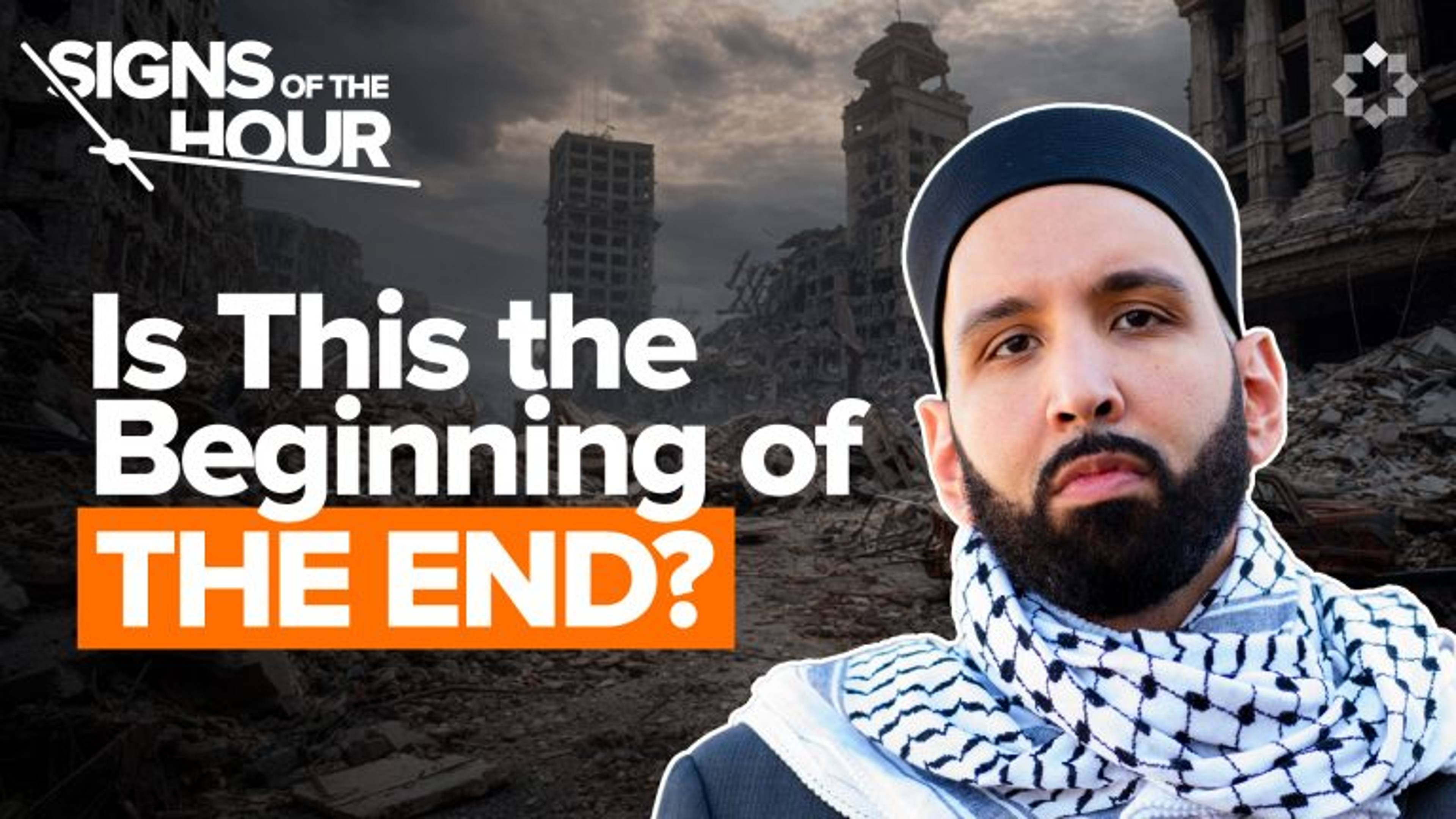
Does the Killer Know Why He Kills? | Signs of the Hour Ep. 20

Signs of the Hour

Does the Killer Know Why He Kills? | Signs of the Hour Ep. 20

The Prophet ﷺ said that before the Hour, time would shrink, deeds would shrink, greed would grow and tribulations would spread, and that harj would increase. His Companions (ra) asked what harj was. He answered with one word, twice: killing. In another narration he said a day would come when the killer does not know why he kills and the one killed does not know why he dies.

Dr. Omar Suleiman reads these narrations against a world where killing has become distant and senseless, and where a massacre can arrive as just another update. He explains why a believer cannot get used to mass death, and how two sets of the Prophet’s ﷺ instructions that seem to contradict each other fit together: one for standing against oppression, and one for staying out of a fight when no one can tell who is right.

This transcript was auto-generated using AI and may contain misspellings.
00:00Be the servant of Allah that is killed. Do not be the servant of Allah that kills. Break your bows. Cut your strings. Take your swords and break them against stones. Disarm yourself. If the believers are not going to hold the sanctity of every single life, who's going to do it?
00:14Think of the world that we live in, where you got a man that's sitting in Las Vegas with a bag of chips and a can of Coke. And while he's eating his chips and drinking his Coke, he presses a button and a drone hits a wedding in Yemen and murders 200 people.
00:27And he goes back home to his family like nothing happened. Another day at work. He's meeting KPIs. Basically, blood becomes cheap. Some people have lost their hearts. Some people have lost their minds. I'm not going to normalize blood. I'm not going to let oppression be normalized.
00:47This brings us to the next bab, the next chapter. It leads to the emptiness or the meaninglessness of other people's lives. If your life no longer has meaning, then what meaning is someone else's life going to have?
01:01And there's a connection that is made between these things. The collapse of meaning at the individual level, the collapse of meaning at the societal level. I'm in pain. I want somebody else to feel my pain.
01:14And so the Prophet ﷺ said in the hadith of Abu Hurayrah ﷺ,
01:19that time will shrink and deeds will shrink and greed will grow in the hearts of man.
01:35And tribulation will become very obvious, will start to appear, and harj will increase.
01:46They said, O Messenger of Allah ﷺ, what is al-harj? He said al-qatl, al-qatl, murder, murder.
01:52Now, this first hadith that we use where the Prophet ﷺ talks about al-harj, notice the chain, the chain of events. People have lost barakah. They've lost blessing in their lives.
02:05People have become greedy. So they kill out of a loss of barakah. They kill out of greed or people are succumbing to despair because of the amount of fitan that are out there.
02:19But all of these things lead to a lot of harj, a lot of killing and murder. So basically blood becomes cheap, so cheap that the Prophet ﷺ said,
02:31by the one in whose hand is my soul, the world will not pass until a day comes upon people where the killer does not know why he killed and the one who is killed does not know why he is being killed.
02:43So the qatil and the maqtul don't even know why the murder is taking place. Like killing is becoming so mechanical. I don't know why I'm killing you and the one who's being murdered has no idea why they are being murdered.
02:56Now, Subhan'Allah, if you think about this, again, how did the 'ulama in the past interpret this? Imam an-Nawawi, he actually looked into the word harj. Harj is actually an Abyssinian word.
03:07It's an Abyssinian word and the Prophet ﷺ is very intentional about the words that he uses, which is why the Arabs didn't recognize it. Harj is blind killing, blind killing.
03:18And so what an-Nawawi and other 'ulama in the past, the way they spoke about it was like, you know, tribalism, mob mentality, like basically you're told to kill this person, you don't even know why.
03:29This person, you know, just the tribal leader said do it, so you just went and you did it. You don't have any personal issues with it, but you're so empty and so cold and so blind in your murder that it's just like, yeah, whatever. Right?
03:43That's how they spoke about it back then. But then, Subhan'Allah, you think about the way that the modern mechanics of murder have evolved. Right? So obviously mass shootings, may Allah protect us.
03:54Like why in the world would someone go into a school or go into a masjid or go into a church or go into a grocery store? Why? Why? Right? He doesn't know why he's killing and the person who's being killed doesn't know why they're being killed.
04:08Now is there a connection to the first one? Yeah, I mean you go to a place like Srebrenica and you hear the stories of like how cold and machine-like the murder of our brothers and sisters in Bosnia was like. It's like how?
04:21Right? It becomes machine-like. You look at Gaza. You look at people that are sent off to commit these heinous acts. Right? They don't know why they're killing, but then there's an even bigger layer to this, another layer to this.
04:32Subhan'Allah, the first person that really put this in perspective for me was Imam Zaid. He said something really interesting. He said, think of the world that we live in where you got a man that's sitting in Las Vegas with a bag of chips and a can of Coke.
04:44And while he's eating his chips and drinking his Coke, he presses a button and a drone hits a wedding in Yemen and murders 200 people.
04:51And he goes back home to his family like nothing happened, another day at work. He's meeting KPIs.
05:04The murder becomes so cold and distant with modern machinery. Right? Like what are we doing here? Subhan'Allah, like how cold and how distant has it become?
05:15Basically we become soulless and other people become soulless. So there's a dehumanizing of the victim that is so far and there's a senselessness to death that is so crazy. And by the way, like you read about the days of Jahiliyyah and you might find it like crazy.
05:29Like how did these people go to war for 40 years over the death of someone messing with someone's camel or someone writing a poem that upset somebody? Or like someone got into an argument with his brother and killed his brother.
05:42Or didn't like his wife's cooking. Do you read why people kill in America? You try to portray backwardness, honor killings.
05:54There's more spousal murder here, partner murder here, boyfriends killing girlfriends and girlfriends killing girlfriends. Like here than anywhere else in the world.
06:07What are you talking about? Right? It seems like more backwards and hellish. Don't you see that a person like kills his pizza man because he doesn't like the way the pizza came or like road rage incidents that happened here.
06:15There is really a senselessness to this killing now that is way beyond anything. Way beyond anything.
06:28Right? And the Prophet ﷺ was asked, he said, well in that case, in this narration, he said, who will be in the fire? He's asked who will be in the fire.
06:42Now in this hadith the Prophet ﷺ mentioned, al-qatil wal-maqtul, both of them are in the fire. In this narration. Why? Because that's when two people are both fighting over something senseless and they don't know why they're going to war with each other.
06:52They don't know why they're trying to kill each other. Somebody told them to kill each other. And one of them just succeeded in killing the other. The Prophet ﷺ said they're both in hellfire.
07:05And in a specific narration from Abu Bakr ﷺ, the Prophet ﷺ said that when two Muslims meet each other with their two swords, both al-qatil wal-maqtul fi-n-nar, the one who kills and the one who is killed are both in hellfire.
07:16And they said, Ya Rasulullah, hath al-qatil, fa ma bal al-maqtul? We understand the killer, but why the one who was killed? And he said, because innahu kana harisan ala qatli sahibihi.
07:29Like he wanted to kill his brother too. He simply did not succeed in doing so. He said ﷺ, la tarji'u ba'di kuffaran yadribu ba'dukum riqabu ba'd.
07:37In an authentic narration, don't go back to being disbelievers after me, striking at the necks of one another. And so there's a fitna obviously where Muslims even start to kill each other, right?
07:51And he mentioned ﷺ that da'wahuma wahida, that their call will be one. Now there's a historical part of this, which is where the Prophet ﷺ mentioned that the Hour will not come
08:02until fi'atan azeematan min al-muslimin, great armies of the Muslims go to war with each other. Two great armies of the believers or the Muslims go to war with each other.
08:14This is different from the individual, right? People that don't know why they're killing or why they're being killed. This is really interesting here because it's very important how the 'ulama qualify this.
08:27When two believers fight with da'wahuma wahida and their da'wah is one, they're making the same claim. They actually both think they're fighting for the sake of Allah and that's a tragedy.
08:38That's a tragedy in and of itself. But you hope for forgiveness for both of them. But when two people are fighting in senselessness and murder and killing, it's a different type of tragedy because they both deserve hellfire because there's nothing righteous that's stirring them in the first place.
08:51So this is a fitna and this is a fitna, but the outcome of these things is different in that regard. And Abdullah ibn Amr narrated that the Prophet ﷺ said,
09:04لَزَوَالُ الدُّنْيَا أَهْوَنُ عَلَى اللَّهِ مِنْ قَتْلِ رَجُلٍ مُسْلِمٍ that the whole world disappearing is lighter to Allah than the killing of a Muslim.
09:14So it just kind of shows you the way that we're supposed to approach an era of murder. May Allah protect us where people start to turn on one another.
09:24And even the sanctity of belief does not stop two people from turning against each other. The Prophet ﷺ, he mentioned that just before the Hour, there will be a type of killing
09:37and it will not be your fighting of the mushrikeen. But he ﷺ said, your killing of one another until a man kills his neighbor,
09:49his brother, his uncle, and his cousin. Listen to this hadith from Abu Musa ﷺ. So now even the sanctity of blood is gone.
10:02People kill their own family members. People start to kill their own family. The Sahaba, they said to the Prophet ﷺ that, وَمَعْنَا عِقُولُنَا يَوْمَئِذٍ
10:14Do we have our brains at that point? Have we lost our minds? Are you talking about a junun here, Ya Rasulullah? Are you talking about an insanity here where people even start to kill their family members?
10:25People turn on each other? And the Prophet ﷺ said that the minds of the people, لَتُنزِعْ عِقُولُ أَهْلِ ذَلِكَ الزَّمَانِ that the minds of the people will be gone to the point that there will remain
10:39some of the most worthless people on the face of the earth. يَحْسَبُ أَكْثَرُهُمْ أَنَّهُمْ عَلَى شَيْءٍ وَلَيْسُ عَلَى شَيْءٍ Most of them would think that they actually have something, but they're actually upon nothing.
10:53There's nothing that's driving them. There's nothing that is grounding them in that way. And that's actually the terrifying part of this as well, And that's actually the terrifying part of this as well, that they'll think they're on something. They'll think they're doing the right thing.
11:07Again, this seems very far-fetched for us because, like, alhamdulillah, we're not living in that type of an environment. But I want you to think about some of the political contexts that exist in the world today.
11:19You don't see, like, people turning against each other and even killing their family members and they think they're doing the right thing. Lost their minds. So some people have lost their hearts. Some people have lost their minds.
11:30Now, one of the ways that we protect ourselves, obviously, is we cannot normalize mass death.
11:43We cannot get used to mass death. If the believers are not going to hold the sanctity of every single life, who's going to do it? And if you think about, subhanAllah, the assault on our minds and our hearts where we've become
11:56so apathetic, where, like, another massacre in Gaza was just an update. How many today? 112. How many today? 226. Oh, it's a ceasefire. They've slowed it down. 42 today. 16 today. What?
12:10It's not normal. And we can't normalize that. Right? Becoming numb to mass death is something you have to resist and you have to instill in the conscience of people.
12:20And that's why, subhanAllah, like, when you think about Hind Rajab, right, that one girl, wa-idha al-mawoodatu su'ilat bi-ayyi dhanbin qutilat, that should be our call.
12:31I'm not waiting for Hollywood stars to figure out the sanctity of Hind Rajab, right? That's one person. But you know what? That becomes the rallying call that we have to resist mass casualty, right?
12:43And the idea that mass casualty is normal. Number two, the Prophet ﷺ gave us what seems like two contradictory sets of instructions for how to deal with this time.
12:57I want you to pay attention. The first struggle is a righteous struggle. And this is in Sahih Muslim. Well, actually, let's start with this.
13:09The first struggle, obviously, is where Allah ﷻ mentions the defense of the oppressed. You're defending other people, obviously. You are fighting on behalf of someone else, right? There's righteous struggle. That's the obvious one, right?
13:22I'm not even talking about that. What's obviously noble struggle. I'm talking about when it involves you on a personal level. In one narration, Sahih Muslim, Abu Hurayrah radhiAllahu ta'ala anhu says that a man came
13:34to the Prophet ﷺ and said, Ya Rasulullah, if a man comes and wants to steal my money unlawfully, what do I do? I'm going to put you in a situation.
13:48Someone wants to take your money. What do you do? What do you guys think? Give him the money? Prophet ﷺ said, La tu'tihi malihi.
14:03Don't give him your wealth. So, Ya Rasulullah, what if he then fights me? Qala qatilhu. He said, fight him back. Sallallahu alayhi wasallam. Qala, Ya Rasulullah, what if he kills me?
14:17Qala fa anta shaheed. Then you will be a martyr. And then the man said, Ya Rasulullah, and what if I kill him? What's the answer?
14:29Qala sallallahu alayhi wasallam, huwa fi al-nar. He's in hellfire. SubhanAllah, like what a loser. He chose to rob someone and gets killed in the process and ends up in hell.
14:43He didn't get the money and he ended up in hellfire. The Prophet ﷺ is saying, fight back. Not for deen. Pay attention here, okay?
14:54And when you watch this online, don't stop the video and clip me out of context, okay? Not for deen. For money. For your wealth. By the way, I feel like I have to give a million disclaimers now, SubhanAllah. This is the internet.
15:07I'm not talking about like you're in a vulnerable situation where you can't defend yourself. Maybe you're like, I got nothing to fight back with. No, I'm going to give my money because this is not an equal type of thing. I can't fight him back, right? So this is not the situation.
15:22I'm talking about a situation where you've got a way to defend yourself and this man is coming at you and he's trying to take your money and the easy thing to do would be just give him the money. And the Prophet ﷺ said, no, fight back.
15:35And if you die, you're a shaheed, okay? In another narration, also authentic, from Sa'eed ibn Zayd, qala ﷺ man qutila doona
15:46malihi fahuwa shaheed, wa man qutila doona ahlihi fahuwa shaheed, wa man qutila doona deenihi fahuwa shaheed, wa man qutila doona damihi fahuwa shaheed.
15:58He said ﷺ, whoever is killed defending his wealth is a martyr. Whoever is killed defending his family is a martyr. Whoever is killed defending his religion is a martyr.
16:11And whoever is killed defending himself, like his life, damihi, is a martyr, okay? Now put that to the side.
16:21In another narration, also authentic, the Prophet ﷺ mentioned when the outbreak of
16:28fitnah comes, break your bows, wa qata'u awtarakum, cut your strings, your bow strings.
16:37And he ﷺ said, wa daribu sayufakum bil-hijara, take your swords and break them against stones. Disarm yourself entirely, okay?
16:49And he ﷺ said, fa indakhala ala ahadikum, if someone enters upon you, falyakun kakhayri ibni Adam, ibni Adam.
16:59He said ﷺ, if someone enters upon you in your home and you've disarmed yourself, then be like the better of the two children of Adam.
17:10He said ﷺ, kun abdullahi al-maqtul, wa la takun abdullahi al-qatil. Be the servant of Allah that is killed, do not be the servant of Allah that kills.
17:20All right, someone reconcile this for me. We can actually finish before Isha if you do. Somebody reconcile this for me. How does this make sense?
17:32How do you reconcile these two things, these two sets of narrations? Anybody want to give it a shot?
17:42Okay, I'll do it insha'Allah ta'ala. The first set of ahadith, when the Prophet ﷺ is talking about defending against zulm,
17:53the benefits against yourself, the ulama mentioned, the fa'idah, the benefit of that is that zulm does not become normalized.
18:03So when we think about our masajid, when we think about defending ourselves against these people that are instigating hate against us, we should absolutely take our means.
18:16We should absolutely be trained and be ready and know how to defend ourselves. Just like our brother Ameen, rahimahullah ta'ala in San Diego, defended those children.
18:26There's something noble in that, that zulm not being normalized, that you take a stand against zulm and even if you're killed taking a stand against zulm, then you die in that
18:37sense with a ma'drah, with an excuse before Allah ta'ala that I was not a part of excusing this zulm. I knew I wasn't going to win. I knew I was going to die. But I'm not going to normalize zulm.
18:51I'm not going to let oppression be normalized. This is praiseworthy, even if you're defending your wealth, even if you're defending your own personal self, because if the person gets away with murdering you and gets away with
19:02stealing your wealth, then he's going to be intoxicated by that evil and go do it to somebody else. So when you take a stand for yourself, you're actually also taking a stand for somebody else. We're not going to allow this.
19:16We will not be okay with this. That is the stature of the believer. So then what's the second body of ahadith? This is what the ulama mention, qital al-fitnah. This is when it's confusing.
19:30This is when the believers are fighting each other. This is when Muslims are picking up swords against each other. This is when there is no clear oppressor and oppressed.
19:42At that point, I just want to make myself safe. safe in the Akhira. I'd rather be safe in the Hereafter than be safe in this world. Even if that means it's going to cost me my life.
19:56Subhan'Allah, you notice the trend across all these different things? Even when I defend my life, I'm defending it for my deen. I'm defending it for something noble. Right?
20:08So likewise, I want to defend my deen, but at some point, I don't want to offend my deen by defending myself. I don't know. At that point, I don't know who's right and who's wrong. Leave me out of it.
20:21Someone comes saying "La ilaha illallah," I'm saying "La ilaha illallah," let him bear the sin of killing me. I'm not killing him. Right? And there's a lesson here, and I'll end with this, that if that's the case with murder
20:34and with swords, it's also the case, by the way, with your tongues in the time of fitnah. It's also the case of how you weigh in, how you participate in a way that's less than murder.
20:48Because remember, right, fitnah, shaddun min al-qatl, right, can be worse than qatl, can be worse than murder. The Prophet ﷺ teaching us about backbiting—it's like killing a person by destroying their
21:02reputation. When you don't know, stay out. When it's confusing, don't participate in anything. "Wa in ta'ifatain min al-mu'minin iqtatalu fa-aslih bayanahuma."
21:16When two groups of believers break out in a dispute amongst themselves, your first instinct is, let me sit them together, let me bring them together. Right? And then, "Im baghat ihda huma ala al-ukhra fa-qatilu allati tabghi."
21:28If one of them is clearly the aggressor against the other, then all of you fight the aggressor together. That's how you set the equilibrium. It's not, "Oh, but I still like this brother, and I still want to be reconciling between two groups." No.
21:41If one group, if one person is clearly transgressing against the other, then the believer sets the equilibrium right. Absolutely. That's like the one who defends himself and defends his wealth because of something more noble. No, this isn't about, "I like this person or I even like myself."
21:56This is about setting things right. "Qatilu allati tabghi hatta tafi'a ila amri Allah." Until it goes back to the order of Allah, Subhanahu Wa Ta'ala. Then, "Fa-in fa'at fa-aslih bayanahuma bil-adli wa-aqsitu."
22:10If it passes, right, then sit them down once again, make justice. "Inna Allah yuhibbul muqsiteen." Allah loves those who establish equity and justice. This is in the case where there's clear aggression, clear transgression, but when you don't know,
22:24don't participate. So we ask Allah, Subhanahu Wa Ta'ala, that He guides us to the truth and He guides us to act upon the truth when we see it.
22:36And we ask Allah, Subhanahu Wa Ta'ala, to protect us from falsehood and to protect us from acting upon falsehood, even if we may feel like it's truth. Allahumma Ameen. JazakumAllahu khayran wa salamu alaikum wa salaatu wa assalamu 'ala nabiyyina Muhammad wa 'ala alihi wa sahbihi ajma'in.
22:50Wa assalamu alaikum wa rahmatullahi wa barakatuh. Al-Fatiha.