fbpixel
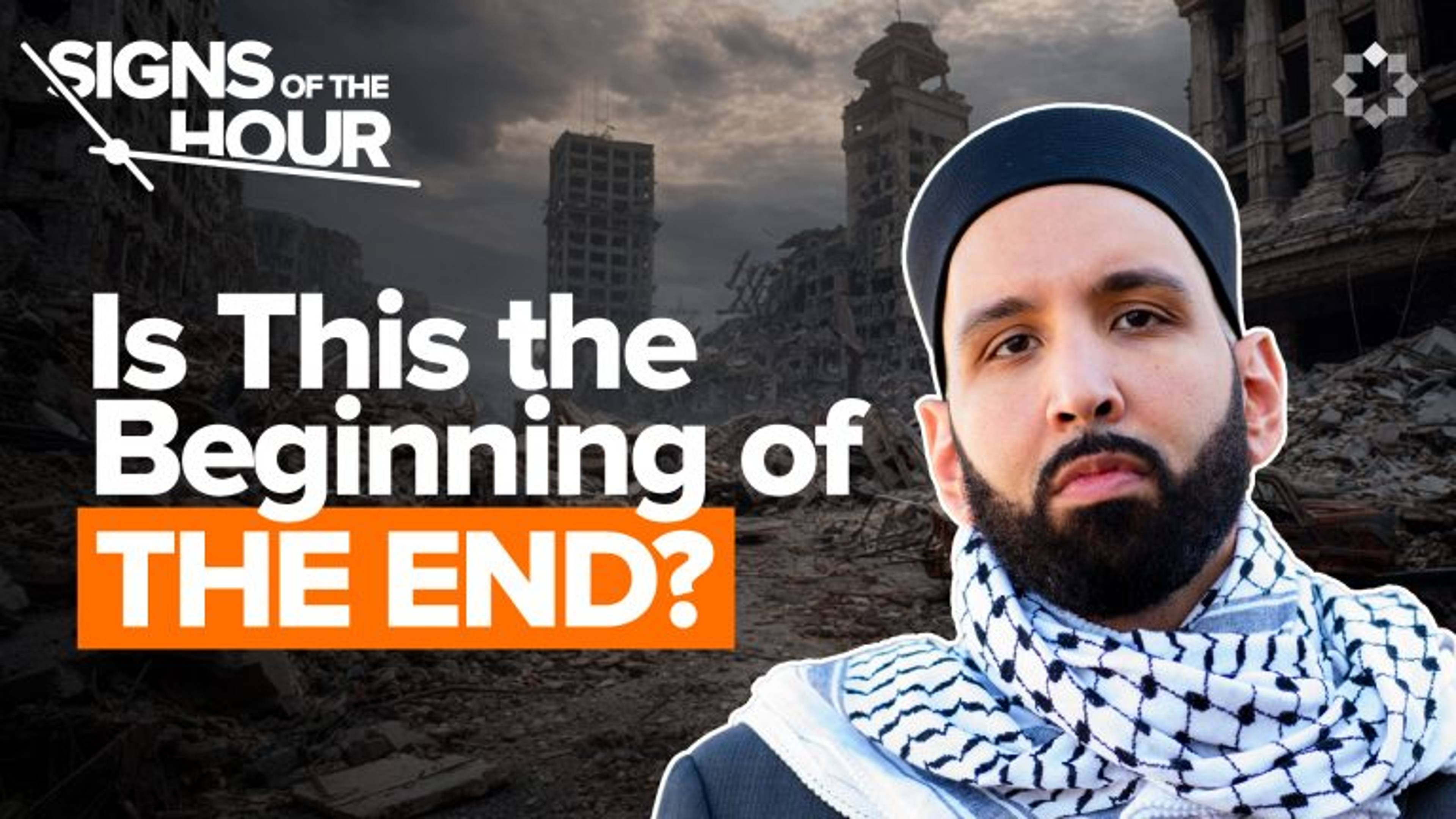
The 10 Patterns of Religious Corruption | Signs of the Hour Ep. 12

Signs of the Hour

The 10 Patterns of Religious Corruption | Signs of the Hour Ep. 12

Will Islam one day look unrecognizable, the way other major religions have? The Prophet ﷺ left his ummah a stark warning: don't follow previous nations into a lizard's hole. It's a call to hold firm to your faith, even when the crowd moves elsewhere.

In this episode, Dr. Omar Suleiman talks about the 10 patterns that led other religions astray and what every Muslim needs to watch for today.

This transcript was auto-generated using AI and may contain misspellings.
00:00The last part of this that I'll talk about, bi-idhnillahi ta'ala, fits these two things in terms of the decline of religion and decline of knowledge.
00:16Which is the idea that you will follow the ways of those who came before you. And this is a genre of hadith from the Prophet ﷺ. Hadith Abu Sa'id al-Khudri, radiallahu ta'ala anhu, where the Prophet ﷺ said,
00:29Latattaba'unna sunana man kana qablakum shibran shibran wa dhira'an bi dhira'an. You will follow the ways of those who came before you. Span by span, inch by inch.
00:42So much so, the Prophet ﷺ said, that if they went into a lizard's hole, you would follow them into that lizard's hole. They said, "Ya Rasulallah, al-Yahudu wa al-Nasara?" The Jews and the Christians? The Prophet ﷺ said,
00:56"Faman?" Who else would I be speaking about? Why am I bringing this hadith here in this particular study? First and foremost, let's talk about the lizard hole.
01:09And what this is actually speaking to and why the scholars spoke about this in particular. Does a lizard's hole sound pleasant to you? Like, if you were any type of animal, would you go into a lizard's hole?
01:23No, it's a very narrow, difficult, unpleasant place in the desert. It's not rational or reasonable for you to try to get into a lizard's hole.
01:36Like, imagine if you were a camel or a horse or whatever it is. You're not trying to get into a lizard's hole. Even if you were a smaller desert animal. So what's the wisdom of this? Number one: to show extreme imitation. That you would follow the nations that came before you,
01:49even to very ugly, narrow places that don't make any sense whatsoever. So the extremity, the precision. Like, to get into a lizard's hole, that means I'm trying to get in there. You don't fall into a lizard's hole.
02:03As if you're trying to get in there. Like you're following the exact same trajectory. Number two: the irrationality of it. So it's not a place that a human being would typically enter into. Number three: when the Prophet ﷺ mentions
02:17hand span by hand span, inch by inch, it's to show the gradual nature of this. It doesn't happen overnight. It doesn't happen overnight that suddenly Islam starts to resemble
02:28what happened with Judaism and Christianity. And Muslims start to resemble what happened with Christians and Jews. So what does this entrance into a hole mean? Now some of you might hear this and you're like,
02:41"Okay, like, how do we reconcile the honor of Ahlul Kitab?" Like, Ahlul Kitab, the people of the book, are used in an honorable way in the Qur'an, right? We're calling to them on the basis of similarity
02:54that we are people of this book. You are people of a book. We're people who, you arise from a place of, at least the starting point of divine revelation. We have more in common. Indeed, we have more in common than with the mushrikin in Arabia
03:06and the different religions, right, that exist around the world. We have more in common and you're calling them on the basis of that. And the Prophet ﷺ was keen when he went to Madinah to establish, right, connection with the Jewish community in Madinah.
03:19There is so much to that while also maintaining distinction, theologically, connection on the basis of what unites us. So it's very interesting here because we are closer to the Jews
03:30and the Christians and other religions because it originates from a similar point. And that's actually why this hadith becomes so powerful. Because just like they had a messenger, you have a messenger.
03:42Just like they had a message, you have a message. Just like they had Shari'ah, right? Every prophet had Shari'ah. Shari'ah is the legislation that came with the prophet. Just like they had a law and legislation and they had a way, you have legislation, you have a way, you have everything that came along with
03:56what came with them, right? So there's similarity there that makes pitfalls similar. You understand?
04:07Like it's actually the point here that that's why Bani Isra'il is spoken about so much in the Qur'an. Remember we talked about truthful and beneficial stories because they're the nation that came before you,
04:20the ummah that came before you. Pay attention because you're likely to fall in the same ways that they fell, not in different ways to them because of your similarities, right? So it's actually the similarity and the common cause that the Prophet ﷺ is speaking to,
04:33which has the common pitfalls as well. that the prophet Sallallahu Alaihi Wasallam is speaking to, Now on that note, when the Prophet ﷺ is warning the ummah of falling into what previous religious communities that come from the same departure point have fallen into,
04:47he's not primarily talking about fashion and culture and some of the more societal things.
04:57Even though that's part of, it could become part of. Of course, I don't want to go down a long fiqh discussion, but sometimes we also use that hadith to make haram what's not haram,
05:08and there are vibrant discussions that exist, at the very least we can say in the tradition, about what is tashabbuh and what's not, right? What is imitation and what's not imitation?
05:21What's like the people of a land in your culture and what's imitation as it is related to the specifics of their religion. But the first thing the Prophet ﷺ is talking about is the pattern of religious corruption.
05:33That's the primary meaning of this hadith, first and foremost: distortion of teaching, prosperity preaching, corruption of authority, legal manipulation, spiritual consumerism, right?
05:45It's division, sectarianism, hypocrisy. These are the first things the Prophet ﷺ is calling our attention to in regards to following their way. So not just that you'll follow them in regards to their sins,
05:58no, you'll follow them in regards to their path, their theology, their scripture, how they approach scripture, how they approach places of worship, how they approach law, how they approach spirituality. And so you have the famous narration of Adi ibn Hatim,
06:11radiallahu ta'ala anhu, and Hassan ibn Qayrih, that he came to the Prophet ﷺ and he had a cross of gold around his neck. And the Prophet ﷺ said, remove the idol from yourself.
06:25And I heard him reciting from Surah Al-Baqarah, that they took their rabbis and their priests as lords besides Allah Subhanahu wa Ta'ala.
06:40So Adi, being a Christian, or coming from a Christian background, he said, "You know, but they didn't worship those men besides Allah Subhanahu wa Ta'ala.
06:53Like, they didn't worship their rabbis, they didn't worship the monks besides Allah Subhanahu wa Ta'ala." The Prophet ﷺ says, "It's not that, oh Adi.
07:13It's not that they used to worship them in that way. It's not when they made something lawful for them, they considered it lawful. And when they made something unlawful for them, they considered it unlawful.
07:26It was the authority that was given to them that surpassed divine authority and led to legal manipulation and distortion. By the way, even within Judaism and Christianity, there were concerns about this, right? Concerns about how far is authority being stretched?
07:40Where's corruption happening? There are different layers of preservation. Some sects that are more about preservation. Others that don't care much about preservation. Some that take this text as authoritative. Some that don't.
07:54The way that priesthood is approached. And Catholicism versus Protestantism. Like, these are divisions that happened within Christianity and Judaism. Look at an Orthodox Jew versus a Reform Jew, right? And the Prophet ﷺ is saying,
08:07you're gonna have the same problems. And the prophet Sallallahu Alaihi Wasallam is saying, you're gonna have the same problems. You as an ummah of Muhammad, Sallallahu Alaihi Wasallam, will go in the same trajectory. And this is the point.
08:21The ummah loves the Qur'an too much for someone to outright say, "Hey, I've got a new Qur'an for you." And actually get away with it. At least at this juncture. That doesn't mean people are not gonna try.
08:33But I think we're at a point in our ummah still where if someone said, "I made up a new Qur'an," people would call them ridiculous and consider them to be crazy and not take them very seriously. The ummah loves the Qur'an too much. And it prides itself too much on tawheed
08:47to allow outright shirk, right? Or to actually say, "We now believe in shirk," right? So elements have to be introduced to scrape away. While the Qur'an is being upheld,
09:01like think about something being dug away. Tawheed is upheld. It's being dug away, right? Scriptural authority, it's being dug away. And that's what the Prophet, Sallallahu Alaihi Wasallam, is talking about. And that's also one of the fawa'id of the hadith,
09:14by the way, the benefits of the hadith, when you're crawling into a hole, right? Slowly, slowly digging away. And I want to look at this hadith and think about when Allah 'Aza wa Jal says,
09:28"Wa la tattabi'u khutuwat ash-shaytan." "Don't follow the footsteps of the devil." Who's leading that path? Shaytan is leading that path. "So come on in, walk with me. Take my hand, take this step, take that step, take this step.
09:42As a community, because remember I talked about this, right? Not the previous segment, but the one before that. There's a community element of this and there's an individual element of this. The community element, the Prophet, Sallallahu Alaihi Wasallam,
09:54said that the shaytan has despaired of being worshipped fi Jazirat al-'Arab in the Arabian Peninsula. So what did he resort to? "Let me divide them.
10:07Let me put them against each other. Because I can't get them to outright worship me. So let me create sects and division amongst them. And then I can start to plant some ideas here or there. If I disintegrate the community,
10:21then I can cause dissension and I can poison the ideas here and poison the ideas there." And then again, it becomes just like the Jews and the Christians split into sects, the Muslims split into sects
10:34and things start to happen, right? And ideas start to become poison. So that's on the grand scale, the community scale. On the individual scale, Ibn al-Qayyim, Rahimahu Allah, goes through in Madarij as-Salikin the steps of shaytan.
10:47First, he comes to you with kufr, outright kufr and shirk, disbelief in Allah, Subhanahu Wa Ta'ala. If he succeeds there, Alhamdulillah, he's happy. If he gets you to actually disbelieve in Allah or disbelieve in any of the pillars counter to iman,
10:59the pillars of iman, I got this, I'm happy. If he's unable to get you with kufr, he comes to you with al-bid'ah, with innovation. "Let me sell you something that you'll think is good for your religion, but it's actually not.
11:12It's an innovation in the religion." If he can't get you there, then he gets you with major sins, al-kaba'ir. "Let me try to get you to drink alcohol, commit zina, do something else." If he can't get you there, then he accumulates minor sins for you. He gets you to accumulate minor sins.
11:26 If he can't get you there, then he floods you with what? Al-mubah, permissible things. "What's wrong with permissible things? What's wrong with this?
11:40This is halal. Nothing's wrong with these movies. Nothing's wrong with these songs. Nothing's wrong with this. Nothing's wrong with that." But your priorities get so messed up to where you're flooded with the permissible and you're leaving off your purpose.
11:53And if he can't get you with that, so you're still keen about your deen, then he'll make you prioritize lesser good deeds over bigger good deeds, more important things. He'll mess up your priorities in the deen itself.
12:07And then if he can't get you with that, Subhan'Allah, Ibn al-Qayyim, Rahimahu Allah, said, if he can't get you with any of the six, then he will incite human beings against you to slander you and to hurt you and to try to bring you off of your deen.
12:21But he is relentless. He never gives up, right? What does it start off with? What Allah 'Aza wa Jal tells us. He says it in the Qur'an.
12:33Cutting off the ear of a cow, changing the creation of Allah, Subhanahu Wa Ta'ala, some charms here, some stuff over here, some stuff over there, like he gets you off of your deen with that.
12:46"Then I've got you. You're in the lizard's hole. Now let me pull you in deeper and deeper and deeper and deeper." So again, if the shaytan can't remove the Qur'an from your shelf, he'll remove it from your heart. He removes the authority of it from your heart.
12:59And if he can't get you to abandon revelation, he'll twist it for you. And he'll get you to abandon the purpose of revelation. I know I'm over time. Let me inshallah ta'ala wrap up here. There's another connection that I want to make here
13:12between what the Prophet, Sallallahu Alaihi Wasallam, said of crawling into the lizard's hole and how the Prophet, Sallallahu Alaihi Wasallam, described an-nifaq, hypocrisy, or what hypocrisy actually even means.
13:24The word nifaq comes from the tunnel of al-yarbu', which is a desert rat. If you want to know how ugly one of those things are, then you look them up. Just like you wouldn't follow a lizard's hole if you saw that thing walk into your house.
13:38Okay? But it's a desert rodent. And the jerboa, the yarbu, basically it enters into a hole and it creates an illusion of solid ground behind it. So it's really empty on the inside,
13:52but it looks like it's covered on the outside. And why is this so important? The contradiction between the outwardly and the inwardly and going into the hole. Perhaps it's a fa'idah here, right? At the end of the day, Allah 'Aza wa Jal warned us
14:06that the destruction of the nation before was through nifaq, was through hypocrisy. And everything that resembles nifaq, everything that resembles hypocrisy, makes you more susceptible to these things that the Prophet Sallallahu Alaihi Wasallam
14:19is mentioning in specific. I'll give you 10 patterns, and I'll only name them because of time. 10 patterns that I wanted to summarize. This is from that class I taught in Massachusetts,
14:32SubhanAllah, almost 20 years ago. And I took 10 patterns of how the religious communities before us lost the deen and what the signs of the Day of Judgment are.
14:42Number one, text without an intention to submit. You have the text. Qulu hattat, right? And they say hittah. You have no intention to obey the command.
14:56So you have the text, but you don't want to obey the command when it goes against your desires. Number two, you have authority without accountability. So religious figures that aren't accountable anymore, either because they have the way to redefine halal and haram,
15:10and the community has lost its basic literacy to be able to control that, or there isn't enough accountability amongst themselves, or there isn't enough taqwa in the authorities themselves to be able to govern that. Number three, sometimes you have law without spirit.
15:24Right? So you do have some of the hadith where the Prophet Sallallahu Alaihi Wasallam talks about extremism in the ummah where people get caught up on the text and they lose the purpose of it. Right? And then on the other hand, you have spirit without law.
15:37So religion becomes about feelings, not fiqh. Spirituality, not obligation. Right? Number five, so that was number four. Number five, prosperity religion. Religion that promises you everything in this world. And if you're good in this world,
15:50then that means God loves you. It's a dangerous decline of religion. It takes over every religion, east and west. Number six, the arrogance of chosen people. Sometimes we get that too.
16:03I'm a Muslim, so I can do this, and I can do this, and I can do that, and I can do this. And at the end of the day, lan tamassan an-naru illa ayyaman ma'dudah. Good luck with that. All right, I'll go to hell only for a few days. Alhamdulillah, I'm a Muslim. The Sheikh said that if I have 10% of deen,
16:16that I get to go. That's not the way this works. Number seven, sectarianism, division. Right? The Prophet specifically named that as something that happened to the community because once believers fall into sects,
16:30then they can become cultish. Personalities take over. Religion is corrupted. Motives change. Priorities change. Number eight, hypocrisy with religious language. So public Islam, private disease.
16:45Number nine, aversion to the messenger. If you look at all these religious communities, what it ended up with, at some point they got sick of their prophets. If you're finding yourself sick of your prophet, Sallallahu Alaihi Wasallam,
16:58with an aversion to the messenger of Allah, Sallallahu Alaihi Wasallam, hating who he is, hating what he said, then that's number nine. Number 10, which is the final and the worst, which is redefining Allah himself.
17:12Either by changing who God is or changing the nature of God. Right? So either associating partners or saying that his hand is stingy or that he repents or that he loses his temper
17:26and things of that sort. So you either redefine God in divinity or you redefine him in nature. InshaAllah Ta'ala, the next few episodes will be about the genres or how the Prophet Sallallahu Alaihi Wasallam
17:40of the misuse of deen in three ways. Deception, division, and dunya, worldly pursuit. And then you'll find categories of ahadith there. And we ask Allah 'Aza wa Jal to protect us. And we ask Allah Subhanahu wa Ta'ala
17:53to keep us firm on the religion as it is. Allahumma ameen. Subhanaka Allahumma wa bihamdika ash-hadu an la ilaha anta astaghfiruka wa atubu ilayk wa sallallahu alayhi wa sallam wa 'ala nabiyyina Muhammad wa 'ala alihi wa sahbihi ajma'in wa assalamu alaykum wa rahmatullahi wa barakatuh
18:09Al-Fatiha.