fbpixel
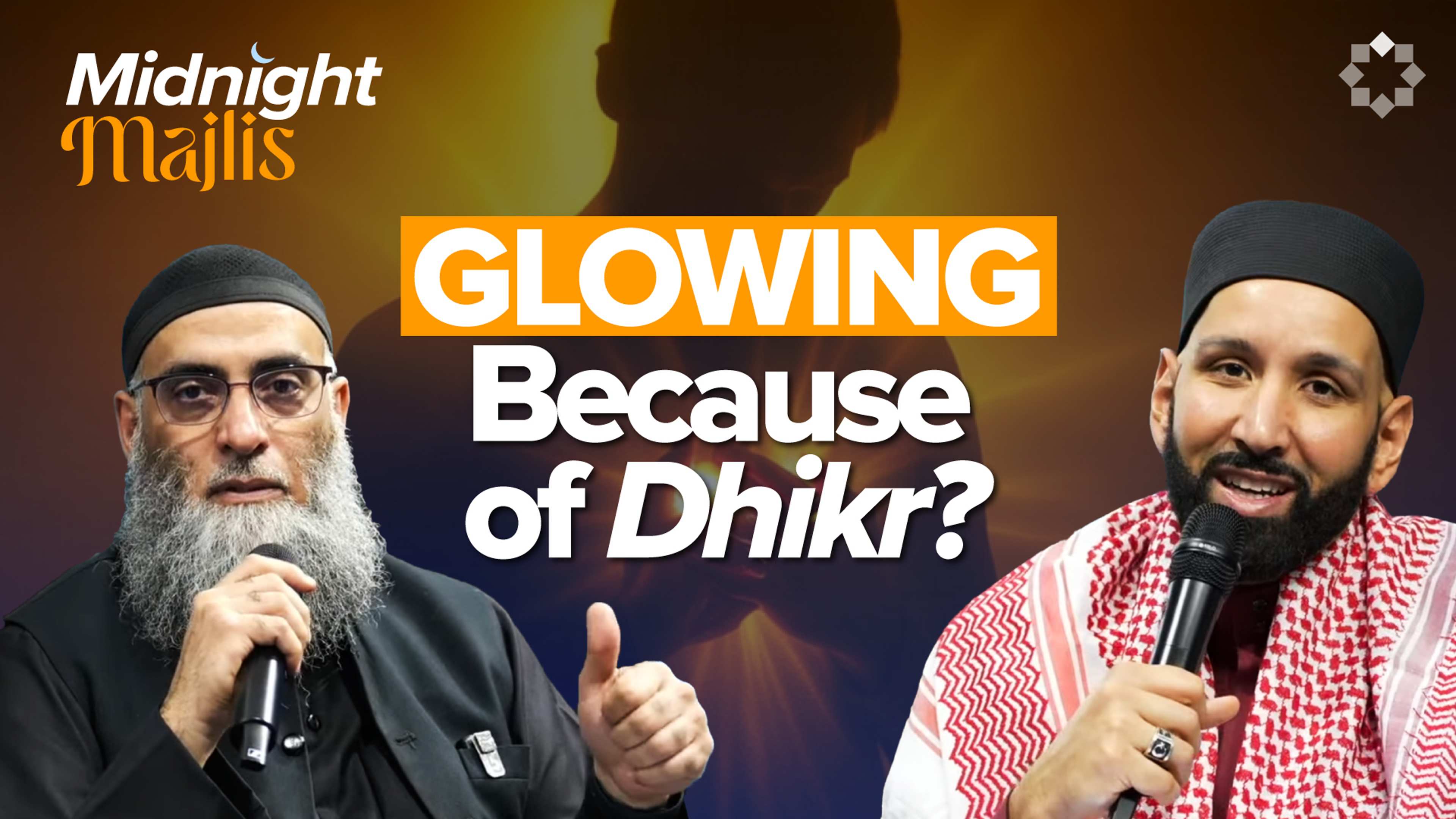
Your Dhikr Makes You Beautiful | Midnight Majlis S2 Ep. 2

Midnight Majlis

Your Dhikr Makes You Beautiful | Midnight Majlis S2 Ep. 2

How does the remembrance of Allah calm your body? Can you love the Qur’an and music at the same time? Does Allah ever mention you by name? And how do you move beyond doing dhikr on autopilot?

Dr. Omar Suleiman and Sh. Yaser Birjas share gems from the first 17 benefits of dhikr (remembrance of Allah) that are outlined by Ibn al-Qayyim (rh) in his book Al-Wabil al-Sayyib min al-Kalim al-Tayyib (available in English translation under the titles “The Invocation of God” or “Remembrance of the Most Merciful”).

This transcript was auto-generated using AI and may contain misspellings.
00:00So I think we can just go through the list, inshallah, and we can comment especially on some of the one-sentence points. So the first one, he said rahimahullah, are the benefits of remembrance.
00:10For those who are reading with us in the English text, it's page 114 in the English text and the Arabic text is actually page 94, inshallah wa ta'ala. He says, قال في الذكر نحو من مائة فائدة
00:24When it comes to remembrance, there are almost close to a hundred benefits. Then he mentioned al-ula, the first one. قال أنه يطرد الشيطان ويقمعه ويكسره It repels the shaytan, restrains him, and breaks him.
00:39ذكر الله سبحانه وتعالى يطرد الشيطان ويقمعه ويكسره It really repels the shaytan, it actually restrains the shaytan, and breaks the shaytan. Let's take some examples here.
00:51So when it comes to يطرد الشيطان, that repels the shaytan, one of those forms of dhikr that does that is actually al-adhan, believe it or not.
01:02When you call the adhan, the Prophet ﷺ said, when the shaytan hears the adhan, what does he do? He runs away, tries to close his ears, running away from the adhan.
01:14And even the Prophet ﷺ says, while he's actually releasing gas, like he's running away from the adhan. And when the adhan is over, he comes back again. And when the iqamah is called, he runs away and comes back again, subhanallah.
01:28So that's why the ulema say, if you're in a moment where you're afraid, like you're afraid from jinn, from shaytan, and so on, it's okay for you to call the adhan
01:39so that you can ease yourself as well as repel the shaytan away from you. Let's say, for example, if you went to an event, like for example this event, when you're done,
01:51you go to the parking lot, you park far away, and you walk in by yourself right now, and your mind is just going all over the place, you see things, you hear things. You get into the car, and now you hear something in the backseat. So what do you do?
02:05You call the adhan. You say, Allahu akbar, Allahu akbar. And that repels the shaytan, repels the jinn. But if you hear in the back, when you say, Allahu akbar, Allahu akbar, you hear something that says, Allahu akbar, Allahu akbar, that means you have a Muslim jinn, alhamdulillah.
02:20That's good, right? But seriously, the adhan is a form of dhikr that repels the shaytan. Allah 'azza wa jal says, وَإِمَّا يَنْزَغَنَّكَ مِنَ الشَّيْطَانِ نَزْغٌ فَاسْتَعِذْ بِاللَّهِ
02:31That if the shaytan comes and he pokes you and he agitates you, then right away, استعِذْ بِاللَّهِ، قُلْ أَعُوذُ بِاللَّهِ مِنَ الشَّيْطَانِ الرَّجِيمِ One way to think about this in the most visual sense is, the Prophet ﷺ, one of the commentaries on the hadith where
02:44the Prophet ﷺ said that the shaytan, يَجْرِي كَمَجْرِ الدَّمْ that he flows in your blood, in your veins, the way that blood flows, is that you actually have to remove the oxygen of the shaytan. You have to suffocate him.
02:57Like, imagine yourself suffocating the shaytan. How do you flood him out of your vessels? How do you flood him out of your veins? How do you not give him space? And you'll notice that all of the ayat and the ahadith about the shaytan
03:10are about giving him space. Once you give him space, he'll work his magic. And so the Prophet ﷺ emphasizes this idea of not giving him space in the first place. So when you start your food, بِسْمِ اللَّهِ الرَّحْمَنِ الرَّحِيمِ He says, I have no food here.
03:24I can't eat here. When you begin with the name of Allah in anything that you do, "Okay, I have nothing to do here." Okay, you recite the Qur'an. "Okay, I can't get in here." You do the adhan. "I can't get in here." Anytime you occupy a space, inside or outside,
03:38with the name of Allah Subhanahu wa ta'ala, shaytan suffocates. His oxygen is your absence. And when the Prophet ﷺ speaks about this visualization of him, I want you to think about what's being said here.
03:52That not only do you repel him, but you break him. And you make him lose hope in you. If you were studying yourself right now, if you were your own shaytan, alright, this is how you have to think like your enemy sometimes.
04:05If you were your own shaytan, how much hope would you have in yourself right now? See yourself getting a little religious. "Ah, sorry, just another week and I've got him. I got her. Give it a little bit of time. Ah, yeah, you know, acting really religious right now. All I have to do is trigger this.
04:19It's okay, don't worry." The shaytan actually has hope in you, not on the basis of your sin. You know what it is? The lack of consistency? Your inconsistency. Your inconsistency.
04:31See, because even a major sin can be repented from. But if you're inconsistent, then he doesn't worry about you. Because he knows that you just act in phases. And so when Allah Azawajal mentions, al-waswas, al-khanas.
04:45The whisperer and the one who slinks away. Itha ghaflata waswasa wa itha dhakara Allaha khanas. No, sorry. Itha ghaflala waswasa wa itha dhakara Allaha khanas. As the ulama say,
04:57when he's absent of the remembrance of Allah, when he's heedless, then shaytan whispers. And if he remembers Allah, then he slinks away. Like, imagine you're sinking him away. And the other thing here, subhanallah, is what the Prophet ﷺ mentioned about his own shaytan.
05:11Anahu aslama. That he submitted. See, with Sayyiduna 'Umar radiallahu ta'ala 'anhu, shaytan would not even take the same road as him. He just knew that he could never get to 'Umar radiallahu 'anhu anymore. Because 'Umar radiallahu ta'ala 'anhu
05:24was so insistent on crushing his nafs, his own self. Shaytan tries to poison the self. So he really has no way in with 'Umar radiallahu ta'ala 'anhu anymore. So he just takes a different road. "I gave up on him."
05:38With the Prophet ﷺ, anahu aslama, he submitted. The ulama have two different interpretations. That the Prophet ﷺ, shaytan actually aslama, became Muslim. Or he submitted, like he gave up. So does your shaytan have hope in you
05:50because of your inconsistency? And that's really what's being said here: the consistency of dhikr. Subhanallah, the beautiful example you mentioned about when you come to eat, when you come into the house, and you mention the name of Allah Subhanahu wa ta'ala,
06:04you restrain the shaytan. So as a result, the shaytan says, "You know what, there's no food, you can't stay over here." And you exhaust that shaytan. And subhanallah, Ayat al-Kursi specifically as well, when you go to sleep and you put that shield over you.
06:18when you go to sleep and you put that shield over you. So all these words of dhikr definitely will repel the shaytan, restrain the shaytan, and break the shaytan. The second point, the second benefit of dhikr, the benefit of dhikr he says, rahimahullah wa ta'ala,
06:30anahu yurdu ar-Rahman al-'Azzawajal. It pleases the Most Merciful, subhanahu wa ta'ala. In the Qur'an, Allah al-'Azzawajal says, "Faadhkuruni adhkurkum." You remember me, I remember you.
06:44And Allah subhanahu wa ta'ala says, as the Prophet, sallallahu alayhi wa sallam, as a matter of fact, the Prophet sallallahu alayhi wa sallam says, "Inna Allaha ta'ala yarda 'an al-'abd." Allah subhanahu wa ta'ala will be pleased with the servant
06:56ya'kulu al-aklata wa yashrabu ash-sharabata fa yahmaduh alayha. When you put a morsel of food or take a sip of drink, and you say alhamdulillah, Allah will be pleased with you. So when you make that dhikr, even though as simple as saying
07:10alhamdulillah when you eat or when you drink, Allah al-'Azzawajal will be pleased with you. So it's not because what you said is too short or too long or too fancy or too powerful. No, it's because the power is in the One that you're remembering
07:23and you're praising in that moment. So Allah subhanahu wa ta'ala will be pleased with you. So remember, little things such as saying alhamdulillah can bring the pleasure of Allah subhanahu wa ta'ala in your way. If the little sins show disregard to Allah subhanahu wa ta'ala,
07:36then the little good deeds show higher regard to Allah subhanahu wa ta'ala. And what the 'ulama mention here is that radiyallahu 'anhum wa radu 'anh. Allah is pleased with them and they are pleased with Him. The highest gift that Allah gives
07:50in terms of experience on the entrance into Jannah is seeing Him subhanahu wa ta'ala. That's the highest gift that you get to see Him. The highest gift that Allah gives in terms of amnesty,
08:03in terms of an actual certificate, if you will, is that I'm pleased with you and I'll never be displeased with you again. Ya ahlal-Jannah, I'm pleased with you and I'll never be displeased with you again. And if you look at this idea of personalizing your relationship with Allah subhanahu wa ta'ala,
08:17this is when you move from transactional to having a transformational relationship with Allah. I love to please my Lord. I love what my Lord loves. Allahumma inni as'aluka hubbaka wa hubba man yuhibbuka wa hubbu 'amalam yuqarriruni ila hubbik.
08:32Right? You ask Allah for His love and the love of all those that He loves and the love of every deed that brings you closer to Him. And so at that point, you don't need the actual quantification of the reward to be attached to the dhikr.
08:45You just know that it pleases Allah subhanahu wa ta'ala, it pleases ar-Rahman. And the more that I please Him, the more that He will please me. So I don't even need the details in between. You know, when we talk about du'a, Sheikh, and how there can be ta'di in du'a, there can be transgression in du'a
08:59when you start to get too detailed in your du'a sometimes, right? Likewise, when it comes to dhikr, if you're constantly looking for the next fake WhatsApp message that tells you to say this and you'll get 46,000 times this,
09:11that's a weakness of your regimen of remembrance. Like Allah loves it. Of course, I love what Allah loves. And if I please Allah, then He will certainly please me subhanahu wa ta'ala.
09:23So the second one is to please Allah subhanahu wa ta'ala when you make your dhikr. And I want everybody to remember that this list is for you. How much you would like to accomplish with your dhikr of Allah subhanahu wa ta'ala? What exactly you feel that I'm lacking, that I need to bring into my life?
09:37So I need to repel the shaytan. I need to please Allah subhanahu wa ta'ala. Number three, he says, and that's one of my favorites, subhanallah, because that's the main reason sometimes people, they go for dhikr.
09:52 Because it removes, he says, dhikr of Allah subhanahu wa ta'ala, it removes sadness and sorrow from the heart. Especially subhanallah, as humans, our life is always ups and downs. Alhamdulillah, when we are in the up,
10:05the moment of our lives, we become very heedless, unfortunately, as human beings. But then when the dip comes in, that's when everybody starts panicking. And that's when we start having anxiety, stress, and so on.
10:18And we're looking for some sort of relief. And that's when you realize Allah subhanahu wa ta'ala is on your side. You remember Allah 'azza wa jal. You please Allah subhanahu wa ta'ala. It brings that peace and tranquility.
10:34Allah subhanahu wa ta'ala says, Those who have faith, and their hearts find peace and tranquility through the remembrance of Allah. Because indeed, through the remembrance of Allah,
10:46the heart will find peace and tranquility. And so, when you think about the heart, and you're gonna see now as this list grows out, he'll start with the inside, and he'll start to go to the body, and he'll start to go to
11:00different elements of your exterior. when it comes to the inability to move, the inability to move, if the heart is shut off, then nothing else will actually be able to function properly. Right?
11:13And so, the fact that it fills your heart with joy, it expands your heart. Allah 'azza wa jall specified, the heart's subtle. Because if a person's heart is settled, then everything else immediately has more life to it.
11:26And so, it starts with the matter of the heart. You know, Sheikh, there is one dhikr that is recommended to mention during the day and during the evening, specifically for this point. From the hadith of the Prophet ﷺ, when he used to make that du'a and that dhikr,
11:44وَأَعُوذُ بِكَ مِنْ غَلَبَةِ الدَّيْنِ وَقَهْرِ الرِّجَالِ So, you all ask Allah subhanahu wa ta'ala, at the beginning of the day and the evening, you say, اللهم أعوذ بك من الهم والحزن I seek refuge with you from al-hamm, sadness, al-hazan, sorrow, and grief.
11:58وَأَعُوذُ بِكَ مِنَ الْعَجْزِ وَالْكَسَلِ I seek refuge with you from al-'ajz and al-kasal. Al-'ajz is basically kind of like laziness by choice, or by circumstances, or inability by circumstances.
12:11Al-kasal is inability by choice. I don't want to do anything, right? وَأَعُوذُ بِكَ مِنَ الْجُبْنِ وَالْبُخْلِ And I seek refuge with you from being a coward and being stingy. وَأَعُوذُ بِكَ مِنْ غَلَبَةِ الدَّيْنِ وَقَهْرِ الرِّجَالِ
12:23And I seek refuge with you from being overwhelmed with debt and overpowered by other people. These things will bring to you stress and anxiety, you know, the pain in the heart,
12:36and your life becomes messed up, subhan'Allah. Dhikr can help you, relieve you from all of this, at least in your heart. And usually, obviously, when your heart, alhamdulillah, is calm, you'll be able to think straight.
12:50But if your heart is disturbed, no matter how much you try, you're not going to be able to think straight. So subhan'Allah, dhikr is available for this in the morning and in the evening as well too. The fourth point right now, he says, rahimahu'llah. Number four, he says,
13:03أَنَّهُ يَجْلِبُ لِلْقَلْبِ الْفَرَحَ وَالسُّرُورَ وَالْبَسْطَ It brings happiness, delight, and relief to the heart. Remembering Allah subhanahu wa ta'ala
13:15will bring happiness, delight, and relief to the heart. A very powerful statement here, subhan'Allah. Yeah, and this kind of speaks to, like the Salaf, when they would comment on this, they would say, look at the person who has Allah 'azza wa jall
13:29and the one who does not have Allah subhanahu wa ta'ala. The Prophet sallallahu 'alayhi wa sallam says, مَثَلُ الَّذِي يَذْكُرُ اللَّهَ The example of the one who remembers Allah and the one who does not remember Allah is like al-hayy wa-l-mayyit, it's like the living person and the dead person.
13:42You don't know it if you don't experience it. And so if you have a strong regimen of dhikr, the way that it opens the heart to happiness and joy. And what makes this so beautiful is that it makes you independent of circumstance. We talked about yesterday,
13:56people that only worship Allah 'azza wa jall in accordance with circumstance. But if a person's heart is settled with dhikr, then they have a constant happiness that circumstance cannot change. Because they only focus on the condition of their heart and the heart is given life
14:10by the remembrance of Allah subhanahu wa ta'ala. So the circumstances will follow as well. How many people have seen, subhan'Allah, they go through a lot of difficulties and hardships and life is completely difficult. But then when you speak to them, you would like to buy that smile they have
14:23on their face with millions of dollars. Because subhan'Allah, their heart is content, it's happy with Allah subhanahu wa ta'ala. And that reminded me of a video that became viral a few years back. And every time when I come to gratitude,
14:36I think of this man. A Sudanese shepherd who was grazing the camels in the desert for one of those locals in the Gulf, subhan'Allah. If you look at him, his clothes, his demeanor,
14:48he's just like a very humble person. So this guy, he comes, he drives by, fancy, beautiful car with the AC on, masha'Allah, in the desert. He's not bothered by the weather.
14:59And then he stops to speak with this man. And then he asks him, he goes, Do you need anything? Like after he told him, he says, How are you doing? He said, Alhamdulillah, I'm here, I'm good. He says, Do you need anything?
15:13This man, he gave a beautiful answer. He says, No, alhamdulillah. He goes, No, no, no, I'm good. He goes, No, I can give you anything. He goes, Look, نَحْنُ الْحَمْدُ لِلَّهِ نَحْنُ فِي زِحَامٍ مِنَ النِّعَمِ.
15:25He says, I have traffic jam of blessings. That's the literal translation of the words. Like the blessings, the traffic jam. Allah is sending in abundance, alhamdulillah. But when you look at him,
15:38and his situation, what is he talking about? This guy is in the middle of the desert, in the heat of the desert, with the camels, instead of being in a fancy, beautiful mansion with AC on and blasting,
15:51beautiful cold breeze and so on. No, but this guy in that condition, he says, alhamdulillah. نَحْنُ فِي زِحَامٍ مِنَ النِّعَمِ. Allah is showing us, you know, His mercy is rahmah and abundantly. That's what it means over here.
16:05No matter the circumstances. There's the ayah, Shaykh. قُلْ بِفَضْلِ اللَّهِ وَبِرَحْمَتِهِ فَبِذَٰلِكَ فَلْيَفْرَحُوا هُوَ خَيْرٌ مِّمَّا يَجْمَعُونَ Say in the bounty of Allah, subhanahu wa ta'ala, His mercy. Let them find joy in that.
16:17It's better than all that they gather. Point number five, he says, أَنَّهُ يُقَوِّي الْقَلْبَ وَالْبَدَنَ It strengthens, as he says,
16:29it strengthens both the heart and the body. Frankly, when you think about it, okay, the heart we understand, but how does it strengthen the body? Subhan'Allah, interestingly, today I had a conversation with sister Du'a. She actually had good,
16:43masha'Allah, feedback on last night's session. She said when we were talking about all these beautiful things about how dhikr, you know, it calms the heart and so on. So she went back to her notes from college times,
16:55and she shared with me interesting things about how human psychology and as well as the nervous system, subhan'Allah, helps with that. So she shared a few things with me. I even went to search on my own. I'm not a doctor,
17:09so I don't know about these terms anyway. But subhan'Allah, she said like the vagus nerve, the vagus nerve which is a nerve that starts from the brain stem, goes all the way down
17:19and goes behind the muscles of the throat, that goes all the way down to the heart, to the gut, all the way to the colon. A very long, actually one of the longest nerves you could say. And that nerve,
17:32that's actually that nerve, the vagus nerve, responsible for so many things in the human body. And one of them, interestingly, one of them is the parasympathetic state
17:45of the mind and the heart and the body, as well as it helps with calming down, you know, in terms of anxiety, in terms of feeling stress. So it's all about calming you down and keeping you in a peaceful state of mind when you feel nervous and so on.
17:59How can you activate that nerve? How can you activate that nerve that will help you start calming yourself down? Believe it or not, they say in order to activate that,
18:11using the vocal cords, what do you need to do? He says you need to do humming, singing, regulating breathing. And you look at these things, you're like, wow!
18:25That's what dhikr does. When you sit down and say, Subhan'Allah, al-hamdu lillah, wa la ilaha illallah, wa Allahu akbar, wa la hawla wa la quwwata illa billahi al-'aliyyi al-'azeem. Look, you're regulating your breathing
18:39and you're repeating it multiple times. You're activating the vagus nerve, subhan'Allah, that will calm you down and bring you to a peaceful state of mind. So when he says over here, it really, really strengthens the heart and the body. I understand the heart
18:52because Allah mentioned that in the Qur'an. But the body, that science is unbelievable. Sheikh, you know the hadith of Fatima Zahra, radiallahu 'anha, when she asked the Prophet, sallallahu 'alayhi wa sallam,
19:06for a servant to help because she was so tired. I mean, she and 'Ali, radiallahu ta'ala 'anhu, were so poor and it was just so exhausting for her physically. And so she wanted, you know, someone to help her. She asked for a servant. The Prophet, sallallahu 'alayhi wa sallam, comes in the middle of the night.
19:20He says, stay seated. And he sits between his beloved daughter and his son-in-law, Fatima and 'Ali. May Allah be pleased with them both. And he says to them, let me give you something that's even better than this. You know what's even better than this?
19:34Say Subhan'Allah 33 times. Say al-hamdu lillah 33 times. Say Allahu akbar 34 times. It's actually connected to this in a way, right? That you'll find a different type of strength. Not only will you have something provided for you, but Allah 'Aza wa-Jal will provide for you through that.
19:47But it gives you strength as well. It actually allows you to have something transform the body because what affects the soul inevitably affects the body as well. The mood, right? We're all connected beings, subhan'Allah. And in that, Sheikh,
20:01like I think there's something really important when it comes to dhikr. You know the difference when you read Qur'an and you don't hear yourself and when you read Qur'an and you hear yourself. When you make dhikr and you hear yourself. There is something like...
20:15There's someone that panicked once. He was asking me about his reading Qur'an. He said, I didn't complete khatms in Ramadan. Like how? He said, I don't actually read, I just look at it. I had to explain to him
20:29that you didn't actually read the Qur'an and he kind of lost it. Like I wasted all this time and I've been doing this my whole life. No, you have to move the tongue. And if you can hear yourself a bit, that's something that's even better, insha'Allah ta'ala.
20:42Not that you need Allah 'Aza wa-Jal to hear you by making your voice loud. But it really does do something for the system as you're mentioning, to be able to hear yourself making that dhikr bi-al-niyyah and hear yourself humming the Qur'an. And when you walked in the masjid of the Prophet, sallallahu 'alayhi wa sallam, you heard. You heard that.
20:56I mean, can you imagine hearing the humming noise of the various Sahaba making their dhikr? And that's why the Bedouin, I talked about him in Khutbat al-Jum'ah. He walks in there and he sees the Prophet, sallallahu 'alayhi wa sallam, humming. And he hears, he sees Mu'adh, radhiallahu 'anhu, humming.
21:10He's like, I don't understand your dandanah and the dandanah of Mu'adh. Like, what are you humming? It sounds so poetic, sounds so beautiful. And he says, what do you do? And it's just, Ashhadu an la ilaha illallah, wa ashhadu anna Muhammadan rasulullah, atashahad. And I ask Allah for jannah
21:23and I ask Allah to protect me from the fire. The Prophet, salallahu alayhi wasallam, said, that's what we do. We just kind of revolve around those things. Just structure around that. Can we exercise one thing together in jum'ah? Can we all together say, Subhanallah, wa alhamdulillah, wa la ilaha illallah, wa allahu akbar. Together.
21:37Now let's try that, inshallah ta'ala. Subhanallah, wa alhamdulillah, wa la ilaha illallah, wa allahu akbar, wa la hawla, wa la quwwata, illa billahi al-'aliyyi al-'azim. Now let's do this three times, but louder.
21:51Subhanallah, wa alhamdulillah, wa la ilaha illallah, wa allahu akbar, wa la hawla, wa la quwwata, illa billahi al-'aliyyi al-'azim. Subhanallah, wa alhamdulillah,
22:03wa la ilaha illallah, wa allahu akbar, wa la hawla, wa la quwwata, illa billahi al-'aliyyi al-'azim. Subhanallah, wa alhamdulillah, wa la ilaha illallah, wa allahu akbar,
22:16wa la hawla, wa la quwwata, illa billahi al-'aliyyi al-'azim. How did you guys feel? The vibration that happens inside you when you pronounce those words and the sound that comes from outside as well, the vibration from the inside and the outside.
22:30Subhanallah, it creates that balance. And I remember when we were in Medina, students in Medina, after Fajr, when people started making dhikr slowly and then after a few minutes people started doing a review of their Qur'an.
22:43And in an instant, the masjid sounds like a beehive, literally, buzzing with the sound of the Qur'an. I cannot tell you how much I love that sound.
22:56You just sit down there and just listen to it. And sometimes you fall asleep to it, actually. And miss classes. But it's okay. The whole idea is just like, Subhanallah, it was just an amazing thing.
23:08And for me to realize it and go and search it myself, and I realized, like, wow. Wow, ya jamaat. Allah, subhanallah, He created us. He knows what is best for us. When He said, look, remember me?
23:20I'll give you serenity and peace and tranquility. It's because He designed us. He knows that when He says dhikr, something in your body is going to react to it. Subhanallah, so Ibn al-Qayyim rahimahullah, when he says, yunawwiru al-wajha wa al-qalb,
23:33I mean, al-qalb wa al-badan, body and heart, subhanallah. I don't know how he figured that out, but it is truly the way Allah, subhanallah, describes. Sheikh, like, Ibn al-Qayyim rahimahullah, a lot of his risalahs, like when he talks about music, by the way,
23:47I know that in Ramadan, a lot of people try to give up their music. And he talks about how music and the Qur'an cannot coexist in the same heart. Look, get into like the whole halal, haram debate about specific instruments and stuff like that,
24:01that's one thing. But a heart that loves Qur'an, you can't coexist with that. That's just their spiritual reality. And so he talks about it, and he gives a lot of details to this, and the tajribah of it, like the experience of it, right?
24:15And what you seek in the lyrics that give ease to your heart, the Qur'an gives it to you so much better. Actually, subhanallah, there was a sister in New Orleans,
24:28and she was the daughter of one of the heads of the Catholic Church, New Orleans is a Catholic city, Irish background, and if you all remember Paltalk, do you remember Paltalk? There's like two of you that remember Paltalk.
24:42You have to be like Sheikh Yasser's age to remember Paltalk, right? Even I was a kid, like... Nice one, Sheikh. We'll get back to it. You know, Sheikh, she was saying like she was going through her sadness and her depression, and she said, subhanallah,
24:56she was just searching for like humming meditation. And she said she had come across a Paltalk forum, and like it was a recitation of the Qur'an, and she didn't know what it was. She was just listening. She said, I didn't understand a word of it.
25:09But she said, I listened to it for like a week, and then eventually someone came on the mic and explained that we've completed our first full recitation of the Qur'an. Inshallah, we're going to now start from the very beginning. And she was like,
25:23she's like almost had a heart attack. Like, I've been listening to the Qur'an, like, what? And subhanallah, she became such a pious, wonderful sister. May Allah give her thabit. A tested woman, subhanallah, from like one of the most Catholic families in New Orleans,
25:37like one of the heads of the church. And it was that, just like listening to the Qur'an. You look at someone who hears the adhan being recited for the first time, who's not Muslim. They don't even understand the words.
25:49But their hearts are, the receptors are on. All right. But then you get the Qur'an. So a heart cannot have those two contradicting things coexist in them. So if you're trying to clean up your playlist,
26:03inshallah ta'ala. Seriously, think about that. Ramadan, what are you going to turn back on? I hope everyone's got it turned off in Ramadan at least. But what are you going to put back into your playlist after Ramadan? Like that's an intentional downloading of something that could really mess with you.
26:17Mess with the receptors of the heart. Is it the biggest issue in the world? No, it's not the biggest issue in the world. I'm not claiming that. I'm saying if we're talking about the value of dhikr and a heart that loves the Qur'an and a heart that loves these adhkar,
26:29the way you'll feel when you hear the Qur'an and hear about the Qur'an and have that, your own recitation in the car, like you listen to something so that you can feel better. Look, do your own dhikr and say it out loud while you're driving
26:42and have, you know, calculated distances from here to here. I'm going to recite this many adhkar. It takes me this much time to get to work. I'm going to have to finish this and read it in that way of rhythm. Subhanallah, wa-alhamdulillah, wa la ilaha illallah,
26:56wallahu akbar, astaghfirullah, wa la hawla, wa la quwwata illa billah, Allahumma salli wa sallim ala Nabiyyina Muhammad. Like say it to yourself and repeat it and get into it. And once you finish a hundred, finish whatever it is,
27:09then listen to something that's beneficial, make your phone calls, whatever it may be, or something that's not harmful to the heart. The point is, don't listen to things that are harmful to the heart. Don't listen to what Ibn al-Qayyim said.
27:20Ibn al-Qayyim calls the intoxication of the soul the wine of the soul. You know, someone who drinks wine, physically, alcohol, they think it makes them happy, but it really makes them intoxicated idiots, right? That's the same effect on the soul.
27:34Like don't intoxicate the soul. The Qur'an has a different type of effect on the soul. And so when Zayd radhiallahu ta'ala anhu, when he was asked about the time between the Adhan and the Iqamah of Fajr, he said it would be about 50 ayat of the Qur'an.
27:48Like, they even measure time by how much, how many ayat they recited. Like, not 20 minutes, it took 20 minutes, not 15, no, 50 ayat. We would recite about 50 ayat between the Adhan and the Iqamah of Fajr. They even measured their time by this.
28:03So really think about what you pour into your heart, what you put into your ears. Ibn al-Qayyim rahimallah writes extensively about those contradictions. And you know, it's true. Don't poison the soul.
28:15Sheikh, to the story of the sister from the Catholic family, that reminds me, when we were kids actually, we used to live in Kuwait. Our neighbors were mixed, subhanallah. So one of the closest neighbors was from Bethlehem.
28:28They were Arab Christians, Palestinian Christians. And he was a good friend. We used to go to school together. And sometimes we carpooled. So every time when his dad turned to take us to school, in the morning, early in the morning, believe it or not,
28:41he'd be playing Abdul Basit al-Minshawi reciting Qur'an. And I'm just like, every day, I'm just sitting in the car, completely, completely stunned. I have no clue what to say. At the time, we were still in middle school, high school.
28:55And I'm just like, every single day in the morning, his dad, he's just learning the Qur'an. I thought maybe it's because I'm Muslim, so he does it for me, blah, blah, blah. So one day I grabbed my friend, I said, Asad, come over here, man. Did your dad become Muslim?
29:10He goes, no, why? I said, why is he playing Qur'an every day in the morning? He goes, he loves it. He goes, he loves it. I said, how come? He goes, he just loves to start his day with the Qur'an.
29:23He's just like, it kind of calms him down. And I said, subhanallah al-azim, wallah, it's unbelievable. How the Qur'an has the effect, subhanallah, on people to that level. To the music part, Sheikh, now.
29:35I don't know the terminology of this industry, subhanallah. But I remember watching a documentary on how music affects people's behavior.
29:44Because intentionally, they put the certain instrument or certain music at a specific wavelength.
29:53And that particular wavelength has the specific vibration that gives a specific response from the receptors in the mind and the heart as well.
30:05And that's why you will see most specific, let's say, music, it runs on the exact same pattern. Because it has the exact same result they get. Subhanallah, so they know what they're doing.
30:17It's not just some random music or song. No, they know how to activate specific receptors in the brain and in the mind and the heart so people can have the right behavior as a result of that.
30:30And the Qur'an, subhanallah, always brings people back down again to calmness and tranquility and peace. Sheikh, there's, by the way, like, again, we're having a very open, real discussion here. This is out of love for the sake of Allah, subhanallah.
30:42Someone says, like, all right, I want to quit listening to this type of stuff. So I'm going to listen to a nasheed but with instruments. A nasheed with instruments are much better than the lyrics of garbage with instruments, right? All right, well, I want to move on to nasheed with vocals only.
30:55Okay, but if you listen to it too much, be honest with yourself. When you're walking and you're moving around, what's playing in your mind? What do you catch yourself humming? You're humming the stuff you listen to all the time. It's better than listening to the other stuff like you're making progress, alhamdulillah.
31:09So I don't want to dismiss the progress altogether. But once you replace that with the Qur'an, it's different. And the Qur'an is the best dhikr. And especially when you're trying to memorize.
31:21And if you want to walk away, you know, I gave you all a challenge when we started Ramadan. Does anyone remember what the challenge was? Memorize Surah Al-Baqarah over the next year. Like, how am I going to memorize Surah Al-Baqarah? You can memorize Surah Al-Baqarah, bi-idhnillah ta'ala. Get a friend, grab someone in the masjid and say,
31:34Hey, this next year we're going to memorize Surah Al-Baqarah together, insha'Allah ta'ala. All right? I remember sheikh, there was a brother. These are true stories, right? We know these people. There was a brother. They were staying in the masjid from Jama'ah al-Tabligh in New Orleans.
31:47And he was in the masjid for a few days. And he was a hafidh. And I remember he fell asleep reading Qur'an. And he slept for like two hours. And no joke, I watched him.
32:00He woke up and he started reciting from the exact same place that he left off two hours ago. And I was like, how did that happen? Subhanallah, just two hours, like it just turned right back on. And he just went right back into the same portion of the ayah that he left off when he went to sleep.
32:13That's occupation. This is the whole point. What do you occupy your heart and your mind with? What do you occupy your heart and your mind with? So, we're not talking just about halal and haram here. We're talking about spiritual elevation. What really elevates the soul and brings it to its higher place.
32:28So, have that relationship with the Qur'an insha'Allah, the best dhikr. And you'll see what it does to you in the long run. JazakAllah khair. So, Imam Ibn Qayyim says, The sixth benefit of dhikr is, it gives light to the face and the heart.
32:41It gives light. It gives shining light really to the face and the heart. Now, obviously, that's not necessarily a light that is coming out of your face.
32:52But when people look at you, they see your face, mashaAllah, beaming. Like it's really, it's so sweet and so beautiful to look at you. Versus seeing someone, unfortunately, they indulge in sins. That you can tell on their face.
33:06It's not the face of a joyful, happy person. And Allah subhanahu wa ta'ala mentioned in the Qur'an, the day when some faces will be white and some will be black. So, some faces will be actually bright and shining with that light. So, that is the light that Allah subhanahu wa ta'ala speaks about,
33:20that be in the dunya and hopefully in the akhirah, insha'Allah wa ta'ala. Ibn Abbas radhiallahu anhu mentions, goodness is a light on the face and light in the heart. That the good deed is light on the face and light in the heart.
33:33And there's a difference between diyā' and nūr here. But the point is, there's a brightness in the face, a lightness in the heart. You know, when you see someone who's really down, you can tell that they're down. The light here that's being spoken about is the light of contentment.
33:48Is the light of contentment, that this person seems content, right? Like they're at ease. And subhānAllāh, that ease is of various levels. But you can see someone when the whole world is crashing around them.
34:02And somehow they're still at ease. I think of Sālih al-Ja'farāwī, rahimahullāh ta'ālā, who was on our screen the whole last Ramadān.
34:12SubhānAllāh, like one video, he's dodging bullets and bombs. And then the next video, he's smiling, big smile on his face, reading the Qur'ān, interviewing someone in Gaza and just talking. Like, what is going on here?
34:26So that nūr is the nūr of contentment. That tatmain̄n al-qulūb being manifested. And it's meant to actually inspire a sense of envy in you, by the way.
34:39But not hasad. It's "Law 'alima al-mulūk mā naḥnu fīhi min al-sa'ādah" Like if the kings knew what we were in in terms of happiness, then they would fight us with their weapons, with their swords to try to get it out of our hearts. So that sa'ādah, remember we're talking about happiness,
34:54that happiness shows like this person's okay, like they're calm. And that's the thing about the Prophet, sallallāhu 'alayhi wa sallam. The Prophet, sallallāhu 'alayhi wa sallam, cried a lot, cried a lot.
35:07Like he had a lot of concern, but he was always content, 'alayhi salātu wa salām. And so how was he always smiling, 'alayhi salātu wa salām? That smile was not a diplomatic smile. That wasn't a forced smile. The Prophet, sallallāhu 'alayhi wa sallam's, smile was effortless.
35:21It's because he had his heart full of the remembrance of Allah subhānahu wa ta'ālā. Like was there ever a moment that the Prophet, sallallāhu 'alayhi wa sallam, was not remembering Allah 'aza wa jall, thinking about Allah subhānahu wa ta'ālā? So the smile was effortless, and it was a reflection of what was in his heart, sallallāhu 'alayhi wa sallam,
35:35of the remembrance of Allah. Shaykh number seven, he says, rahimahullāh wa ta'ālā, of the benefits of dhikr, annahu yajlib al-rizq. It really brings about sustenance, rizq from Allah subhānahu wa ta'ālā. And Allah 'aza wa jall mentioned that in the story of Nūḥ 'alayhi wa sallam.
35:50Faqultu istaghfirū rabbakum innahu kāna ghaffāra Yursil al-samā'a 'alaykum midrāra Wa yamdudkum bi amwāl wa banīn Wa ja'al lakum jannāt wa ja'al lakum anhāra So Allah subhānahu wa ta'ālā is telling the story of Nūḥ 'alayhi wa sallam, when he went to his people and he said to them,
36:04Faqultu istaghfirū rabbakum, seek forgiveness from Allah. Say "Astaghfirullāh," like make dhikr of Allah subhānahu wa ta'ālā. Faqultu istaghfirū rabbakum innahu kāna ghaffāra because he's forgiving, subhānahu wa ta'ālā. Yursil al-samā'a 'alaykum midrāra
36:17If you do that, Allah will send the rain abundantly upon you. Yursil al-samā'a 'alaykum midrāra Wa yamdudkum bi amwāl wa banīn When the rain comes down, you need manpower to cultivate whatever the rain is going to bring about from the ground, from the earth.
36:31And He will provide for you money, wealth and children. Manpower and economic power as well too. Yursil al-samā'a 'alaykum wa yamdudkum bi amwāl wa banīn wa ja'al lakum jannāt wa ja'al lakum anhāra He gives you gardens and rivers.
36:46All of this because you sought forgiveness from Allah subhānahu wa ta'ālā. So one time I gave a khutbah, I remember actually, talking about how can you increase your rizq. And it was around the tax time basically. Everybody wants to increase their rizq by the tax return.
37:00So they want to do whatever they can, so they can get as much tax return as they can, alhamdulillah. May Allah bless them. Because you deserve this tax yourself by the way, not anybody else.
37:09However, one of the means of having extra rizq is forgiveness, seeking forgiveness. When you say "Astaghfirullāh," Allah subhānahu wa ta'ālā will give rizq back to you. When you show taqwā of Allah subhānahu wa ta'ālā, that's collecting the rizq as well too.
37:24So if you would like your wealth to increase, or the barakah of your wealth to increase, then you need to remember Allah subhānahu wa ta'ālā abundantly.
37:32And this is where the differentiation of the different types of adhkār start to show. The dhikr that brings the most sharḥ, openness to the heart,
37:45is no doubt as-salāh 'alā Rasūlullāh, sallallāhu 'alayhi wa sallam. If you know, you know. It's really one of those things. When the Prophet, sallallāhu 'alayhi wa sallam, talks about all the benefits of as-salāh 'alā Rasūlullāh, it gives you a sense of ease, right?
37:59The dhikr that removes al-hamm and removes hardship is istighfār. Seeking forgiveness from Allah subhānahu wa ta'ālā. Because sins cause deprivation, good deeds cause abundance and blessing.
38:13Wa man yattaqi Allāh yaj'al lahu makhrajan wa yarzuqhu min ḥayth lā yaḥtasib Whoever fears Allah, Allah will make a way out for them and provide for them from ways that they don't expect or that they would have never expected. The Prophet, sallallāhu 'alayhi wa sallam, said, Man lazim al-istighfār
38:27It's a narration of Tirmidhi. There's some dispute over it, but the meaning is certainly correct. Man lazim al-istighfār Whoever is consistent with their istighfār, Allah subhānahu wa ta'ālā will make a way out for them from every single trial. Wa razaqahu min ḥayth lā yaḥtasib
38:41Allah will provide for him from ways that he never would have expected. Seeking forgiveness is the greatest way to unblock the paths of rizq and the paths of goodness to your life. Al-Fulaih, rahimahullāh ta'ālā, was asked about
38:54the preference of al-istighfār over al-tasbīh. Astaghfirullāh and Subhānallāh. You need both. Sabbih bi hamd rabbika wa staghfir You need both of these things. Tasbīh and istighfār. The seeking or the praising of Allah subhānahu wa ta'ālā
39:08and the seeking of forgiveness. And he likened it, he said, Istighfār is like removing the stain. Tasbīh is like beautifying the garment. So if you have a big blot on your garment, it doesn't matter how nice the buttons are.
39:21You got a big coffee stain on your shirt. You got to get that out first. Istighfār removes the stains. And so this is where the secrets of every dhikr, the secrets of every dhikr come to play.
39:34And a person who oscillates between as-salāh 'alā Rasūlullāh, sallallāhu 'alayhi wa sallam, and al-istighfār, seeking forgiveness from Allah subhānahu wa ta'ālā, then they'll find that the pathways to the heart are constantly being opened
39:46and the pathways to goodness in their life are constantly being opened. As-salāmu 'alaykum, shaykh. Number eight, he said, rahimahullāh ta'ālā, of the benefits of dhikr, annahu yaksū dhākir al-maḥabbata wa al-ḥalāwata wa al-nadra
39:58It envelops the one who practices it with dignity. That's maḥabbah, sweetness, ḥalāwah, and radiance. And that's al-naḍārah on their face, obviously. But when he says that the one who remembers Allah subhānahu wa ta'ālā,
40:11they're more likely, more likely to speak less. They're more likely to speak less. And therefore, they're always engaged in dhikr even when they're quiet. And as a result, when you look at them, they're very unique.
40:25You know, the one who talks too much, usually, khalās, they got all their secrets out. You feel relaxed around them. But someone who's quiet, how do you feel around them? You don't even know how to feel because I'm not sure. So you have that haybah,
40:39that reverence to them and respect, subhānallah. And I remember Shaykh Ibn Baz, rahimahullah wa ta'ala, was someone like this. Shaykh Ibn Baz, rahimahullah wa ta'ala, when he used to sit down in any gathering, when he's done with giving the halaqah,
40:52then they get to the Q&A session. As the brother who's reading the questions for the Shaykh, you look at the Shaykh and he's moving his lips.
41:04He's making dhikr between the question and the answer. And when the question is over, he starts answering. And then when he's done, he goes back again to his dhikr. Wallahi, you look at this man, subhanallah, he said, "La ilaha illallah,"
41:16wallahi, this man is from among the Salaf, rahimahullah wa ta'ala. He gives that respect and reverence to them. So if you would like to have that self-respect and dignity, then you need to watch this mouth and make it busy with the remembrance of Allah, subhanallah wa ta'ala,
41:29[which will] give you that sense of reverence in the hearts of the people. And this is true anecdotally as well. And if you think about your own experiences, man kathra kalamuhu, kathra saqtuhu. As Umar (r.a.) said, whoever talks too much, makes too many mistakes,
41:43and whoever makes too many mistakes, has too many sins, and whoever has too many sins, then they have a greater chance of attaining punishment in the hereafter. May Allah protect us. But the more you talk,
41:54the more you're likely to make a fool out of yourself. If you think about the quiet, dignified person who sits in the gathering, not arrogantly, not condescendingly,
42:07but doesn't do more than they have to, doesn't go overboard, doesn't have to be the center of attention. See, these all speak to these spiritual diseases, right? They don't have to be the center of attention. They don't have to draw anything to themselves. They don't have to dominate the conversation.
42:21They don't have to come up with a joke so that they can be involved. They don't have to participate. Sometimes they're just okay with just sitting back and maintaining dignity. And so that mahabbah, like this is a person I respect. This is a respectful person. And the beauty of that
42:35is that the Prophet (ﷺ) was that person. Zayd ibn Thabit (r.a.) said, "Kunna ma'a Rasul Allah (ﷺ)" We would sit with the Prophet (ﷺ). "Fa-itha dhakarna ad-dunya, dhakraha ma'ana"
42:47"Wa-itha dhakarna al-akhirah, dhakraha ma'ana" "Wa-itha dhakarna ta'aman, dhakrahu ma'ana" We'd start a conversation. We'd sit with the Prophet (ﷺ). He'd come sit with the youth. We talked about things of this world.
43:00He'd participate as well. He'd share something beneficial. We talked about the akhirah. He'd talk about the akhirah too. The hereafter. And if we talked about food, the Prophet (ﷺ) had no real interest in food.
43:13He'd share some things here or there just to participate. But not, he wasn't overboard. His words were very measured. He never spoke more than he had to.
43:26And sometimes you feel like you need to be dignified by others. And so just like you dress. Umar (r.a.), when he entered into Jerusalem, the very famous story, and the way that he was dressed,
43:40and the way he entered into Al-Quds, and he said, "Nahnu qawmun a'azzana Allahu bil-Islam." We're people that Allah dignified with Islam. "Wa-in ibtayna al-'izzah lighayrih adhallana Allah." When we seek dignity for anything else, Allah humiliates us. Likewise with your speech. Like, what are you trying to get out of your speech?
43:54What are you trying to get out of, you know, your expressions? Why are you trying to draw this attention to yourself? And what is the emptiness that you're trying to fill with other people's appreciation, other people's gaze?
44:08In the world where it's all about noise, that kind of meaning of silence is becoming so rare. And to be quiet, making that dhikr when everybody else is noisy around you, Allahumma sta'an. It's very precious. And it reminds me also when we were students in Medina,
44:22and I mentioned that story multiple times, you can tell a freshman student from a senior, depends on how much they talk. So we'll be around the dinner table together, and you'll find the freshman students, they're all yelling at each other,
44:35discussing and talking and this and... And the guy who's about to graduate is digging into his food, minding his own business. So when someone alerts him, he goes, "Hey, what do you think about this? What he said, blah, blah, blah."
44:48He goes, "I don't know." "What do you mean you don't know? You're about to graduate. You're done." He said, "I just don't know." "Why?" He said, "Because there is too much to it that you guys don't know yet. Like I know too much about it
45:02that I know my limit. You don't. That's why you talk." And the example for this is just like the ocean. When you're at the shore, at the beach, it's very noisy and very loud. But when you go deep into the ocean,
45:16it's so serene and so calm, subhanallah, until, of course, there is a storm. But there, because it's so deep, you have so much respect for the ocean. You get scared of it. But at the shore, it's so easy, subhanallah,
45:30to play with it and mess with it. Rahimahullah ta'ala, he mentions point number nine. He says, of the benefits of dhikr. Of number nine, he says, of number nine, he says,
45:47He says that this actually, it means it causes love, mahabbah, which is the spirit of Islam. When you remember Allah subhanahu wa ta'ala, he says, you start developing that love
46:00for Allah subhanahu wa ta'ala and for the deen of Allah, 'azza wa jal. He says, it is the spirit of Islam. What does that mean, jama'ah? He says, look, when it comes to,
46:13when you love somebody, what do you do? You love to mention them all the time, right? Especially, look at these, masha'Allah, newlyweds, how they talk about each other. Like they say that one time,
46:26a guy, he said, new neighbors moved into the apartment next to him. So some of his friends, he says, who's moved there? He says, yeah, a couple newlyweds, they just moved in. And they said, okay, so how long have they been?
46:39He said, about four months, five months. Do you know their names? He says, no. He says, how come? He says, well, when they call each other, they always call each other, ya habibi, ya ruhi, ya 'umri. So my love, my dear, my heart. So I don't hear their names yet.
46:53So yeah, when you love somebody, you give them so many beautiful names and you love to remember them. First time mommies and daddies, the same thing. That baby becomes the center of their life. Like, hello, you're not the first person
47:07to have a baby, right? But their baby is the center of their life right now. So every opportunity, every opportunity comes, they will talk about their baby. Oh my God, look at those beautiful toes. Oh, look at this. You know how they do this. How they... All the details.
47:21So when you love someone, you make a lot of dhikr of them. And when you make a lot of dhikr of somebody, that will indicate that love for that individual. So here he says, Subhanallah, Allah says, look, if you continue dhikr of Allah, Subhanallah,
47:35I hope it will inherit that love for Allah. And it's because this love is the spirit of Islam. وَقُطْبُ الدِّينِ It is the focal point of our faith, our religion. To have that love for Allah. And if you remember guys,
47:49we mentioned in the previous session, when Ibn Qayyim said that, for the heart to remain steadfast, there are two pillars that need to be maintained. Number one, كَمَالُ الْمَحَبَّةِ
48:01The full love for Allah. Number two, تَعْظِيمُ الْأَمْرِ وَالنَّهْيِ That you have reverence for the commandments, for the obligations. So these are extremely important two points over here. So he says,
48:15رَحِمَهُ اللَّهُ تَعَالَىٰ وَقَدْ جَعَلَ اللَّهُ لِكُلِّ شَيْءٍ سَبَبًا وَجَعَلَ سَبَبَ الْمَحَبَّةِ دَوَامَ الذِّكْرِ And Allah subhanahu wa ta'ala has made the cause, Allah has made for everything a cause.
48:27And He has made the cause of love, consistency and remembrance. Like if you want to get that love, you're gonna have to continue to remember Allah subhanahu wa ta'ala with consistency. He says, رَحِمَهُ اللَّهُ تَعَالَىٰ
48:41فَمَنْ أَرَادَ أَن يَنَالَ مَحَبَّةَ اللَّهِ عَزَّ وَجَلَّ فَلْيَلْهَجْ بِذِكْرِهِ So whoever wants to gain the love of Allah, let him be devoted in his remembrance to Allah subhanahu wa ta'ala. قَالَ لِمَاذَا Why is this so important?
48:55فَإِنَّ الدَّرْسَ وَالْمُذَاكَرَةَ كَمَا أَنَّهُ بَابُ الْعِلْمِ فَالذِّكْرُ بَابُ الْمَحَبَّةِ He says, just like it is part of knowledge,
49:06just like reminder and studying is part of knowledge, remembrance is the door to love and the greatest and most upright path. So if you would like to get that love of Allah subhanahu wa ta'ala,
49:19then what do you need to do, jama'ah? Always remember Allah, 'azza wa jal. Actually, this is why the 'ulama mentioned that when Allah, 'azza wa jal says, فَاذْكُرُونِ Remember me. أَذْكُرْكُمْ I will remember you.
49:32And then Allah mentions the jaza, the reward. Because if Allah remembers you, if Allah remembers you, then that's greater than any reward that He'll give you after that. Subhanallah, think about the... We talked about validation and a lot of the remembrance of Allah subhanahu wa ta'ala
49:46has to do with who you seek validation from. How does it feel to have your name mentioned by someone that you revere? Like, oh, whoa, he mentioned me, she mentioned me, like they thought about me.
49:58And this is truly like the beautiful narration of Ubayy ibn Ka'b, radiAllahu ta'ala 'anhu, and with the Prophet, sallallahu alayhi wa sallam. And the Prophet, sallallahu alayhi wa sallam, said to Ubayy, إِنَّ اللَّهَ أَمَرَنِي Allah commanded me, أَنْ أَقْرَأَ عَلَيْكَ لَمْ يَكُنِ الَّذِينَ كَفَرُوا مِنْ أَهْلِ الْكِتَابِ
50:12Surat al-Bayyinah. Allah commanded me to read to you Surat al-Bayyinah. He said, wait a minute, wait a minute. He said, سَمَّاكَ Allah said, My name? Ubayy? Allah told you to read to Ubayy? And the Prophet, sallallahu alayhi wa sallam, said, yes.
50:26And Ubayy, radiAllahu ta'ala 'anhu, broke down crying. Like, it's not... That stopped him in his tracks. Allah said, My name? So what is it like when you hear Allah, 'azza wa jal, say, أَنَا عِنْدَ ظَنِّ عَبْدِي بِي
50:40I am what My servant expects of Me. وَأَنَا مَعَهُ إِذَا ذَكَرَنِ And I'm with him when he remembers Me. If he makes mention of Me to himself, I make mention of him to Myself. And if he makes mention of Me in a gathering,
50:54then I make mention of him in a gathering, better than his gathering. At every moment you remember Allah subhanahu wa ta'ala, He remembers you by name. How is it the Lord of the worlds?
51:05How is it to know that He mentions you in love? And if He tells Jibril (a.s.) He loves you and everything that comes from that, that's greater than any reward, any reward that you're going to get in terms of the quantity here.
51:16This is exactly what point number 15 was. Point number 15, he says, rahimahullah ta'ala, of the benefits of dhikr, that it grants him the remembrance of Allah, the Most High. As Allah, the Most High, said, "Remember Me and I will remember you."
51:30And if there were no other benefit in remembrance, except this alone, it would be sufficient as an honor and nobility. He says, rahimahullah ta'ala, the benefit of dhikr, it graces him with Allah's own mention of him.
51:43And Allah subhanahu wa ta'ala says, "Remember Me and I will remember you." Remember me and I will remember you. Then Ibn Qayyim, rahimahullah, he comments on this, he goes, If this was the only benefit, the only benefit of remembrance,
51:56then it will be sufficient as a merit and honor. Like enough for you, that if you say subhan'Allah, Allah will tell the angels, [so-and-so] just mentioned me, he praised me. Imagine this.
52:10What an honor, that you'd be mentioned by name, just like in the story of Ubayy, radi Allahu ta'ala 'anhu. Finally, the last point I want to mention, Shaykh, number 17. Number 17 is a very interesting point here. He recalls his interaction with some of his teachers,
52:24or one of his teachers, Shaykh As-Safadi Tamir, rahimahullah. He says, number 17, The benefit of remembrance, it is the nourishment of the heart and soul. So if the servant is deprived of it, he is like the body when it is deprived of its nourishment. He said,
52:38It is invigorating to the heart and soul. And if the servant is deprived of it, it is like the body which has been deprived of nutritious food. So if you deprive your heart from dhikr,
52:52it's just like depriving your body from nutrition. Then he says, I was present with Shaykh Al-Islam Ibn Taymiyyah once after he prayed Fajr. Then he sat remembering Allah, the Most High, until near the middle of the day. He said, It was once,
53:06I was present when Shaykh Al-Islam Ibn Taymiyyah, his teacher, he prayed after Fajr. And then he sat down to remember Allah subhanahu wa ta'ala until the middle of the day. The middle of the day,
53:20like he had, he took a day off basically. He sat down after Fajr, making dhikr of Allah subhanahu wa ta'ala. He said, Then he turned to me. Then after that he looked at me. And then he said to me, This is my morning meal.
53:34And if I do not take this nourishment, my strength would fail. Or something like that. He says, Then he turned around to me and he said to me, He said, This is my morning breakfast. Like this is my nutrition.
53:47This is my meal. That's my spiritual meal, he says. If I do not take my morning meal, I shall lose my strength. I shall lose my strength. So my dear brothers and sisters,
53:59what kind of breakfast do you eat in the morning? Besides the oatmeal, and the date shake, and the biryanis, and all that stuff and so on. Biryani for breakfast? Oh, you'll be surprised, Shaykh. Here in the masjid, when we have a community breakfast,
54:13we get haleem, we get nihari, we get biryanis for breakfast. Mashallah. We get the nihari and the haleem, but not the biryani. Next time we'll get it for you, mashallah. So you can try it.
54:27But to this point, subhan'Allah, this is your spiritual meal. Just like you feed your body in the morning to be able to sustain a living, and to make sure to go throughout the day. How are you sustaining your heart in the morning? With what?
54:42So that's a very important message here. Shaykh, the statement that he used, look at the analogy. He says... Remembrance of Allah to the heart is like water to a fish.
54:55How is a fish out of water? Alright, now here's something to give you a visual as well. How many of you have been fishing before? Alright, you see when you take the fish out?
55:06How the fish flaps around, you know, whatever it is, right? That's how your soul looks when it's not remembering Allah subhanahu wa ta'ala. That's the visual of yourself.
55:18Suffocating, jumping, can't stay still. That's if you feel bothered constantly, anxious constantly. Like the self is never settled. That's the fish jumping around, hoping for water.
55:31And nothing will satisfy it except for water. Like you can't talk to the fish and calm it down. Like, don't worry about it, you're good. You can't offer the fish something else to calm it. The only thing that will settle it is water. Right?
55:45And so that's your spiritual self when it's out of dhikr. And a practical thing to take from this for you is like, How many reps of dhikr can you do? And expand, inshallah.
55:58Just like the physical self. How quickly do you get bored reading the Qur'an? Like how many pages can you read at a time? You don't just overnight get to read multiple pages of the Qur'an.
56:11How quickly do you get bored of your dhikr of Allah subhanahu wa ta'ala? Right? So expand your repetition of it and expand your ability and your capacity of it. And all of this... Can I comment on the repetition? Please, please.
56:24Because when I was researching the vagus nerve again and how it's affecting, subhanallah, the calmness of the body and the heart and so on, they're talking about in order for this to happen, the whole humming and singing and regulating your breathing and so forth,
56:38it goes into cycles. Cycles of repetition. Which is exactly what dhikr is. You sit down, you count a hundred of saying, Subhanallah, alhamdulillah, wa la ilaha illallah, wa allahu akbar, wa la hawla wa la quwwata illa billahi al-aliyyi al-azim.
56:52Like your brain, your heart, the vibration that happens, subhanallah, the effect on the nervous system comes into waves of consistency. Those cycles help calm you down.
57:05The dhikr of Allah, subhanallah, has the effect. He's the Creator, subhanallah, wa ta'ala. May Allah 'Azza wa Jal make us among those who remember Allah and those who remember the Lord of the worlds. If it's okay, we're going to go to the questions, insha'Allah.
57:16The first question we have, someone is asking, I want to know what is the fastest way to memorize a surah? And how do I get better at reading the Qur'an? Jazakallah khair.
57:28When it comes to the Qur'an, honestly, like, if you want to do serious memorization, you need a Qur'an buddy, you need a halaqah, you need a group of people that are also memorizing with you.
57:39And a teacher, obviously, that's most important, insha'Allah, ta'ala. So, consistency with the Qur'an, when it comes to hifz in particular, requires some sort of collective effort.
57:52And that's something that I'd recommend, insha'Allah, ta'ala. It's not hard to find a Qur'an circle, maybe, that you can become a part of, or start one. You know, get someone to do it with you, insha'Allah, ta'ala, to start memorizing alongside you. Imam Al-Bukhari, rahimullah, was asked one time,
58:06هل تعلم دواء للحفظ؟ Like, is there any medicine that someone can take so they become, masha'Allah, memorized very well? Like, most of us, that's what we're looking for. We're looking for a quick fix, ya'ni. Give me a pill so I can memorize better, insha'Allah, ta'ala.
58:20He said, قَالَ لَا أَعْلَمُ دَوَاءً أَفْضَلُ مِن نَهْمَةِ الرَّجُلِ وَكَثْرَةِ النَّظَرِ Because, I don't know anything better for you than, نَهْمَةِ الرَّجُلِ, which means the burning desire.
58:34It has to come from the inside. Like, what is your need to memorize? What are you memorizing for? Is it just to start reading Taraweeh? Then, good luck with that. But if you're memorizing because I want to have the words of Allah in my heart,
58:48it's a noble thing to look for. So, the burning desire, number one. Number two, he says, قَالَ لَا أَعْلَمُ دَوَاءً أَفْضَلُ مِن نَهْمَةِ الرَّجُلِ وَكَثْرَةِ النَّظَرِ Repetition. Like, you occupy yourself with it many, many, many times until it sticks. Subhanallah.
59:02Yeah, Sheikh, and this is like, again, your playlist. What are you listening to? If you go to sleep, like, my experience with hifz on a personal level, I know everyone's brain is different, but subhanallah,
59:15like, the day that you're memorizing a page, you're like all messed up by the evening, and then you wake up in the morning, and subhanallah, it's as if it was just solidified for you. Like, after Fajr, you recite it with so much ease. So, you're drilling it, drilling it, drilling it,
59:28and then you rest the brain, and Allah 'Azza wa Jal plants it there. You wake up the next day, and it's there. But the constant recitation of it and listening to it, and this just purifies everything for you.
59:41And by the way, when you become dedicated to memorizing the Qur'an, you don't have to become a hafidh. You don't have to become a hafidh. Like, by the way, this is one of the biggest issues that we have, is like, hafidh or nothing. You don't have to become a hafidh. Make it a life, you know, insha'Allah,
59:54I'm gonna memorize five juz' in my life. That's a pretty good amount of Qur'an. It's better than a part of Juz' Amma, which is the majority of the Muslims. You know, I'm gonna get five juz' down. I'm gonna get one juz' down a year. Half a juz' down a year,
01:00:08but I'm gonna have some sort of regimen. That motivation, that habit tracker of memorizing the Qur'an, changes your entire life. There's nothing that shapes your life like having a memorization goal. Especially when it comes from you.
01:00:22It's not a parent that's forcing their kid to become a hafidh. Especially when it comes from you, that internal motivation and desire to do so. Sheikh, you remember, I don't know if you heard this story, Sheikh Omar Ashgar, rahimallah's mom, rahimtullahi alayha,
01:00:36she memorized, she went from being illiterate to being a hafidh in five years. Not being able to read or write anything, to being a hafidh in five years in her seventies.
01:00:49If that motivation is there, it will happen. Sheikh, we met a gentleman, 'Mazin Nabi', salallahu alayhi wa sallam. He was, they pointed to me and said, you see this guy over there? An old man, 84 years old. He memorized the Qur'an in his eighties.
01:01:03In those years, he memorized the Qur'an. And there is, of course, there is a way. So that's when we say, when there's a burning desire, it's coming from that strong internal will. And I need to memorize it. It's not like I want to know, I need to memorize the Qur'an.
01:01:17Because if I don't have it in me, then I feel suffocating as well too. And then the second thing is, make time for it, the commitment. Don't let the Qur'an be at your spare time, O Jama'ah. The Qur'an is the focal point in your life, insha'Allah wa ta'ala. Surah Al-Baqarah, guys.
01:01:31You can do it next year, insha'Allah. Some of you that are sitting here next year will have Surah Al-Baqarah committed to your memory next year, insha'Allah. And that's going to open up pathways for you in a way that you just don't, you will not be able to appreciate until you get there, bismillah. So hopefully, insha'Allah wa ta'ala, by next Ramadan,
01:01:45when we start asking you, raise your hands if you memorized Surah Al-Baqarah, I hope, insha'Allah, the whole masjid will be able to do that, insha'Allah wa ta'ala. Bismillah. Second question, Sheikh. Someone is asking and says, Masha'Allah, I love this topic. How can I deliver this message to my teenage children?
01:01:59How to encourage them to do that? Doing dhikr and Qur'an and so on. Teenagers, what do we do? Look, it's a total package. If you don't know Allah, then why would you want to remember Him? If you don't love Allah,
01:02:13then why would you want to remember Him? If you don't live a life where deen is an active part of it, and being shown to you beautifully through your parents and through the environment, why would you want to remember Allah, Subhana wa ta'ala?
01:02:27So it's a total package. It's not like someone that doesn't really have that connection, like, hey, do dhikr now, and read this. There has to be an internal incentive. So,
01:02:40you know, look, we work very hard to cultivate content that would place, bi'ithnillah ta'ala, the love of Allah, 'Azza wa Jalla, or start to plant those seeds in the hearts of young people. There's an abundance of content now
01:02:54that bi'ithnillah ta'ala can do that, can start to cultivate that for you. Sometimes your kids need another messenger other than you. And that's okay. Be their friend. Sometimes they need another messenger other than you, because everything that comes from you
01:03:07comes through the mouth of authority to them. It shouldn't be that way. But sometimes they do need another messenger than you. So try to create the environment, try to, you know, listen to things with them, watch things with them, have discussions with them, let them contribute to the discussion, so it's not always just one directional.
01:03:21You know, like, we pray one prayer as, and to be clear, I don't do this with my family. We probably should do this together. I've had the intention, and there were times you pray together and you read the A'ad Salihin, one of the kids reads a hadith,
01:03:35gives their reflection on it. Like cultivating a discussion about the remembrance of Allah, Subhanahu wa ta'ala, something I personally want to do in my own household, bi'ithnillah ta'ala. And I just know that the households that do that cultivate a lot of barakah, a lot of blessing. Another thing, sheikh, I want to remind people that
01:03:49your duty as a parent is just to make the nasihah and make the command in the house. The response is coming from Allah, Subhanahu wa ta'ala. Because Allah says, إِنَّكَ لَا تَهْدِي مَنْ أَحْبَبْتَ You can't guide those who you love. Allah is the one who guides the people, Subhanahu wa ta'ala.
01:04:03So the guidance of the hearts comes from Allah. Your job is to do the commandments. And Allah, Subhanahu wa ta'ala, says, قُلْ وَأْمُرْ أَهْلَكَ بِالصَّلَاةِ وَاصْطَبِرْ عَلَيْهَا You order your family to pray. Let them know that they need to pray. That's it. And be patient in doing that.
01:04:17Even if there is no response from them. When Allah, Subhanahu wa ta'ala, praises Ismail, what did he say about him? وَكَانَ يَأْمُرُ أَهْلَهُ بِالصَّلَاةِ وَالزَّكَاةِ وَكَانَ عِنْدَ رَبِّهِ مَرْضِيًّا And he used to command his family to pay zakah and to make the salah.
01:04:31And Allah was pleased with him for that. So your job is just to make the statement, to make the command or the order, the nasihah. And ask Allah, Subhanahu wa ta'ala, that the acceptance comes from Allah through the hearts of these children, insha'Allah wa ta'ala.
01:04:44Another question, Shaykh Naheed says, That's a... If someone does a lot of dhikr daily but still gets angry easily, any tips on how to restrain one's tongue?
01:04:59I mean, look... Yeah, there's the remembrance of Allah with the tongue and not with the heart. Then take the time. We talked about this yesterday. The mindful dhikr is important to actually calibrate the soul.
01:05:12Mindless dhikr can only protect the tongue from slipping in a moment. But mindful dhikr can actually calibrate the soul. So that's where you have to have your intentional wird. Your intentional morning remembrance, for example, to set the day right.
01:05:25And really lean into what that dhikr actually is. Also, the Prophet, sallallahu alaihi wasallam, gave dhikr as part of the package. So for example, when it comes to anger, it wasn't just say, A'udhu billahi minash Shaytani ar-rajim. It's also make wudu.
01:05:39It's also disconnect yourself from acting in the moment. Be quiet. It's also leave the gathering. It's also if you're standing, sit down. And if you're sitting down, lay down. All of these are to minimize your acting in irrational behavior. Right?
01:05:53You're acting in a moment of irrationality. So disconnect so that you can connect to Allah, Subhanahu wa ta'ala. And the ulama mentioned, for example, in isti'adhah, seeking refuge in Allah, 'Azza wa Jalla. Saying, for example,
01:06:05A'udhu billahi as-Samee' al-'Aleem minash Shaytani ar-rajim. Right? I seek refuge in Allah, the All-Hearing and the All-Knowing, from the accursed devil. It's a more complete form of isti'adhah. Because it reminds you of Allah, Subhanahu wa ta'ala, as well.
01:06:19And His hearing and seeing and knowing of the situation as well. So knowing the meaning of these adhkar and utilizing them as part of a package is important. There's another question about the intention of dhikr.
01:06:32So if we begin doing dhikr with a specific intention, such as making istighfar for ease or opening of rizq. Can our intention naturally shift towards doing it purely to draw closer to Allah subhanahu wa ta'ala?
01:06:44Or is it better to intentionally change our intention? If I may just comment on this, Shaykh Ahmad. If you remember, yesterday we said that, look, one of the biggest problems we have in our 'ibadah is that we are pursuing the 'ibadah for the emotional high that comes with it.
01:06:57Like I'm doing it to feel it. Right? And we struggle with that because I'm not getting what I'm supposed to, what I thought I'm going to get out of it. And that becomes problematic and people start stopping doing these 'ibadah.
01:07:09But you need to pursue Him in that 'ibadah. So when I'm making dhikr, my ultimate goal is to please Allah subhanahu wa ta'ala. I'm doing it to please Allah 'azza wa jal. If by virtue of making that dhikr,
01:07:22Allah subhanahu wa ta'ala rewards me with rizq and this, then alhamdulillah. Alhamdulillah. However, don't take me wrong. There is nothing wrong with intending expansion of your rizq with istighfar.
01:07:35Because Allah mentioned in the Qur'an, if you seek forgiveness, I'll give you abundance. So therefore, I would like to have this abundance. So I'm making istighfar, alhamdulillah. Because Allah told me to do so. So there is nothing wrong with that. But the more sincere and pure your intention is,
01:07:48I hope inshallah the more effect will happen to you and the more results you get from within Allah 'azza wa jal. It's like sadaqah. Like the Prophet salallahu alayhi wa sallam mentions, that money does not decrease for charity. But you don't give charity to get rich.
01:08:00You simply give charity to please Allah subhanahu wa ta'ala knowing that Allah who you give for is also the one who provides. And so therefore, the one that you are giving for will not provide you less or deplete you
01:08:13for something that you did for him. Ar-Razzaq will continue to give you. So it's a benefit, but it's not the ultimate pursuit. The pursuit is Allah's pleasure. The benefits are there because Shaitan tries to amplify worldly consequence
01:08:27to stop you from afterlife pursuits. But if you pursue the afterlife, the consistent messaging is that the dunya follows as well, the worldly pursuits follow as well. What you would have been pursuing of the world will actually come to you as well.
01:08:40Why don't people worship Allah subhanahu wa ta'ala? Why don't people commit to deen? Because they're afraid that by committing to religion, they're not gonna live their fullest lives. I know it's true, I know it's a good thing, but I'm not ready to make that commitment.
01:08:54Why am I not ready to make that commitment? Because I wanna pursue this, this and that. What you're seeking in the pursuit of this, this and that will not come to you. And you would have left off the commitment that would have actually been better for you.
01:09:07So, respond to Allah and everything that you would have pursued outside of the scheme that Allah gave you of salvation will not give you happiness. But instead, pursuing that scheme of salvation will give you happiness as well
01:09:20as an added benefit, as an added result. Jazakallah khair. Someone's asking, I've been making this du'a for two years in a row. Sometimes I struggle that it hasn't been accepted yet. How do I motivate myself to keep having faith in that?
01:09:35By knowing that every du'a has an effect, an impact. If you make a du'a a hundred times and the worldly consequence of that du'a
01:09:48is granted on the hundredth time, then the 99 times that you made that du'a, Allah subhanahu wa ta'ala unlocked something for you in the hereafter instead or averted from you an evil instead. But no du'a that is made sincerely to Him
01:10:01goes without response. It's just that sometimes that response is not going to be in the time frame or with the specifics that you're asking for. And that's why you trust the one that you're asking.
01:10:13You don't just trust Him as His being powerful enough, being Al-Qadir, Al-Muqtadir. You trust Him being Al-'Aleem, Al-Hakeem as well, being All-Knowing and All-Wise as well.
01:10:25I know you can give this to me. If it's good for me right now, then give it to me. If it's not, then you know best. And I trust your knowledge. So I don't just trust Allah's power, I trust His knowledge as well. And that's what's encompassed
01:10:38in the du'a that you make to Allah subhanahu wa ta'ala. Someone is commenting or asking actually about a point you made. I wanted to ask the same way that you mentioned weaning out of a sin like listening to music. Should we use this approach in other sins as well
01:10:52such as watching something haram? If I may comment on this first, Shaykh. The Prophet (ﷺ) is very clear to us. He says, "Whatever I have forbidden you from, avoid it, and whatever I have commanded you to do, do as much as you are able." So he said,
01:11:05whatever I forbade you from, abstain. Like there is no really going halfway through it. No, abstain immediately. Because abstinence is a negative action. It doesn't require effort from you in terms of doing.
01:11:17It's actually just staying away from it. But then he said, but whatever I command you to do, do as much as you can, according to your ability. So that depends on the ability. But abstinence, it's a negative action. You don't have to put an effort to take that action.
01:11:31You need to actually stay away from it and you're fine. But it's us who unfortunately break the rule and we just go and make these actions and we put ourselves into the situation. So again, I would say, I don't think it's the same.
01:11:45You're going to have to make sure that you abstain and abstain completely. And the thing is that to do things that are neither praiseworthy nor prohibited, to stay away from the prohibited becomes an act of worship. I'm going to say that again.
01:11:59becomes an act of worship. I'm going to say that again. To do things that are not necessarily praiseworthy nor prohibited as a means of staying away from the prohibited becomes an act of worship in and of itself. This is something that we learned
01:12:13from Abu Darda, may Allah be pleased with him, as well. Sometimes doing something that's just halal, that doesn't necessarily have a benefit. It's not dhikr. It's not religious in its nature. It's not praiseworthy in its nature. But it keeps you away from something haram.
01:12:25Then that thing becomes an act of worship as well. That's your way of drawing close to Allah, the Exalted. However, you do have to come to terms with the idea that not everything has a badīl, not everything has an alternative, and that's okay.
01:12:38There are some things you just have to sacrifice and it doesn't have an alternative and that's okay, right? That's the whole point of sacrifice. Most things don't fall in that category. Most haram things have a halal alternative.
01:12:51Sometimes they don't and that's okay. You don't have to make it work, right? It's like the whole "halal-oween" stuff. It's all right. Our kids can do without Halloween. They'll be all right. I promise you they'll survive, right? They'll survive. They won't hate you
01:13:05because you didn't let them trick-or-treat. It's okay. You didn't have to come up with a halal alternative. It's okay, right? That's just one example. But the point is, like in general, Allah, the Exalted,
01:13:18has not made this religion unreasonable for us. It's really not unreasonable. Like all you have to do is channel what you want in a way that's pleasing to Allah, the Exalted,
01:13:31and the halal is abundant. The basis of all things is that they're permissible unless Allah, the Exalted, made them prohibited. So everything is by default permissible, right?
01:13:45Just stay away from restrictions. And inshallah you'll find plenty of fulfillment, plenty of happiness in that process. Someone is asking, Sheikh, I personally do dhikr completely on autopilot. Like my tongue is moving, heart somewhere else entirely. Is that still counted?
01:13:59Does it really benefit the soul in any way? Is there any practical way to cure oneself from this? Yeah, it benefits but not enough, right? When you do it on autopilot. That's the point that I was saying, right? That's kind of the immersion process.
01:14:12Sometimes that means growing the dhikr that you make. So like there's "La ilaha illallah," and then there is growing the "La ilaha illallah," different ways that the Prophet (ﷺ) built upon "La ilaha illallah." Sometimes there's "Alhamdulillah,"
01:14:24and there's "Alhamdulillahi hamdan kathiran tayyiban mubārakan fīhi," growing on the hamd. There's "Subhanallah," and then there's "Subhanallahi wa bihamdihi, ʿadada khalqihi, wa ridā nafsihi, wa zinata ʿarshihi, wa midāda kalimātihi," grow the tasbīh. There's "Astaghfirullah,"
01:14:38and then there's "Allahumma anta rabbī, lā ilāha illā anta, anta khalaqtanī wa anā ʿabduka." Until the end of it, say it in istighfār. So the point is that sometimes you grow the dhikr, and in that extension, you extrapolate deeper meaning,
01:14:52and deeper immersion, inshallah, in that dhikr as well. Sometimes it's changing the environment. Sometimes it's refreshing yourself on the meaning of that dhikr.
01:15:03Look, I did, like on a personal level, I did a series called "Deeper Into Dhikr," I think three years ago, "Deeper Into Dhikr." I prepared the notes,
01:15:17I wrote the content, and I forgot some of it. I sometimes go back and I refresh my own reading of what I wrote to remind myself of the benefit of a phrase. Right? That's part of what this is. Do a refresher. What does this actually mean?
01:15:31What does this word actually mean? What are some deeper insights into it? And by doing so, then you'll find a deeper resonance with that, inshallah. Someone is saying here, is dhikr considered the best form of worship? And if yes, why?
01:15:45If I may say, if you mean by dhikr, the exclusive act of saying "Subhanallah, Alhamdulillah, wa lā ilāha illallah, wa Allahu Akbar," in that fashion, the answer is no. Because the Prophet (ﷺ), he was asked, "Ayyul aʿmāl afdal?"—
01:15:59"What is the best of the good deeds?" He says, "To pray on time." Right? However, if you're going to make dhikr from an inclusive definition of dhikr, which includes also actions such as salah, then yeah.
01:16:13From that perspective, remembering Allah (ﷻ) all the time, which includes fasting, that's dhikr. Because now you are in a constant state of ʿibādah, all your day, because you're fasting. That's a form of dhikr, right? And you keep reminding yourself you're fasting.
01:16:27So you're in a constant state of dhikr. When you pray, you recite the Qur'an, you make duʿā, you praise Allah (ﷻ), that's a form of dhikr. So yeah, if you want to look at it from that perspective, definitely dhikr has a lot of— Alhamdulillah—
01:16:40engagement in the obedience and worship of Allah (ﷻ). Last question, Shaykh, inshallah. Someone says, what name of Allah could we call on to ask Him (ﷻ)
01:16:54to help us memorize the Qur'an? There are multiple names, but the one that I would probably immediately resort to is "Al-Fattāh"—the Opener.
01:17:07So you ask Allah (ﷻ) to open your heart, open your mind, to be able to do so. "Al-Wahhāb"—give us the gift of memorization of the Qur'an. I mean, all the names of Allah (ﷻ) are beautiful.
01:17:19I mean, "Al-Karīm"—from His generosity, that He would allow you to take that gift. and to be honored by that gift. Al-Hadi will guide you to it. It's all there, subhan'Allah.
01:17:33Jazakum Allah khair. Jazakum Allah khair for this beautiful discussion, inshallah. Tomorrow, inshallah, we'll continue from point 18, bi-Illahi al-'azawajal, onward, at the same time, bi-Illahi al-tabaraka wa ta'ala. Jazakum Allah khair. Assalamu alaikum wa rahmatullahi wa barakatuh.
01:17:47Assalamu alaikum wa rahmatullahi wa barakatuh. Jazakum Allah khair and to all of you for putting up with us despite the rain. I know it was very loud and disruptive tonight, inshallah ta'ala. We ask Allah to make it a sign of acceptance for you. Jazakum Allah khair.