fbpixel

10 years of Yaqeen. Help power the next 10.
Donate Now

Pharaoh’s Strategy Against Musa Is Now a Modern Weapon | Snapshots with Imam Tom Facchine
Why the Islamic Calendar Matters | Snapshots with Imam Tom Facchine
Why the Islamic Calendar Matters | Snapshots with Imam Tom Facchine

What Activism Is Missing Today | Snapshots with Imam Tom Facchine

What Activism Is Missing Today | Snapshots with Imam Tom Facchine

How to Stop Chasing Validation | Snapshots with Imam Tom Facchine

How to Stop Chasing Validation | Snapshots with Imam Tom Facchine

Is This Da’wah or Entertainment? | Snapshots with Imam Tom Facchine

Is This Da’wah or Entertainment? | Snapshots with Imam Tom Facchine

Islam Isn’t Just Therapy | Snapshots with Imam Tom Facchine

Islam Isn’t Just Therapy | Snapshots with Imam Tom Facchine

How Your Victim Mindset is Destroying You | Snapshots with Imam Tom Facchine
How Your Victim Mindset is Destroying You | Snapshots with Imam Tom Facchine

Modesty Is More Than What You Wear | Snapshots with Imam Tom Facchine
Modesty Is More Than What You Wear | Snapshots with Imam Tom Facchine

Will Recognition Help Palestine? | Snapshots by Imam Tom Facchine

Will Recognition Help Palestine? | Snapshots by Imam Tom Facchine

Living Up to the Prophet’s ﷺ Final Speech | Snapshots with Imam Tom Facchine

Living Up to the Prophet’s ﷺ Final Speech | Snapshots with Imam Tom Facchine

How Should We View Gaza’s Celebrity Support? | Snapshots with Imam Tom Facchine

How Should We View Gaza’s Celebrity Support? | Snapshots with Imam Tom Facchine

How to Stop Falling for Fake Mahdis | Snapshots with Imam Tom Facchine

How to Stop Falling for Fake Mahdis | Snapshots with Imam Tom Facchine

Why You Can’t Escape Organized Religion | Snapshots with Imam Tom Facchine
Why You Can’t Escape Organized Religion | Snapshots with Imam Tom Facchine

Kings Chased Thrones. He ﷺ Chased This Instead | Snapshots with Imam Tom Facchine

Kings Chased Thrones. He ﷺ Chased This Instead | Snapshots with Imam Tom Facchine

What Real Masculinity Looks Like | Snapshots with Imam Tom Facchine

What Real Masculinity Looks Like | Snapshots with Imam Tom Facchine

The Truth About AI’s Intelligence | Snapshots with Imam Tom Facchine
The Truth About AI’s Intelligence | Snapshots with Imam Tom Facchine

What the Qur’an Says About Christianity | Snapshots with Imam Tom Facchine
What the Qur’an Says About Christianity | Snapshots with Imam Tom Facchine

How Does the Qur’an View the Bible? | Snapshots with Imam Tom Facchine

How Does the Qur’an View the Bible? | Snapshots with Imam Tom Facchine

What ‘Allahu Akbar’ Really Means (And Why It Scares Them) | Snapshots with Imam Tom Facchine
What ‘Allahu Akbar’ Really Means (And Why It Scares Them) | Snapshots with Imam Tom Facchine

Debunking the Myth of the ‘Oppressed Muslim Woman’ | Snapshots with Imam Tom Facchine
Debunking the Myth of the ‘Oppressed Muslim Woman’ | Snapshots with Imam Tom Facchine

What Sharia Law Actually Means | Snapshots with Imam Tom Facchine
What Sharia Law Actually Means | Snapshots with Imam Tom Facchine

Does Islam Actually Oppose Science? | Snapshots with Imam Tom Facchine
Does Islam Actually Oppose Science? | Snapshots with Imam Tom Facchine

How ‘Taqiyya’ Became an Islamophobic Talking Point | Snapshots with Imam Tom Facchine
How ‘Taqiyya’ Became an Islamophobic Talking Point | Snapshots with Imam Tom Facchine

Who's Your Real Enemy? | Snapshots with Imam Tom Facchine
Who's Your Real Enemy? | Snapshots with Imam Tom Facchine

Epstein and the Double Standard of Justice | Snapshots with Imam Tom Facchine
Epstein and the Double Standard of Justice | Snapshots with Imam Tom Facchine

Are You Sincere? | Snapshots with Imam Tom Facchine

Are You Sincere? | Snapshots with Imam Tom Facchine

Intelligence vs. Wisdom in Islam ( And What Iblis Teaches Us) | Snapshots with Imam Tom Facchine
Intelligence vs. Wisdom in Islam ( And What Iblis Teaches Us) | Snapshots with Imam Tom Facchine

Why Toxic Competition Feels Normal (But Isn't) | Snapshots with Imam Tom Facchine

Why Toxic Competition Feels Normal (But Isn't) | Snapshots with Imam Tom Facchine

Why Flock Cameras Aren’t Making Us Safer | Snapshots with Imam Tom Facchine
Why Flock Cameras Aren’t Making Us Safer | Snapshots with Imam Tom Facchine

The Difference Between Knowledge and Discernment | Snapshots with Imam Tom Facchine
The Difference Between Knowledge and Discernment | Snapshots with Imam Tom Facchine

The Devil Whispers. Your Intellect Does the Rest | Snapshots with Imam Tom Facchine

The Devil Whispers. Your Intellect Does the Rest | Snapshots with Imam Tom Facchine

The Illusion of False Choices and How to See Through Them | Snapshots with Imam Tom Facchine
The Illusion of False Choices and How to See Through Them | Snapshots with Imam Tom Facchine

Why Harmful Ideas Contain Some Truth | Snapshots with Imam Tom Facchine
Why Harmful Ideas Contain Some Truth | Snapshots with Imam Tom Facchine

Decoding Society’s Hidden Moral Language | Snapshots with Imam Tom Facchine
Decoding Society’s Hidden Moral Language | Snapshots with Imam Tom Facchine

Pharaoh’s Strategy Against Musa Is Now a Modern Weapon | Snapshots with Imam Tom Facchine
Playing

Pharaoh’s Strategy Against Musa Is Now a Modern Weapon | Snapshots with Imam Tom Facchine

Snapshots with Imam Tom Facchine

Pharaoh’s Strategy Against Musa Is Now a Modern Weapon | Snapshots with Imam Tom Facchine

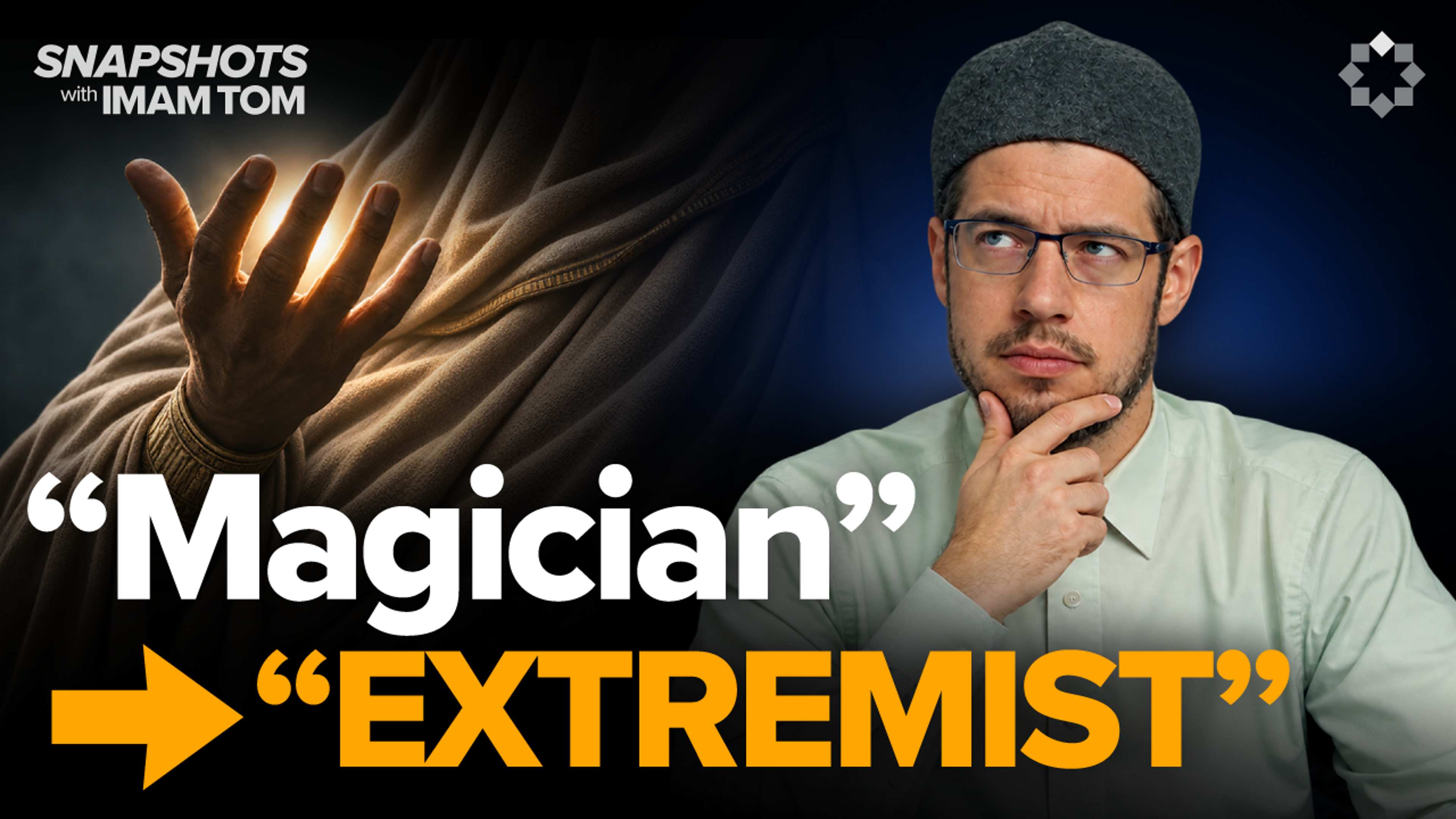
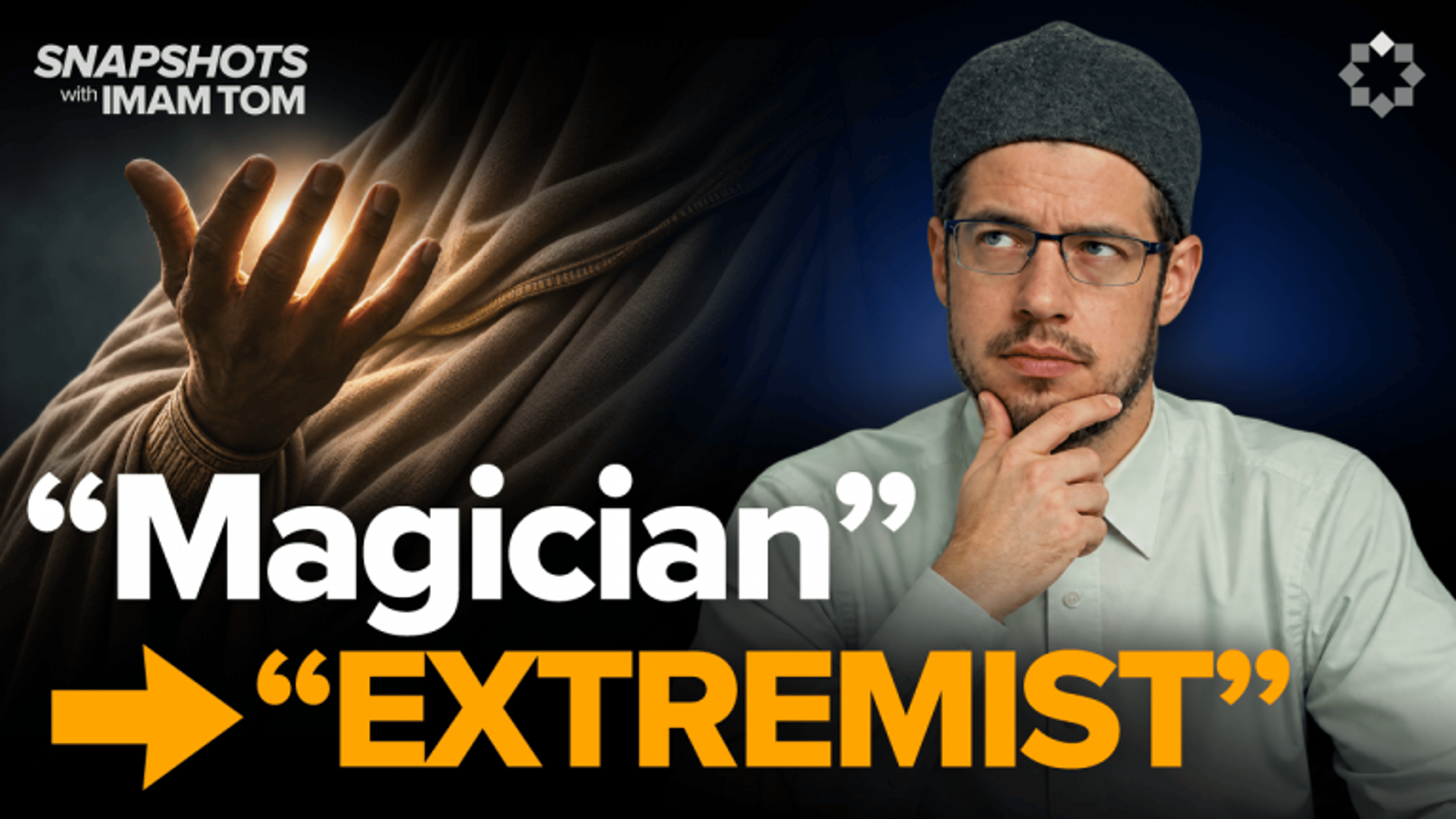
Pharaoh had just watched Musa (as) perform a miracle. He couldn’t deny what the people saw, so he did something more subtle and effective: he labeled it as magic. One word, and the proof became a trick, the messenger became a suspect, and the argument was already tilted before anyone weighed the evidence. In this Snapshot, Imam Tom Facchine unpacks how that same move still works today, as language frames the moral universe before a debate begins, and why Muslim leaders must learn to recognize when a word or a question is a trap. Drawing on the Qur’an’s close attention to names, labels, and accusations, he shows what it looks like to answer without accepting someone else’s frame.

This episode covers:

— Why words like “extremism” and “moderation” aren’t neutral, and what they assume

— Why some questions are built so that answering them means losing, and when a leader should reframe or refuse

— Four questions to ask of any loaded word before you respond

— Why Muslims need a moral vocabulary rooted in revelation

This transcript was auto-generated using AI and may contain misspellings.
00:00One man's terrorist is another man's freedom fighter. Public battles are often won before the facts are discussed because the words have already framed the moral universe.
00:14Security, extremism, moderation, progress, radicalization. They're not neutral words. They express policy positions and assumptions.
00:22Muslims, of course, are subjected to this selective outrage and are constantly interrogated and demanded to denounce and defend various things. And it's completely hypocritical. People get upset about huris in Jannah while their own leaders are going to Epstein Island.
00:35I would love to see the same energy applied consistently across the board. Programs like Prevent in the UK define extremism so broadly that they cast normal religious and political views as pre-criminal.
00:47This harkens back to Orwell's 1984 and its concept of thought crime. And it's no surprise that China has hosted the UK to learn from its Prevent program in how to suppress and erase its own Uyghur population.
00:57Words carry emotional charge and emotional instructions. If someone can call your courage extremism, call your faith backwards, or call your modesty oppression, then they've already shaped the outcome.
01:10Muslim leaders must not only know what to say, they must know when the words themselves are traps. And in the Qur'an, Allah subhanahu wa ta'ala is deeply attentive to language. Names, labels, claims, accusations, and false speech are constantly being clarified.
01:23The Qur'an, in fact, pushes back on various categories. And we even see in the example of Firaun the attempt to maintain control over the narrative. Let's say when he's confronted by Musa, alayhi salam, he labels him a magician.
01:37Many Muslims are constantly responding to questions that are designed to make them lose. And the importance of subverting the script is in reframing the question and insisting on context. We absolutely have to do that if we're to have a fair shot.
01:49Muslims should be super aware, keen, and proactive about getting out there to try to make the first impression for ourselves before the media makes the first impression for us.
01:58I think that we can be a good example. We can focus on the people who we believe are actually open to being educated or who might change their mind.
02:07And then recognize the people who are actually coming from a place of complete hatred for Islam as what they are and find a way to deal with it. We're never going to get rid of that group of people. Allah subhanahu wa ta'ala told us in the Qur'an that this group of people is here.
02:20They're here to stay. And part of our struggle as an ummah is to maneuver and deal with those sorts of people. A leader must sometimes refuse the question entirely before addressing the issue. Muslims need their own moral vocabulary that's rooted in revelation, and leaders are there to develop it.
02:34So as a practical question, before answering any type of "condemn this or condemn that" question, ask: What's the key word and what work is it doing? Where did it come from and who defined it? What assumptions does it carry?
02:47Is there something in the Qur'an, or something more Islamic, that is more holistic or less politicized? Whoever controls the words, at the end of the day, controls the world.