fbpixel
Why Flock Cameras Aren’t Making Us Safer | Snapshots with Imam Tom Facchine

Snapshots with Imam Tom Facchine

Why Flock Cameras Aren’t Making Us Safer | Snapshots with Imam Tom Facchine
More than 120,000 cameras now track where Americans drive. They’re sold on a simple promise: watch enough, and crime disappears. But studies have shown that it doesn’t. And dozens of the officers running that very system have been accused of using it to stalk people instead.

In this Focal Point, Imam Tom Facchine examines what a national license-plate surveillance network reveals about the gap between being monitored and being moral, and what Islam offers as the only accountability that actually reaches a person when no one else is looking.

This transcript was auto-generated using AI and may contain misspellings.
00:00We are currently building a society in which cameras increasingly watch where we go in the hope that surveillance will make us safer.
00:11Deepening debate over those Flock license plate readers now in use across 49 states. But does being watched actually stop people from doing evil? And what happens when the people controlling the cameras themselves misuse them?
00:23Islam offers a radically different starting point. Instead of only asking who's watching people, it asks who are you when no human being is watching?
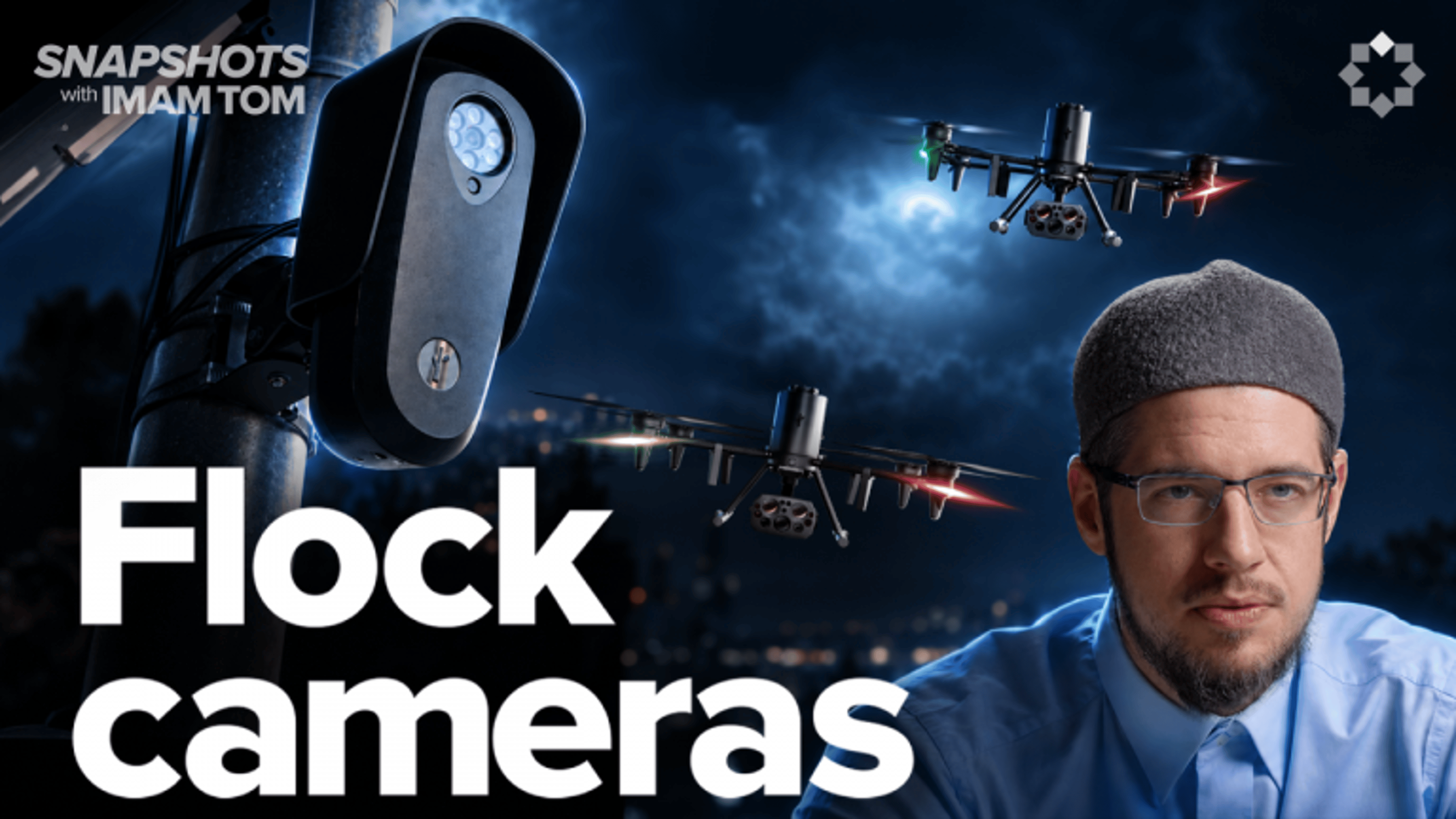
00:31You've probably heard at this point about Flock Safety cameras. The company Flock Safety has built a large nationwide network of automated license plate readers, ALPRs.
00:41These cameras photograph vehicles and license plates and allow authorized users to search where a particular vehicle has appeared. Recent reporting places the network at more than 120,000 cameras across the United States.
00:54The pitch seems compelling: find stolen cars, locate wanted suspects, help find missing children, and reconstruct where suspect vehicles traveled.
01:03But the open question is, if you knew that a camera could see everywhere you drove, would that change the way that you behaved?
01:09Automated license plate readers can clearly be useful investigative tools. Perhaps they can help police identify or recover stolen vehicles and reconstruct vehicle movements. But that's different from proving that the technology prevents crime from happening in the first place.
01:22The National Institute of Justice Crime Solutions profile rated license plate recognition technology used as a crime deterrent ineffective based on more than one study.
01:31It reported no statistically significant effects on general crime, auto-related crime, vehicle theft, calls for service, or auto theft.
01:39A later quasi-randomized study covering 785 patrols at 33 hotspots found that LPR use increased stolen vehicle recoveries, but did not increase arrests and showed little clear evidence of additional crime-preventing effects.
01:53Important distinction: a technology can be useful at identifying someone after something happens without necessarily changing the person who was going to do it in the first place.
02:03The cameras were built to help authorities identify potential criminals, but a growing number of cases involve officers allegedly using the system for personal surveillance.
02:11The Guardian reported in August 2023 that more than 50 officers had been accused of misusing Flock technology, including stalking-related abuses.
02:20404 Media reported more than a dozen cases in which police allegedly used Flock to stalk or improperly track people.
02:26The deeper point is not that police as a whole are corrupt, it's that any surveillance system is ultimately operated by human beings, which means the person controlling the technology also needs moral restraint and accountability.
02:38Perhaps the deeper problem is not simply that people are not sufficiently watched. Maybe it's that people have not learned to watch themselves. Islam has an entire spiritual concept built around consciousness of being observed by Allah. That's called muraqabah.
02:51Allah subhanahu wa ta'ala says, does he not know that Allah sees? Notice the question. In the Hadith of Jibreel, the Prophet, sallallahu alayhi wa sallam, defines ihsan as worshipping Allah as though you see him.
03:01And if you know that you can't see him or you can't reach that level, then at least knowing that he sees you. The surveillance system says instead, behave because we might be watching. Ihsan says behave because Allah is always watching.
03:14It's not difficult to appear trustworthy while someone is monitoring you. The real test is what do you search for when nobody knows? What do you look at when nobody sees? What do you take when no one will notice? What power do you abuse when nobody believes you will be caught?
03:28Even the person sitting behind the surveillance system eventually reaches a place where he thinks no one is watching him. Except, of course, Allah always is. Islam does not assume religious belief makes law enforcement unnecessary.
03:40Islamic societies had judges, they had policing, and public accountability was huge. People, including Muslims, can sin and they sure can abuse power. So the argument should not be, well, if everybody believed in Allah, then we wouldn't need cameras.
03:52No, the better formulation is that Islam never assumes that belief eliminates the need for law. But it also never imagines that law can replace belief.
04:01External accountability has a role, but external accountability cannot by itself manufacture internal moral restraint. You're not permitted to indiscriminately spy on one another. Allah, subhanahu wa ta'ala, says in Surat Al-Hujurat, "Do not spy."
04:15And do not spy. Very, very clear cut. Flock transparency portals for participating agencies explicitly list personal use and harassment or intimidation among prohibited uses. And they require users to enter a valid reason for access.
04:28Yet documented abuse still happened. In response to recent scandals, Flock announced stronger auditing tools intended to flag suspicious searches and potentially suspend access pending review. I think hindsight is a brutal tool.
04:42Of course, we could have done more earlier. And we listen, and we learn, and we'll continue to move forward. That produces an almost philosophical chain. We can create cameras to monitor people. Then we need systems to monitor the people who use the cameras.
04:56Then we need audits to monitor those systems. Where does the chain of surveillance actually end? A modern society can build increasingly sophisticated systems of external accountability. Cameras, databases, tracking, audits, facial recognition, algorithms, and police.
05:10But no amount of technology answers the ancient question, What stops a human being from doing evil when he believes he can get away with it? Islam's answer begins earlier than the police officer or the security camera. It begins inside the human heart.
05:24Perhaps safety cannot come simply from creating a society in which everyone is watched. Because eventually, somebody has to watch the watchers. Islam proposes something much more deep and profound. A society in which people learn to watch themselves.
05:37Because they know that Allah is watching them. Yes, we still need laws. Yes, we still need accountability. But no camera can manufacture a conscience. Maybe the measure of a person's character is not how they behave while the camera is recording,
05:49but who they become when they think the camera has turned off. For more Yaqeen videos, visit www.yaqeen.org